
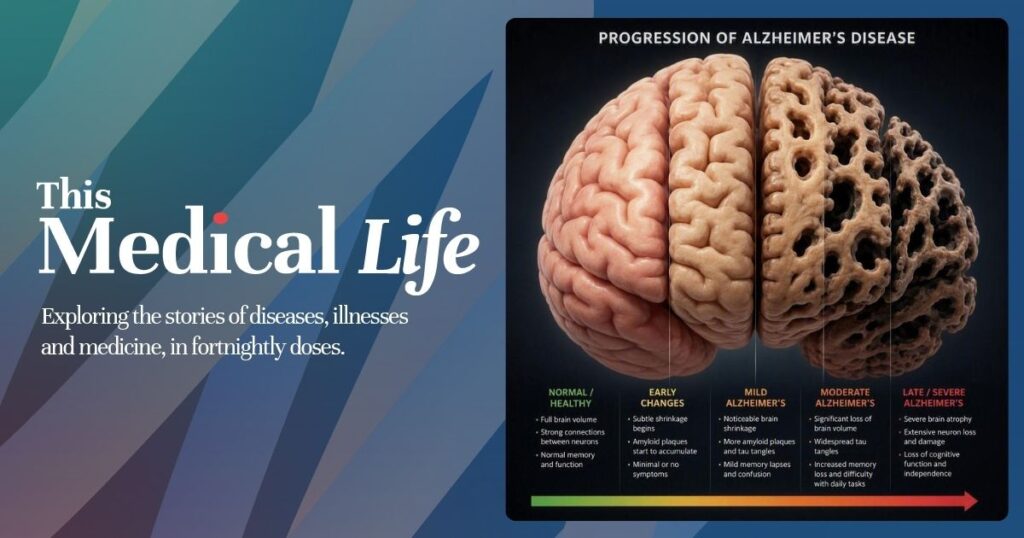
One doctor’s case from 1901 changed how we understand memory loss. Auguste Deter was 51 when her husband Carl brought her to see Dr Alois Alzheimer in Frankfurt, worried by memory lapses that had turned into paranoia and confusion. When Auguste died five years later, Alzheimer examined her brain and found two things under the microscope: amyloid plaques between nerve cells and neurofibrillary tangles within them. His 1906 presentation to a room of psychiatrists drew no questions at all. It was not until 1910, when Emil Kraepelin included the case in his Handbook of Psychiatry, that the term Alzheimer’s disease appeared in print for the first time.
Dr Liam Mulcahy, physician trainee and author of Beyond the White Coat, traces that discovery in detail, then Dr Travis Brown turns to two guests for where the disease stands in 2026.
Dr Daniel Clarke, consultant neurologist at Sir Charles Gairdner Hospital and director of clinical trials at Alzheimer’s Research Australia, covers how Alzheimer’s actually presents (often nothing like the stereotype), why history remains the most important diagnostic tool, and why non-pharmacological measures such as exercise and vascular risk control come before medication. He also explains why family history is often overrated, and why he does not recommend routine APOE4 gene testing.
Dr Gemma Daley, consultant chemical pathologist at Sullivan Nicolaides Pathology, explains what the new p-tau181 and p-tau217 blood tests can and cannot tell a GP, who should and should not be referred for them, and why they are adjunctive tests rather than standalone diagnostic tools.
What to listen for: the presenting features that separate Alzheimer’s from ordinary age-related forgetfulness, and what a negative or positive p-tau result actually means for a patient in front of you.
This is the story of Alzheimer’s disease.
Useful links:
Dementia Australia: https://www.dementia.org.au/
Alzheimer’s Research Australia: https://alzheimersresearch.org.au/
Our Special Guests:
Dr Liam Mulcahy is a physician trainee with an interest in neurology and author of Beyond the White Coat
Dr Daniel Clarke is a consultant neurologist and director of clinical trials at Alzheimer’s Research Australia
Dr Gemma Daley is a consultant chemical pathologist at Sullivan Nicolaides Pathology
Listen:
This Medical Life podcast is available on all podcasting services, Apple Podcasts, YouTube, and Spotify. Members of the RACGP are able to log the hours as CPD (Education) that they listen to the episodes under self record via Quick log. We invite you to help support us on our donation page.
Automated Transcript:
This transcript was generated automatically by Descript. I will contain errors and spelling mistakes, but is offered as a guide and resource to help AI and search tools discover the content on behalf of GPs, medical students, other allied health professionals, and the general public.
TML S07E108
Steve Davis: [00:00:00] Welcome to This Medical Life podcast. These are the stories of medicine with Steve Davis and Dr. Travis Brown. This is the story of Alzheimer’s disease
Dr. Liam Mulcahy is a doctor completing physicians training in Perth, Western Australia, with an interest in neurology. He has a degree with first-class honors in neuroscience and studied medicine at University College Cork. He enjoys writing and storytelling with his latest book called Beyond the White Coat.
Today, we’re discussing chapter nine, Forgotten, about the first identification of Alzheimer’s [00:01:00] disease. Liam’s a returning guest here on This Medical Life podcast. Liam, welcome back.
Dr Liam Mulcahy: Thank you for having me. I’m glad to be back.
Steve Davis: Let’s start at the beginning. Where does the story of Alzheimer’s disease start?
Dr Liam Mulcahy: So Alzheimer’s disease starts with, uh, one individual, uh, one lady by the name Auguste Deter. And, uh, she was born in 1850 in Imperial Germany. Nothing exciting about her life. She grew up, had a very simple life, and she met her husband, Carl Deter, who was a railway clerk, and together they built a very, uh, modest home, had a daughter.
Um, nothing out of the ordinary. Um, so things slowly began to change. Uh, Carl noticed these things, things you wouldn’t be concerned about. So she would forget, you know, a grocery item or a recipe card. Nothing dramatic, nothing making you think, you know, this is a devastating brain disease. It happened to all of us at some stage.
Um, but then, uh, Carl noticed that these, uh, lapses grew [00:02:00] stranger. Um, she became suspicious. She was accusing him of infidelity, and, uh, she would wander through the house, uh, at night by herself, muttering to herself. Um, and she seemed increasingly frightened by the world around her. Um, and what I want to highlight, um, her- what’s, uh, important about her is her age, ’cause she was in her early 50s when this all started.
This is not your typical, you know, sev- 80-year-old, um, with these symptoms. So this… So there was definitely something wrong going on.
Steve Davis: Putting myself in Carl’s shoes This is before we knew about anything like Alzheimer’s disease. I would’ve been out of my mind with worry about what the heck was happening. I mean, I would have nothing to judge this against.
Dr Liam Mulcahy: E- absolutely, and that’s exactly w- what Carl found himself in. He was ve- he was concerned that the love of his life was declining in front of him, and he didn’t know why. So, um, w- uh, i- in 1901, he [00:03:00] said, uh, he was just overwhelmed, that he brought her to her doctor, and her doctor saw, heard the symptoms, and made a referral letter to the asylum in Frankfurt, where Alois Alzheimer’s was working.
Uh, and we have that, uh, referral letter. “
Steve Davis: Mrs. Auguste D. has been suffering from a longtime weakening of memory, persecution mania, sleeplessness, restlessness. She is unable to perform any physical or mental work. Her condition needs treatment from the local mental institution.”
Dr Liam Mulcahy: And I, I just want to add one thing.
Uh, throughout this whole process, uh, at a time when, um, people were locked up in asylums, um, many husbands had left their wives. Uh, Carl was the only exception. He stayed, uh, with, uh, Auguste throughout the whole thing, even when she was no longer herself, which I’ll get into later. But, uh, I just wanted to point out he truly loved this woman and did not leave her side, even at her worst stage.
Dr Travis Brown: Now, can you tell us about Dr. Alois [00:04:00] Alzheimer?
Dr Liam Mulcahy: Yeah, so he was an interesting figure, and I think to give context as to his mindset, it’s, um, uh, important to note the upbringing and the environment that he was in. So he is, was born in 1864, uh, at a time when Germany was being transformed by industry, railways, and, um, at a time where there was scientific optimism.
So they believed that science could explain almost everything, including the mysteries of the human mind. So he was a medical student, uh, training across some of the great centers of German medicine, and he was influenced by the idea that mental illness wasn’t, you know, a moral weakness or madness, that it could have roots in the physical structure of the brain.
Um, and that idea really shaped him. But he, he wasn’t just, you know, a, a, um, a, an isolated, unique academic, um, individual. He was very much a, um, a, a college lad, if that makes sense. He was a part of the boys club. He was in, um, a fencing fraternity where they [00:05:00] got in trouble with the police, you know, for causing commotions.
And, uh, even at one stage in a fencing due, uh, in 1884, he had a scar, um, on the left side of his face. So any picture you look up of him, he’s always facing so the right side is shown- Oh, wow … ’cause he didn’t want the left side to… Yeah, so he, he was just very much, uh, a- he enjoyed life. Um, but obviously then, uh, when he was working, he got his first major post in the asylum in Frankfurt, which was unusually progressive for its time because they believed in patient dignity as well as scientific research, and that was the perfect combination for Alzheimer’s because he had a compassion for patients, and he was curious about what was going on inside, uh, the brain.
So essentially when, uh, by the time Auguste arrived, um, he was already the asylum’s most trusted physician. But it’s interesting, I should point out that at that time he was grieving when she, uh, arrived because in 1901, um, his wife Cecilia, uh, died, uh, leaving him with three young [00:06:00] children. So he could really sympathize with, um, Carl, um, the, the, the fact that he, uh, uh, with the feeling of loss because while he lost his own wife, he was also seeing a man with a woman who was slowly losing herself.
Steve Davis: Has anybody turned this into a book or a film? Because this has every- his swashbuckling upbringing, the depth of this with his wife, the meeting Auguste and, uh, her husband, all the ingredients are there.
Dr Liam Mulcahy: I agree, and that’s why I really wanted to do a chapter dedicated to, uh, to this gentleman because, um, it was so- he’s so interesting.
Um, and e- especially Auguste’s story. Um, so that’s why I w- ’cause I couldn’t find a book on its own. Um, but there’s lots of research and, and papers discussing about their situation.
Dr Travis Brown: What impact did Franz Nissl have on Alois?
Dr Liam Mulcahy: Franz Nissl is, um, he was… Uh, so to start off, he had a huge impact on Alzheimer because Alzheimer’s whole discovery, which w- what we now know him for, [00:07:00] um, wasn’t found in isolation.
So Franz Nissl was a brilliant young neuropathologist- And he met Alzheimer’s in 1889, and he brought with him a new way of seeing the brain. So he developed a staining technique, which we still use today, called Nissl staining. Uh, and essentially it’s made to highlight the microscopic structures of the brain cells in a way that hadn’t been seen before.
So in a very literal sense, Nissl gave, uh, Alzheimer’s a sharper lens through which to look at the disease. Um, but it, it wasn’t just a technique he taught him. He also influenced Alzheimer’s to look beyond the patient, uh, look beyond the bedside, uh, and try and correlate the symptoms he’s, uh, seen with the patients with the brain structure disease, um, postmortem.
Um, but they were, they were, uh, uh, of course, they were more than just colleagues. They were very close friends, to the point that Franz Nissl was his, um, witness at Alzheimer’s wedding. Um, [00:08:00] and even later in life, um, he had an impact on Alzheimer’s career. Um, when Alzheimer was unsure where he should go, um, he opened the door for him to work with Emil, um, Kraepelin, who was one of the influential psychiatrists of his era.
So these, uh, two men were very close together.
Steve Davis: Okay, this has to be a movie now.
Dr Travis Brown: Now, how did Auguste Deter’s condition progress?
Dr Liam Mulcahy: When she arrived, um, in November 1901, she, uh, she was 51 years old. Uh, and Alzheimer’s already noticed that her memory and sense of identity were already fragmenting. So he would ask her, “So what’s your name?”
She would say, “Auguste.” And then he’d say, “What’s your surname?” And he’d say… And she’d say, “Auguste.” And then he’d ask her, “S- what’s your husband’s name?” And she’d say, “Auguste, I think.” So she was able to answer simple questions, you know, like the color of snow or soot, but anything more complex than that, she would collapse into confusion, and over time, that [00:09:00] confusion worsened.
So her speech broke apart. She became anxious, paranoid, frightened that people were trying to harm her. And then sometimes she would have very soft moments where she would be as if she was back in her own home offering imaginary tea, which were quite sad at times because we were seeing glimpses of the woman she had been previously.
Uh, but unfortunately, as the disease kept advancing, uh, her speech eventually dissolved into murmurs, um, her face became blank, uh, and her, in her final year, um, she withdrew almost completely, unable to care for herself. And then as a result of pneumonia, infected bedsores, and septicemia, um, she died in April 1906, just, uh, weeks before her 56th birthday.
So her decline, uh, was not just memory loss, but it was just a gradual loss of language, and her independence, and her personality and identity. And we actually have a clinical note there describing of what she was like at that time.
Steve Davis: Completely stupefied, [00:10:00] always lying in bed with legs drawn up, regularly soiled with urine and feces, never says anything, mutters to herself, has to be fed.
Dr Travis Brown: When we’re looking at, uh, when she died, uh, did they do an examination? Did they do an autopsy? What, what happened then?
Dr Liam Mulcahy: At this stage, Alzheimer was already moved to Munich. He wasn’t in Frankfurt anymore. But when he heard that she died, he asked for all her medical records and her body to be sent to him.
Uh, and then he started examining her brain, and that’s when he saw two remarkable things. So the first thing he came across was he found, uh, amyloid plaques, and essentially these were like dense clumps of protein, um, fragments sitting in between nerve cells, so the nerve cells couldn’t communicate between each other.
The other thing he found was things called neurofibrillary tangles, and essentially these were twisted strands of protein, like knotted threads, and these were inside the nerve cells themselves, so they c- uh, [00:11:00] and it affected their internal transport sy- uh, systems, slow providing nutrition. And therefore this, uh, the nerve cells, uh, were starved and, uh, would eventually die.
So this was quite a profound moment because I think this was at the moment he realized, you know, Auguste’s confusion, paranoia, memory loss seemed to have an answer rather than just being labeled madness. There was actually a, a structural physical form in the brain, uh, likely explaining the disease.
Dr Travis Brown: Now he ended up presenting these findings.
What was the response? The
Dr Liam Mulcahy: presentation was very underwhelming, um, which is surprising because … So in November 1906, he went, uh, he presented her case at the Tübingen, um, meeting of Southwest German psychiatrists. So he laid out the whole story. He went through the whole clinical, uh, presentation of her memory loss, her speech, her decline, and then his following findings, which were the plaques and tangles, uh, ex- likely explaining what happened to her And you would think that would have electrified the room.
Uh, you know, uh, [00:12:00] here’s a discovery. Um, but no, the audience were indifferent. Uh, and, you know, rather, uh, brutally, they were … The next lecture, which was on compulsive masturbation, seemed to generate more anticipation than Alzheimer’s discovery. So yeah, so when he finished- So my,
Steve Davis: my epic movie treatment-
that’s gonna be a
Dr Liam Mulcahy: moment of comic relief. Yeah, absolutely. Uh- Yeah … because, um, w- when he finished, there was no question, not even a discussion. Um, and, uh, even the speaker said, uh, “There’s no desire for a d- debate here.” Um, so e- essentially, um, when we look on, back on it now, it’s actually mind-blowing ’cause it’s one of the most significant moment in neurology history, and it seemed to have fallen on deaf ears at the time.
But it, it didn’t stop Alzheimer’s. He didn’t let that, you know, um, stop him from, uh, continuing, uh, you know, writing up her case. So he, he wrote up and published her case in 1907, and that became the first full description of what we now [00:13:00] know as Alzheimer’s disease. I-
Dr Travis Brown: if it didn’t really make waves in, in 1906, but you put it as a published report in 1907, how did it actually find its significance?
Dr Liam Mulcahy: So that didn’t actually happen till about three years later. Uh, we’re looking at 1910. And, um, this was thanks to Emil, uh, Kraepelin, uh, who included the condit- the description of the condition in his Handbook of Psychiatry, and he distinguished Alzheimer’s, uh, case from ordinary age-related decline, and it was for the first time the term Alzheimer’s disease, uh, appeared in print.
Um, and that gave the illness a name. So from there, the significance began to grow, and by 1911, doctors across Europe and, um, America, uh, were using Alzheimer’s case description, uh, to recognize similar patients. I think people used to be dismissed as, you know, hysterical or as senile or prematurely mad, but now they could be understood differently.
And going back to what I was saying [00:14:00] about Auguste’s age, why I thought it was very important, is because she was in her early 50s, which made her illness harder to dismiss as a simple, you know, senile decline. So in a way, her unusually young age, um- which we now know as early onset, uh, Alzheimer’s disease, allowed a pattern to stand out and, uh, allowed Alzheimer’s to ask what’s going on.
So then as they found similar plaques and tangles in, um, older patients, I think that’s when the significance widened, and that’s when they started to say, “Look, this unusually young woman who had these presentations wasn’t a rare curiosity, is actually a new way of understanding dementia itself.”
Dr Travis Brown: I’ve always loved neurology.
I love the diseases. Like, they’re just fascinating. That being said, I couldn’t do neurology because a lot of the… I find the stories very sad. Talking about Alzheimer’s, and clearly you have an interest in neurology and neuroscience, do [00:15:00] you have optimism going into this area and potentially even looking at things like Alzheimer’s when, when you’re dealing with these, well, I guess, patients and this kind of disease process?
Do you, what, w- where do you sit?
Dr Liam Mulcahy: The thing I really appreciate about neurology, it goes back to old school basics of the importance of history-taking and, uh, examination. Uh, not too heavily reliant on, you know, imaging and whatnot. And I think the, what I really like is if we can start to get a, a sense of early things happening, we can do something sooner.
We’re not going to cure, uh, well, uh, presently we’re not going to cure it, but at least we can try and do ways to try and slow it down and maintain a quality of life. Because I’ve seen, uh, and fir- firsthand I’ve seen what happens to people with Alzheimer’s, and it’s almost stripping away the person’s identity.
I like the idea of being able to do something sooner to still carry on that quality of life, um, just to give them that few [00:16:00] extra years. And maybe one day we’ll eventually get there, but I, I always am a f- firm believer when people retire to not stop and do nothing anymore. Keep the brain active, uh, you know, uh, c- take up a new skill.
Things to kind of help, um, little things like that rather than just relying on medication. It just, uh, changing your lifestyle to try and keep your brain active and healthy, and I f- I, I’m a strong believer in that.
Steve Davis: Liam, where can people get your book, Beyond the White Coat?
Dr Liam Mulcahy: So it’s available on Amazon as a hardback paperback or Kindle.
Um, so it’s available there, and, uh, I hope you enjoy reading it if you do get it.
Steve Davis: Well, I’m certainly ready now to ask even better questions when Dr. Daniel Clark joins us shortly. Liam, hopefully we’ll talk to you again on another episode of This Medical Life. Thank you.
Dr Liam Mulcahy: Thank you.[00:17:00]
Steve Davis: Dr. Daniel Clarke is a consultant neurologist at Sir Charles Gairdner Hospital, the neurosciences unit at Graylins Hospital, and at Hollywood Private Hospital. He’s also the director of clinical trials at Alzheimer’s Research Australia. Dr. Clarke graduated with first class honors from the University of St.
Andrews in Scotland and the University of Manchester. He worked in Bath and Bristol before emigrating to Australia where he completed his physician and specialist neurology training in Western Australia, and later completed a fellowship in cognitive and stroke neurology. Daniel’s specialist interests include Alzheimer’s disease and other dementia syndromes.
He’s active in medical research at St. Charles Gairdner Hospital, as well as at the Perron Institute and with the Alzheimer’s Research Australia. Daniel is our guest here on this Medical Life podcast. Daniel, thanks for making time for us amid all of that.
Dr Daniel Clarke: Oh, well, thank you for having me. I’m very excited to be here.
Steve Davis: [00:18:00] Daniel, let’s start with the question that many listeners want to know, especially beyond the GPs to the general public listening in. How common is Alzheimer’s disease?
Dr Daniel Clarke: Well, I think we all know it’s very common. Dementias generally affect around three hundred and fifty thousand to four hundred and fifty thousand people in Australia, but that…
and that’s only increasing with prevalence with increasing age. Alzheimer’s constitutes around sixty to seventy percent of this number, so there’s probably at least two hundred and fifty thousand people in Australia with the disease. Alzheimer’s is now the biggest killer of Australian women and is on track to be the leading cause of death for all Australians.
As we’re all aware, effective therapy has unfortunately been lacking up until now.
Dr Travis Brown: So what are the first symptoms patients will experience?
Dr Daniel Clarke: Typically, the first symptoms will be with memory issues. Forgetting recent events or as we often colloquially call short-term memory issues. But there’s other prominent symptoms early on that we shouldn’t forget.
Issues with [00:19:00] problem-solving, technology difficulties, apathy. And in clinical practice, I do find anxiety to be a very early symptom that we see very frequently in patients as well. But Alzheimer’s can present in other ways, and we need to be careful not to miss these important other types. It can prese- um, it can present with executive dysfunction, personality change, mimicking a frontotemporal dementia.
It can present with language difficulties in the logopenic variant of Alzheimer’s disease, and it can even present with visual difficulties, mimicking vision loss and people thinking they need new glasses and things in posterior cortical atrophy.
Steve Davis: Interestingly, anxiety’s there, but also just reflecting more broadly, Daniel, on the portrayal of Alzheimer’s in drama, movies, comedy, et cetera, has anyone been getting it right or are there still pervasive stereotypes out there that send people either down the garden path or to a too narrow [00:20:00] focus of what Alzhei- how Alzheimer’s presents itself?
Dr Daniel Clarke: In the later stages, that’s what Alzheimer’s is like. But I think there’s an assumption that those with Alzheimer’s disease are frail and dependent and not always the case, particularly early on. And often in my patient cohort, in particular, I look after a lot of early Alzheimer’s disease, you wouldn’t even know someone’s got it.
Occasionally being forgetful and repetitive occasionally, but ultimately can live a normal or near normal life. And there’s obviously a huge stigma with the condition and everybody knows older people who’ve had this condition and have a big fear of this. But I think the portrayals are accurate, a- actually, because we’ve…
everybody’s seen it, sadly. It’s so common. But I don’t think it’s typical for early on in the disease, and up to now we kind of let these people, we try to give them blissful ignorance, and [00:21:00] I don’t think that’s quite right. I think identifying early disease and putting in interventions to try and slow down disease process is important.
I think we’re in a new world with this.
Dr Travis Brown: Is there an easy way to distinguish between sort of Alzheimer’s, uh, memory loss and almost the normal aging process of just forgetfulness?
Dr Daniel Clarke: Well, well, well- whilst we naturally do have a cognitive decline with aging, I don’t think that we should accept this. I think that conditions like Alzheimer’s disease are so common that we start to see that as the norm.
And we assume that as people get older, they’ll just, inverted commas, “lose their marbles.” But I don’t think we should normalize this Yes, as we get older, we can slow… our mental processes slow, and perhaps we can get more normal forgetting issues that can become more common, the attentional type cognitive complaints, putting your keys down, forgetting where they are, or getting lost mid-conversation, and so forth.
And we may worry about them more as one gets older. [00:22:00] But in summary, there is actually an easy way to distinguish normal aging with Alzheimer’s disease. We’re very thorough assessment, and I think if there are memory worries that people have, they should be comprehensively assessed, uh, because there are interventions that can help.
But also, we can put people’s minds at ease if they’re not sinister.
Steve Davis: Is one of those interventions doing things like Wordle, crosswords, all those sorts of tools? Because my wife plays them relig- religiously, and she says she’s doing it to keep her brain active to stave off anything like this in the future.
Dr Daniel Clarke: There may be… There’s something to it, but not as much as one would think. Brain training and brain exercises gives us a height to fall from. It keeps us as intelli- it keeps us more intelligent, if you like, and it can therefore help mask some of the symptoms for longer. But I think there’s more… there’s other interventions that are probably more important than brain training that we would probably need to emphasize, in particular [00:23:00] exercise as being, uh, much more useful.
So I think I would suggest if there’s anybody who asks, “How can I delay, slow down the onset of a neurodegenerative disease?” Yes, brain training can help, but I would actually try and get people out and about and doing exercise, and there’s lots of other benefits for that.
Dr Travis Brown: Is there a way to be able to separate Alzheimer’s from other forms of dementia?
Dr Daniel Clarke: It’s hard because Alzheimer’s can present in many other ways and can mimic other forms of dementia. In typical Alzheimer’s, rapid forgetting is very typical in what we would generally think of in Alzheimer’s disease, and in particular being repetitive. But Lewy body pathology can present in this way too.
I think if you do see rapid forgetting, technology loss, problem-solving skills, disorientation, and a lack of pertinent negatives, such as anosmia, REM behavior, sleep disorder, Parkinsonism, then I think there’s, unfortunately, a very high chance that someone will have Alzheimer’s disease if that’s the case.
Dr Travis Brown: Are there any signs when s- a patient presents that doctors should [00:24:00] look for in these patients?
Dr Daniel Clarke: There’s no clear clinical signs, sadly. A lack of P- Parkinsonism is a pertinent negative. Patients will often have a lack in insight into their deficits, and it’s also… It’s often a, a way that we can… It’s a bit of a, a marker that we use in our clinic, that if someone comes in very worried about their memory on their own or have not told anyone about their concerns often are, are actually okay and they’re non-sinister.
But the person who’s dragged in kicking and screaming and has a lack of insight into their issues is often the person I’m more worried about. Patients can have language difficulties early on, even in the more typical forms, and they can have a certain disfluency in their- And an emptiness to the speech which can be in keeping.
Obviously, people being repetitive and telling you the same stories or the same issue in a clinic room in a short period is a very common finding in Alzheimer’s disease and would be a major red flag for me.
Steve Davis: I wanna continue on this thought on behalf of our GPs who are our core audience for this medical life in looking for symptoms.[00:25:00]
The, the ones you listed before went way beyond what I would normally associate, and some of them I went, “Oh, actually, um, yep, I’ve, I’ve had that from time to time.” Is it enough to have one of these presenting symptoms or is there a critical mass of two or three that need to be seen together for a GP to start having confidence in, in this sort of diagnosis?
Dr Daniel Clarke: No, I don’t think we need to have confidence in a diagnosis in order to start pursuing this. It was… It’s not been that long, even just a couple of years when we were in a world where we could give someone some blissful ignorance, tell them to come back in six months or 12 months if we’re worried. But now we’re entering an era of intervention, which is not just pharmacological but non-pharmacological intervention as well, that early diagnosis is important.
And so I don’t think you need to have a high threshold of suspicion that you’ve got something going on in order to pursue a diagnosis because I think the other [00:26:00] avenue is also important. If somebody’s coming to you worried about their memory, they need to be… and it turns out that there’s nothing sinister going on, I think they should have to be comprehensively assessed in order to give them the reassurance, and that’s actually one of the most rewarding parts of my job is to tell someone they’re fine and not to worry.
Dr Travis Brown: So then how is Alzheimer’s actually diagnosed?
Dr Daniel Clarke: Well, first of all, it’s frequently misdiagnosed sadly, and even in the best hands it’s misdiagnosed one in six times. It’s not a diagnosis that’s yet reliant on a single biomarker, and history does remain the most important diagnosis tool that we have. In history we need to exclude mimics such as vascular dementia and Lewy body pathologies.
Um, and I think we need to f- and I still think we need to find evidence of neurodegeneration either with an FDG PET or with neuropsychological deficits. So, a v- I suppose a very typical case could be diagnosed with a history alone and relatively simple investigations, such as blood tests and MRI scan.
But given that this is [00:27:00] actually a, a, what most patients would perceive a catastrophic diagnosis to receive, and there is a high rate of mimics or misdiagnosis, I think that confirmatory testing is, should be the norm. Everybody’s obviously very excited about amyloid con, um, pathology and confirming amyloid status, but I don’t think it’s yet in mainstream clinical practice.
Um, confirming amyloid pathology will be important in, uh, the context of disease-modifying therapy and in, perhaps in atypical cases. Um, but there’s more to be done in that case. But in, in summary, I would say a typical history, confirmatory test, uh, s- cognitive screening tests such as MoCA would be probably the default that most people would go towards.
And then confirmatory testing with FDG PET scan and other tests to rule out mimics would be the norm for my clinical practice.
Dr Travis Brown: Being a pathologist, we’ve come across a few blood tests and CSF tests [00:28:00] for patients. Uh, what’s your view on, on those? Are they useful? Are they helpful? Are they additive? Where do they sit?
Dr Daniel Clarke: They’re not yet mainstream, I think it’s fair to say. But they are becoming very important, and I think they’re gonna have a major role in the coming years, and the, not even a, in the near future, is, to be frank. I, I would talk about first about CSF testing, which is part of my mainstream practice. It’s commonly used when we see folds in CSF amyloid beta, which correlates with a, a CS, um, an amyloid accumulation in the tissue, and also elevations in tau, and p- particularly phosphorylated tau, um, are used to confirm diagnosis and to justify anti-amyloid therapies But CSF is obviously an invasive test and is not ideal, and is not something that patients really want to go through unless they really need to.
Blood-based biomarkers are now available and been recently approved by the TGA. We have P two, uh, p-tau 181, p-tau, uh, 217. There’s also other tests, including amyloid beta [00:29:00] ratios of 42 and 40. But I think we have to be careful with these. Um, we’re not in a place where you can have memory concerns and then a blood test, and then can diagnose someone with Alzheimer’s disease.
But I believe that they’re probably gonna have a big role in screening patients. These tests have a positive and negative predictive values, at best, at around 90% in each case, and so we’re gonna end up with a lot of mis- undiagnosed people who have the disease, but also a lot of worried well who have got a positive marker and get on…
They get very worried, and they don’t need to be. I think they’re gonna have a place. The, probably the place may well be as a screening test, more analogous to a PSA. You have a positive test, you then go and have confirmatory testing thereafter. And they may definitely ha- have much more of a role if we ever get to a point where we’re s- we’re treating people in a pre-symptomatic stage.
Steve Davis: I just want to interject, Daniel, because we know that Dr. Travis Brown is a pathologist, and I don’t want you to be polite- … about pathology just because [00:30:00] of that. And especially I’m thinking- … Travis, about lipoprotein, a, uh, podcast recently where there are some tests that aren’t as useful but then come back into vogue.
There’s no comeback at you, Daniel, if you need to s- mention any tests you don’t think have much diagnostic power at the moment that you would ask GPs to reconsider.
Dr Daniel Clarke: Well, that’s very kind. I, uh, as I say, I would be very reluctant to… Oh, I, I think they’ve got a… They will have a place, but I don’t think that they have a place yet as a routine screening test in our patients because we don’t really…
Our therapies are modestly effective. In cancer, where we have curative treatments or highly effective treatments, early screening and early pickup is, is useful. But if we’re going to give someone a a crystal ball and tell them that they’ve got something that’s gonna happen in a few years’ time, and there’s nothing really that they can do other than exercise and all the other healthy living that we do now.
I think we need to be [00:31:00] careful to not make our patients vicsims.
Dr Travis Brown: Looking at the imaging tests, are the imaging tests useful, like amyloid PET or anything? Is that useful?
Dr Daniel Clarke: Again, amyloid PET are very useful in a very similar way to the blood-based biomarkers. I do not think that cognitive complaints and a positive amyloid test equals Alzheimer’s disease.
Cerebral amyloidosis is common in older adults, perhaps 25 to 30% of them, and perhaps that is a dise- a prodromal state. Maybe they are destined to get Alzheimer’s disease. But when we’re dealing with an older patient cohort, they may pass before it becomes a problem. So we may be causing these people undue concern.
They, this may change, as I say, when we have, we have data coming out soon on pre-symptomatic trials such as AHEAD. But until then, I don’t want to start finding out everybody’s cerebral amyloid status and causing them lots of worry, when actually it might never cause them a problem in life. There are other tests that we obviously use.
I’ve mentioned our FDG PET scans If somebody comes with a typical pattern of, of Alzheimer’s disease and you send them [00:32:00] for this, I find it very useful when we see hypometabolism involving the precuneus and posterior singular as a confirmatory test and highly specific and sensitive in that situation.
Um, but they can also help to flag other neurodegenerative diseases and there’s typical patterns that we see in frontotemporal dementias and Lewy body pathology. MRI brains are not actually as useful in cognitive neurology as one would expect. We can look for things like atrophy, but that can be over and under-called frequently.
But looking particularly for cerebral amyloid angiopathy changes such as microneedle bleeds, superficial siderosis, and looking for other causes of cognitive impairment, in particular looking for vascular disease, that’s an important test, but doesn’t usually clinch the diagnosis.
Steve Davis: Before we progress, what is amyloid?
Dr Daniel Clarke: Um, so amyloid’s a protein fragment that we all naturally p- produce. It’s cleaved from the larger amyloid precursor protein, and [00:33:00] this is normally broken down, but for reasons we don’t actually understand that well, it accumulates in p- as plaques in Alzheimer’s disease. What amyloid does, but I don’t think anyone’s really sure, it may be involved in synaptic activity or helping with neuronal repair.
Dr Travis Brown: Now, you’ve mentioned it a few times, your perspective of tau, uh, spelt T-A-U for listeners, just because I had to listen to people saying tau and I was like, “I’m not quite sure how you spell that.” But what, what, what is tau from, from a neurologist point of view?
Dr Daniel Clarke: Yeah. So tau’s another protein that’s found inside neurons, and its u- its role is in stabilizing microtubules, and it’s encoded by the MAPT gene.
Tau is instigated in many neurodegenerative diseases, but it’s also got a crucial part in Alzheimer’s. In Alzheimer’s disease, the tau becomes hyperphosphorylated and aggregates as neurofibrillary tangles. What’s interesting about tau is that the cognitive decline that we see in Alzheimer’s disease generally only starts when the tau starts to accumulate.
[00:34:00] We have got interesting clinical trials, not just into anti-amyloid therapies, but also anti-tau agents as well. And I think it’s reasonable to assume that in the future we may use anti-tau medications alongside anti-amyloid therapies in our treatment of our patients.
Steve Davis: Before we pause briefly and come back to look at management and ongoing work with patients, I want to pull together some of the different strands you’ve highlighted thus far on behalf of a GP.
If a doctor does suspect that a patient may have Alzheimer’s disease From what we’ve discussed so far, what do you think is an appropriate workup or assessment they could do?
Dr Daniel Clarke: Look, maybe it’s rose-tinted glasses, and maybe we’re dealing with a large number of patients and cognitive complaints in our population is even more a li- a, an even bigger number of people.
But I think that patients, especially early in the disease, should have a comprehensive workup. I think screening testing is [00:35:00] appropriate, and I would advocate for a MoCA rather than an MMSE. And an ACE-3 is an, uh, which is an, uh, uh, Addenbrooke’s Cognitive Assessment, is an even better test than them, albeit more time-consuming and might not be something that’s easily, readily available in, um, general practice.
I think patients should have a detailed history. We should have specific questioning on pertinent differential diagnoses, so screening for obstructive sleep apnea, questions about Lewy body pathologies with REM sleep disorder, hyposmia, parkinsonism, but also assessments for mood disorders as well.
Obviously, patients should have a clinical examination, but it’s usually not particularly helpful unless there’s parkinsonism. And I think patients, as part of the workup, should have relevant screening tests such as MRI brain, so, uh, relevant tests done such as MRI brains, down the line FDG PET scans, and cognitive screening bloods should be done pretty much at the onset of any complaints.
I think what is really important [00:36:00] to get over is that I don’t think that we should be just sending blood-based biomarkers on every patient that co- in a patient who comes into the, the cl- practice room. And I, I suspect that one problem we’re going, that general practitioners are going to have in the near future is patients who have had a cognitive complaint, read about a blood test, and coming in requesting it, which is…
And I think that would be, could well do more damage than good if used incorrectly.
Steve Davis: Wow. On that note, let’s just pause. I’ll finish today’s Wordle, and we’ll come back in just a moment
We continue our discussion now with Dr. Daniel Clark about management, treatment, and the path ahead for patients with Alzheimer’s disease. So regrouping now, Daniel, what is the management for [00:37:00] patients diagnosed with Alzheimer’s?
Dr Daniel Clarke: Even in the era of having medications that are now disease-modifying, the treatment is still primarily non-pharmacological.
I like to highlight with my patients the general brain health. This is something that has been quite, uh, important in the WHO nowadays. I advocate for exercise. In particular, probably the most important step that I try and push on my patients is to be regularly exercising to a point of shortness of breath several times a week, and not just having a, a walk, unless a walk makes them short of breath, obviously.
I advocate for a healthy diet. There’s re- there’s, um, generally I would suggest a Mediterranean diet. There’s some, um, evidence that perhaps a ketogenic diet is helpful as well, and maybe something that people would want to explore. I tell people a vascular risk factor control, optimizing hearing and vision, which is surprisingly very important and very crucial and, um, highly [00:38:00] correla- strongly associated with cognitive decline.
And I, uh, emphasize the importance of control of mood and also looking for things like obstructive sleep apnea. There’s obviously other parts of the management as well. Support is very important, and I regularly refer to local charities, or nationally there’s Dementia Australia. I advocate for things like the ACAT and NDIS applications if there’s functional impairment.
We discuss driving and the importance of, um, m- uh, reporting the condition to the Department of Transport, and I emphasize the importance of multidisciplinary care as and when it’s needed with the use of speech pathol– uh, with the referrals to speech pathologists, physiotherapists, occupational therapists as needed.
Medications are here, and they’re coming, and they’re exciting, but they’re very much second fiddle yet. S- there are symptomatic treatments that are available readily, like donepezil and memantine, but they’re probably not as, um, useful as we initially hoped they would be several years ago. And I don’t think they have much to add for most [00:39:00] patients.
Donepezil in particular has considerable side effects with gastrointestinal issues, and many patients need to finish them. But these are considered nowadays to be more of a symptomatic treatment. They can help with certain symptoms like delusions, hallucinations, perhaps agitation and, uh, in the older population group.
But I don’t routinely start them unless there are symptoms that I’m worried about. Everybody’s obviously excited about anti-amyloid therapies, and they’re there for people who are early in the disease. Uh, but they are at a considerable cost, and there are risks with these medications. And it’s important to emphasize that these are not a cure, but they can slow down disease, and they can delay the progression to the next stage of disease in the right person.
Steve Davis: It’s not lost on me, and I’m pretty sure not lost on GPs, but it might be lost on some casual listeners, that you, along with many other f- previous guests, it doesn’t matter what disease we’re talking about- Keep saying exercise, good diet being key. And I just wonder if you could reflect briefly [00:40:00] on this.
If you look at any social media, people either pile on saying, “Oh, the whole medical system just wants to push drugs.” And at the other side of the coin, people go to GPs and feel ripped off if they don’t get a prescription. Could you just reflect on that? Because you’re in one of these sweet spots where one of your leading things with Alzheimer’s is non-pharmacological.
Dr Daniel Clarke: Yeah. And it’s, it’s fascinating because when I, I’ve, I… Obviously the com- the discussion of management in Alzheimer’s disease is quite a complex, long discussion we have, and I always structure it, and patients are always wanting to pull me towards the medications, and I deliberately put that as the last thing that we discuss.
And I always emphasize it’s not important, and the brain health is so important for not just for neurodegenerative diseases, but for cardiovascular, for cancers, for, for all general health. [00:41:00] Exercise in particular seems to have a very important role in all neurodegenerative diseases, and I think for reasons that we don’t quite understand.
Um, perhaps it’s to do with brain drainage and improving lymphatic flow. Perhaps there’s neuroprotective compounds. Perhaps it’s evolutionary. If you’re the one who’s fit and active and still doing the hunting for your, for your group of people, then perhaps we need to keep you weller for longer. But you’re right, it’s hard that people always want a drug.
Yes. And particularly in my group of conditions that I look after, um, they’re still not the main player by a long way.
Dr Travis Brown: One of the things that comes up is my, you know, family or family member, mother, father, had Alzheimer’s disease. And how important or how strong is family history of someone who’s had, who has, uh, Alzheimer’s disease?
Dr Daniel Clarke: Family history is important, but I think it’s overrated. The reality is we’ve got a disease that is so [00:42:00] common that the chances that at least one grandparent of having the condition is very high. This is now the biggest killer of Australian women. It’s gonna soon be all Australians, so they’re probably gonna have someone in the family with this condition.
I think it’s fair to say that there are monogenetic causes for Alzheimer’s disease, PS1 mutations, PS2, APP, but these are actually really rare and I would only ever really consider them if, uh, if there’s a family history of those presenting under the age of sixty years old. There are risk factor genes that are common though, and I think an important one that we need to highlight is APOE4.
So carrying one copy of APOE4 has a threefold increased risk of Alzheimer’s disease in life, and carrying two copies increases it by tenfold. But it’s not a foregone conclusion. APOE4 gene type is very common. 25% of the population carry at least one copy. 2% carry copy, uh, carry two copies. But [00:43:00] it’s really important to know that half of my patients don’t carry any APOE4 genes, so it’s a risk factor.
So yes, we do put some highlight, and it’s probably more important in the research field where we’re trying to do natural history studies and try and capture people who may be at more increased risk of ge- uh, increased risk of getting Alzheimer’s in the future. But in clinical practice, I don’t think it’s particularly important, which is very different to other diseases such as frontotemporal deman- dementias, motor neuron disease, in which family history is, um, uh, is a very important factor.
Going back to APOE4, I don’t recommend anyone finds out their APOE4 gene status, given it’s so common. It’s not really got any diagnostic utility. Reality is finding out the gene and finding out you’re at risk does, changes nothing because sadly, we’re all at risk of this condition, particularly as treatments for cancer and heart disease are improving all the time.
I think that it’s because we’re all at risk, we should all be doing the interventions, and finding out your APOE4 status doesn’t change that. So we all should be exercising. We all should be [00:44:00] having a healthy diet. We should all be controlling our vascular risk factors and optimizing our hearing and vision.
Steve Davis: Daniel, did you say that Alzheimer’s is or will shortly be the leading cause of death among women in Australia? It,
Dr Daniel Clarke: it is in Australia, yes.
Steve Davis: Is that people dying with it or because of it?
Dr Daniel Clarke: Well, it’s complex because you commonly wouldn’t die of the disease itself, but the complications of stroke. Think of someone coming into hospital with a stroke.
They often will die of a pneumonia, but the pneumonia is because they’ve had a stroke. And in a similar way, Alzheimer’s disease causing other issues such as not eating well or complications with infections, but ultimately the Alzheimer’s disease is the cause, and if you didn’t have the Alzheimer’s disease to begin with, you wouldn’t have them complications to begin with.
So now it is considered the biggest killer of women in Australia, and in for many will very shortly take, be there as well, and some people argue it already is. [00:45:00]
Dr Travis Brown: Touching on medications, even though I know Steve’s anti-medications now as well. No, I’m not. As a host of Boy Oh, so that’s fine. Uh, we’re just… The medications that they’re looking at or currently treating on, is that targeting pretty much, uh, amyloid and tau and trying to either prevent it or dissolve even the, like the, the tangles that are there?
Dr Daniel Clarke: The, the current recently TGA-approved anti-amyloid therapies are predominantly targeting, um, amyloid. So they’re the ones that we’re using in clinical practice now. There’s a, there’s a few hundred people in Australia on these medications. They’re by no means mainstream. Um, and they’re very, very effective at removing amyloid over 75% clearance rates in, with some of the medications.
But despite removing the amyloid entirely in most patients, or at least removing it to a normal level, they only slow disease and only slow it by around 25, 30%. So [00:46:00] there are other exciting trials that are ongoing as well. There’s newer anti-amyloid therapies that are in research such as trontinimab.
There’s anti-tau medications that are being researched as well, and there’s, but there’s- The amyloid hypothesis is whilst it’s the main hypothesis, and the reality is it’s almost certainly correct, but there are other, um, targets that we’re looking at as well, and there’s other things looking at the, um, cerebral cortisol levels and things like, and other trials going on in that space as well.
But in terms of medications that we have a- a- have available to us now in Australia, we have symptomatic treatments which are donepezil and memantine, one for early, one for later disease. And we have disease-modifying therapies and anti-amyloid therapies, of which there’s two been TGA-approved, aducanumab and lecanemab.
Dr Travis Brown: Just with regards to medications that are on the horizon, is there anything that doctors should be aware of that are coming?
Dr Daniel Clarke: There isn’t anything on the horizon that I’m aware of that’s gonna be, um, [00:47:00] potentially approved by the TGA in the near future. Um, but there are trials ongoing in what appear to be, at least scientifically speaking, effec- very effective in, uh, removing amyloid and reducing rates of brain swelling and bleeding and things like that.
But I don’t think there’s anything that’s going to be approved in the months or the year or so.
Steve Davis: In drawing this illuminating discussion to a close, Daniel, can we just regroup again with any final thoughts, any final bits of advice you might have for doctors or even patients who have listened thus far about Alzheimer’s disease?
Dr Daniel Clarke: Sure. Well, well, thank you for, again, for having me. So now we are entering a phase of effective disease-modifying therapy, albeit a modest benefit. And I don’t think we’re now in the era where someone can present with early cognitive complaints, and we can send them away and come back again in a few months if things have progressed.[00:48:00]
I don’t think that’s no- is, is sufficient any longer. I think we’re now entering a phase that’s similar to cancer and heart disease, where early intervention is key. And at the first symptom, I think that we should be now aggressively assessing and intervening in any way we can. And that doesn’t mean that we should be pushing anti-amyloid therapies.
I think when people have cognitive complaints early on, we should be intervening with, again, the non-pharmacological things like exercise and things like… I think the other things I’d like to emphasize is not to be, be careful with the investigations. I, I think we should be very careful with the blood-based biomarkers, particularly if we have the subjective cognitive complaints and the patient who is asking for a blood-based biomarker in particular.
I do think they’re gonna have a role, and I think they’re going to be fundamental to our treatment. But I don’t think we should just be sending them willy-nilly. I think the, the risk of harm is so much higher And I [00:49:00] especially wouldn’t be recommending that we do APOE4 gene testing routinely for patients.
They have got a place partic- and but really only in patients who are being worked up for anti-amyloid therapies because it’s a risk factor gene for, um, complications with the medications. Um, we’ve seen in the media that people have found out their APOE4 gene type, famous actors, and that unfortunately is harmful information to someone to receive when ultimately these are, we’re all at risk, and so therefore we should all be doing these interventions anyway.
So I wouldn’t be routinely sending them for tests.
Steve Davis: Well, just before I go and show Dr. Travis Brown my pill box to just remind him that I do- … think there’s a role for pharmaceuticals, uh, Dr. Daniel Clark, thank you very much for being part of this medical life.
Dr Daniel Clarke: Thank you for having me. It’s been great being here.[00:50:00]
Steve Davis: Dr. Jemma Daley is a consultant chemical pathologist at Sullivan Nicolaides Pathology in Brisbane. She graduated with first class honors in medicine from James Cook University in 2013. Jemma has worked at Princess Alexandra, Mater, and Queensland Children’s Hospitals in Brisbane before completing specialist training in chemical pathology at Pathology Queensland and SNP.
She’s a regular presenter at the Royal College of Pathologists of Australasia, published several peer reviewed journals, and has a passion for teaching. And Jemma’s our guest on this Medical Life podcast. Jemma, welcome.
Dr Gemma Daley: Thank you so much, Steve and Trav. It’s lovely to be here.
Steve Davis: Jemma, are there any useful chemistry or blood tests for patients who are suspected of having Alzheimer’s disease?
Dr Gemma Daley: Yes, there are, and it’s a really, um, exciting and, uh, fastly growing area in chemical pathology and, and neurology at the moment. So as you both [00:51:00] know, um, Alzheimer’s disease is a neurodegenerative disorder and it’s characterized by two core pathologies. So you have amyloid plaque and tau neurofibrillary tangles.
The diagnosis, um, of Alzheimer’s disease has traditionally required, uh, evidence of both of these, so both beta amyloid plaques and neurofibrillary tangles on PET imaging or in the CSF, which is why the development of these blood tests is so exciting, as really it’s less invasive having a blood test compared to, to a sort of lumbar puncture, um, and less costly than PET generally speaking, um, depending on what you’re doing.
So in Australia, the only currently available blood based marker specifically for Alzheimer’s is P- uh, or plasma phospho-tau 181, which I’ll refer to as p-tau181, and we’re expecting to be able to offer plasma phospho-tau 217 or p-tau217 later this year. Both markers, so p-tau181 and 217 are not diagnostic.
They’re intended to support the diagnostic pathway by helping [00:52:00] identify patients who might benefit from further investigation, uh, including assessment by, um, an Alzheimer’s disease specialist, uh, neuroimaging or consideration of some of the newer disease modifying therapy. So it’s very exciting, but it’s, it’s ever-changing.
Every day a new paper’s being published, so it’s a, yeah, a really exciting part of, um, medicine to be in at the moment.
Dr Travis Brown: So looking at the actual elements that you’ve mentioned, so what is neurofilament light chain?
Dr Gemma Daley: Yeah. So neurofilament light chain is another, um, blood based biomarker. It’s not specifically for Alzheimer’s disease, but it can be helpful in the workup of a patient with, with, um, cognitive impairment or memory loss and it’s, it’s really a nonspecific blood-based, uh, biomarker neuroaxonal injury.
So while it’s not diagnostic of any single condition, um, elevated concentrations can be quite useful, um, when you’re, when you’re wondering about disease activity, progression, uh, treatment response, um, in certain clinical context. So- It’s primarily used to, to [00:53:00] monitor disease progression. Um, it’s particularly useful in multiple sclerosis.
So, um, the current guidelines, uh, for multiple sclerosis suggest measuring at a baseline and in response to a change in treatment or every sort of six to 12 months, um, which is really good, um, f- for those patients. It can be quite useful if you have a patient and you’re worried about frontotemporal dementia.
That’s, that’s got some, uh, high value there. So there are many useful, uh, useful reasons that you would order a neurofilament light chain outside of Alzheimer’s disease. Um, but really it can be… It’s nonspecific and it’s el- elevated in a number of conditions, including things like stroke and traumatic brain injury or, or any of the really the dementias or Parkinson’s disease.
Dr Travis Brown: So then you’ve mentioned for Alzheimer’s, uh, tTau and pTau. Do we know, do, do we know what they actually do just normally?
Dr Gemma Daley: So it’s really a structural component, um, in the brain. So tTau, um, is really total tau and, um, it’s nonspecific in [00:54:00] terms of when you’re measuring in the blood from, from a pathology point of view.
Um, and it hasn’t really been pursued as a blood marker alone. Um, it is useful in CSF analysis, um, in, in the workup of, of Alzheimer’s disease, but in terms of blood it’s not particularly useful. But it is showing promise when you measure it, um, as a percentage. So for example, um, I mentioned pTau217, so there is some evidence coming out, um, that there’s promising use for it in the context of percent pTau217 to total tau.
So that’s one use for it. Um, pTau is phosphorylated tau and so as tau becomes abnormally phosphorylated, which is part of the Alzheimer’s disease progression that we talked about earlier, the pTau217 and pTau 181 epitopes reflect different biological points along that cascade Um, and P is just hyperphosphorylation at amino acid 181 or 217, um, of the primary amino acid sequence of tau protein.
So we all have tau, it’s just whether you’re going to, um, [00:55:00] hyperphosphorylate at those, um, in, it, to, and that disease progression will continue.
Dr Travis Brown: You’ve mentioned the number, like, a few ones with numbers and everything like that. Is this gonna be where a whole bunch of other numbers come out with tau, and we’re gonna start getting a high sensitivity and everything?
Is that, is that probably in the pipe works, is it?
Dr Gemma Daley: It is, Trav. So, um, there are more, uh, there’s a lot of new markers coming out, um, that are showing really good promise. So in terms of blood markers, um, there is a number of, of blood markers coming out. So you’ve got, we’ve got 101 currently, which is, and I’ll talk about a bit more detail about later, but, um, we have, uh, other p-taus coming out.
So 231, um, that’s not available yet in Australia. There’s, um, amyloid beta 40/240 ratio. There’s GFAP. There’s lots of, there’s lots of new, um, markers coming out. And there’ll, there’ll be more and more because, um, it’s just such a growing area of, of research. So I’m, I’m really excited to be part of it.
Steve Davis: I do have a layperson observation.
Uh, thus far, [00:56:00] most things you’ve talked about, you’ve said, “This is not diagnostic,” or, “This is not specific,” or… It… Do I get the sense of trying to find a shape within a shadow with these different tools? Is this where we’re at with Alzheimer’s at the moment? It’s exciting, it’s getting close, but it’s, there’s still no smoking gun.
There’s no silver bullet.
Dr Gemma Daley: Yeah. Look, look, it really, it’s really tricky. So if I talk about it, uh, p-tau 181 and 217, I think is, is really the main markers for Alzheimer’s at the moment in Australia that we’ll be able to offer by the end of the year 217. But 101 is a really good rule-out test. So it’s got a very high negative predictive value.
So if you’ve got a negative, um, p-tau 181, and this is only in patients with cognitive impairment, um, above the age of 55, uh, younger than 80. So it’s really important that you choose the right group of patients. It’s not a screening test at this point. Um, so p-tau 181, if you measure that and it’s negative, the likelihood of you having Alzheimer’s is low.
But you need to look for other reasons for, [00:57:00] for patients having cognitive impairment in that, in that setting. p-tau 217 is probably m- even more exciting Because the way it’s being reported in the US, it’s not available here yet, but in the way we’ll probably end up reporting it, um, when we measure it at the end of the year is you have, um, three categories in terms of the results.
You get a very low likelihood of having Alzheimer’s if it’s below a certain cutoff. So you don’t need to do anything further. You look for other causes of cognitive impairment, but you don’t need to do a, potentially a PET or CSF markers generally if, if you’re pretty certain and it fits with the clinical picture.
‘Cause with all these tests, it’s always done in conjunction with the clinician, um, and the clinical picture and, and the individual patient, which is really important. Um, if you have an intermediate result, uh, those patients are likely to benefit from having a PET scan, um, amyloid PET or a, or a CSF biomarkers.
So that, that will really, uh, be helpful in those patients. And then there’s a third category where it’s, um, uh, the higher level, so above a certain [00:58:00] cutoff. It’s probably, uh, likely that the patient has Alzheimer’s disease in that, in that group of patients if it fits clinically and it fits with the, um, Alzheimer’s specialist could c- you know, uh, workup.
Um, and those patients may not need further testing. They may, may n- then can go on to get treatment without having, um, amyloid PET scan or PET, uh, or CSF markers, sorry. So it’s, it’s really actually going to be quite useful in that setting Um, but p-tau 181 is a start. And I think, um, the thing, Steve and Trav, is that a lot of these markers are going to be used together.
So what I see happening is you’ll have a p-tau 217, maybe a p-tau 181, um, maybe an NFL. So if, you know, the first two markers are, are low, um, but you’ve got a high NFL, oh, do we need to think about frontotemporal dementia? So there’s a… There will be, um, a lot of, uh, I guess, panels.
Dr Travis Brown: All right. Just looking at the sensitivity and specificity of neurofilament light chain and [00:59:00] p-tau, t-tau for Alzheimer’s disease, where’s that, where’s it at?
Dr Gemma Daley: So, um, of course, the sensitivity and specificity vary between the cutoff you use, the studies, and the patient groups in those studies. But generally speaking, um, there’s not much data on the sensitivity or specificity for t-tau al- alone in blood because p-tau has really taken off in, in blood on its own.
Um, so p-tau 181 has a reported sensitivity of about 93%, um, and a specificity of about 72%. But importantly, it’s the negative predictive value that’s, that’s high here. So it’s about 94%, um, in the Roche validation study. So it’s got a really good, um, negative predictive value, which makes it a rule-out test really, doesn’t it?
Um, and then if we look at p-tau 217, um, which I mentioned was a rule-in test, it’s a tw- 2025 systematic review and meta-analysis looking at multiple studies reported a sensitivity at around 80 to 83, um, with [01:00:00] a similar specificity of around 83, 86%. And that’s over multiple studies. Um, but it does have a very high positive predictive value of around 94% again.
I was looking at the Mayo Clinic’s information, and they mentioned that, um, for the detection of amyloid, abnormal aminoid, amyloid PET, sorry, p-tau217 test sensitivity at a lower cut point was 92%, and specificity at a higher cut point was 96%. So, um, and they gave the, um, negative, intermediate or positive. So that- that’s- they’re really good numbers.
So again, it’s- it’s- it really depends on the study and the cutoff used. Um, finally, for- for neurofilament light chain, as we, as we talked about, it’s… although it’s not used alone in the workup of Alzheimer’s disease, um, it still is a useful marker to assess neurodegeneration or to help monitor the degree, uh, disease progression of patients with Alzheimer’s disease pathology.
Dr Travis Brown: So looking at these tests, is this… You- you’ve mentioned some are rule in, some are rule out. Is this going to be one where we actually say Alzheimer’s, [01:01:00] like the doctor actually requests Alzheimer’s panel and they just get sort of a, a, a series of tests and it’s sort of almost probability? Or is this going to be…
Is this in, still in work- work in progress?
Dr Gemma Daley: Yeah, Trevor, I think, um, it’s, I think you’re, you’ve got a, you’re onto something there. I think we’ll eventually move to a panel type situation. At the moment though, it- it’d just be requesting, um, at the moment 181, later in the year 217, um, or both later in the year.
Maybe neurofilament light if it fits with the clinical picture. But we really would want the specific, um, test requested at this point in time. Going forward though, I do think we’ll, we will have panels. Um, but importantly on the referral form, it’s great to see pa- uh, referrers, sorry, writing that the patient does have cognitive impairment or what their, what their clinical picture is, um, just to make sure that we are doing this test in the right patient group.
Steve Davis: On that note- … who, who should be tested?
Dr Gemma Daley: Yeah. Yeah, so at the moment it’s very early days and we think that potentially in the future this may, um, become a bit broader. But at the [01:02:00] moment it’s not a screening test. It’s only for patients who have cognitive impairment between the ages of around 55 to 80, um, who, who want to know, um, importantly, so consented to, to have the test.
Yeah, so we, we don’t want to do it in screening, um, we don’t wanna do it in pa- patients with a family history, um, at this stage. Whether that, uh, changes in the future, but at the moment, um, it’s just, it’s just for those patients who do, um, have symptoms of Alzheimer’s disease.
Dr Travis Brown: Now, this is a pretty topical area, and as you mentioned, screening family members and everything is going to come up.
Patients are going to turn up to doctors and say, “I want this test regardless.” What would your advice to be to those doctors though who call up and say, “I wanna call this, but it’s a screening test”? I mean, what’s your advice? I
Dr Gemma Daley: would strongly, uh, discourage referring in the context of screening at this point in time because we just don’t have the evidence to support that Um, yeah, and we, we can’t…
We have to practice evidence-based medicine, of [01:03:00] course, it’s really important, and to protect our patients. So I would be strongly discouraging it. Um, that’s not to say that won’t change in the future, but at the, at this moment in time, the evidence that we do have, um, it’s not a screening test, and I would strongly discourage referring in those patients, um, who don’t have symptoms and are not in our, um, age bracket that we could test for.
Dr Travis Brown: When people are requesting these tests, do they actually have to request… Now, do… I, ’cause I have trouble remembering the numbers. Do, like, do they just do- … p-tau or t-tau, or what would be the request?
Dr Gemma Daley: Yeah, so ideally they’d write, um, p-tau 181 or p-tau 217. We do have a test collection manual of course, and, and all pathology laboratories will have that just to guide referrers on how to order this test and, and which number and, and why.
Yeah, so w- we would ideally have the, the numbers. If we don’t, we can always call the referrer and find out what exactly they want and, and what the clinical, um, picture is and which is the best test for their patient.
Steve Davis: I don’t nor- normally read manuals.
Dr Gemma Daley: It’s easy, it’s online. You just sort of write t-tau- Okay
and it’ll come up with something [01:04:00] and it sort of… Yeah, so it’s, it’s, it’s not a, you know, usual booklet manual that nobody reads. It’s kind of hopefully useful, I think.
Dr Travis Brown: Well, the doctors almin- normally call up anyway, and we have to refer- Yeah … to the manual. I lo- I, I, I often have it open on my desktop anyway, so.
Now, is this, are these tests covered by Medicare at all?
Dr Gemma Daley: Yeah, unfortunately not at this stage. It’s, it’s really going to be, um, something that I hope changes in the future, but at the moment it is a privately non-Medicare funded test. So at the moment… But yes, we’re hoping that in the future it does become, um, there will be a Medicare rebate, we hope.
Um, but it, that’s speculative.
Steve Davis: You certainly have painted the picture of us being on the cusp of some interesting moments in medical history. In closing, though, have you got any final advice or thoughts, Gemma, for doctors on, on testing for Alzheimer’s disease generally?
Dr Gemma Daley: Yeah. So Steve, I think, um, in summary, I guess this is a really exciting time in medicine.
Uh, it’s one of the most exciting times in my career, to be honest with you. Um, [01:05:00] and, and it’s constantly evolving and there’s new information coming out daily, as I mentioned, new papers coming out, um, new evidence. So what I’m saying today will probably be obsolete next year, which is fine, we can just do another podcast.
Yes. But I guess, um, uh, I guess my key messages would be currently they should be viewed as adjunctive tests, not standalone diagnostic tests. Order these tests in the right patient, so someone with cognitive symptoms where Alzheimer’s disease is genuinely being considered. Um, interpret this result alongside the clinical history examination and cognitive testing.
And remember that a negative result makes Alzheimer’s disease less likely, but it doesn’t exclude other conditions that may cause dementia or, or cognitive impairment, I should say. And finally, a positive result should support rather than replace, um, Alzheimer’s disease specialist assessment and confirmatory testing, uh, when, when appropriate.
So that would be my closing remarks on, on these new tests.
Steve Davis: Dr. Gemma Daley, thank you very much for joining us on This Medical Life.
Dr Gemma Daley: Thank you [01:06:00] for having me.
Steve Davis: This Medical Life is recorded in the Talk About Marketing studios in Adelaide. For show notes and more information about the podcast, visit thismedicalife.com.au. You can contact the hosts on social media. Dr. Travis Brown can be found on X. His username is @drtravisbrown, that’s D-R Travis Brown. And Steve Davis can be found on LinkedIn.
Go to linkedin.com/in/therealstevedavis. This has been a Pathnotes Proprietary Limited production