
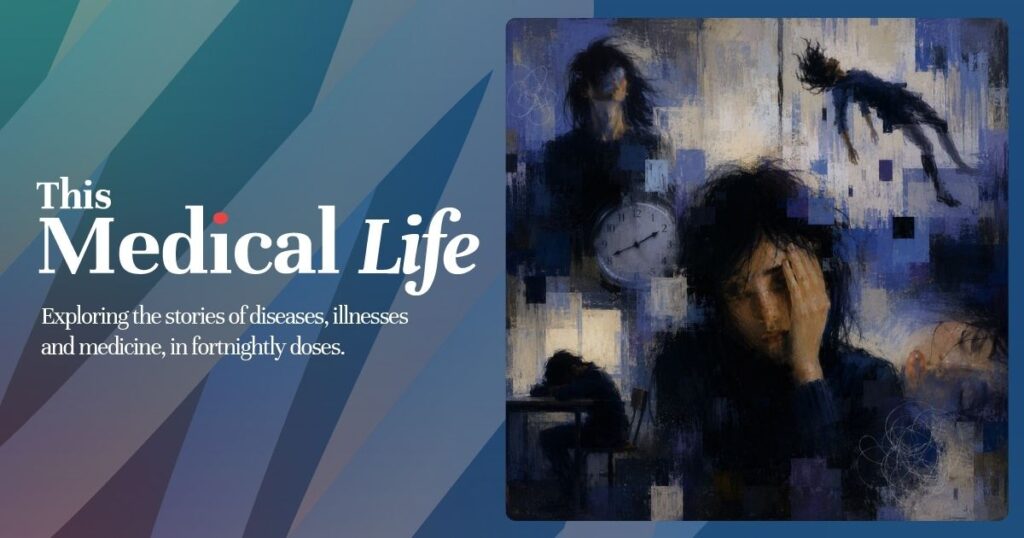
In 1880, a French physician described a patient having up to 200 sleep attacks a day, some triggered by nothing more than a good hand of cards or the sight of his own wine barrels. That case, and an earlier 1877 description from German psychiatrist Carl Westphal, gave the condition its name and its first clinical picture. Dr Travis Brown reads from both original case reports before turning to two guests for where narcolepsy stands today.
Di Spillaine, an Australian narcolepsy advocate and lived experience educator, describes going almost 40 years undiagnosed, mistaking her symptoms (childhood hallucinations, cataplexy triggered by laughter, sleep paralysis) for ordinary tiredness until a multiple sleep latency test finally confirmed narcolepsy. Professor Robert Adams, a respiratory and sleep physician at Flinders Medical Centre and medical director of the Adelaide Institute for Sleep Health, explains the underlying orexin deficiency behind narcolepsy type 1, how it differs from everyday tiredness and other sleep disorders, and the diagnostic pathway, including the Epworth Sleepiness Scale and multiple sleep latency testing.
What to listen for: the questions Professor Adams suggests a GP ask beyond “are you tired”, and why narcolepsy sits, in his words, at the end of the queue of likely causes but should still be considered in young patients with long-standing, profound sleepiness.
This is the story of narcolepsy.
Useful Link:
Epworth sleepiness scale: https://www.cdc.gov/niosh/work-hour-training-for-nurses/02/epworth.pdf
Our Special Guests:
Di Spillaine is an Australian narcolepsy advocate, lived experience educator and creator of the podcast Waking Up Tired: Narcolepsy Symptoms Explained
Professor Robert Adams is a respiratory and sleep physician at Flinders Medical Centre and medical director of the Adelaide Institute for Sleep Health at Flinders University
Listen:
This Medical Life podcast is available on all podcasting services, Apple Podcasts, YouTube, and Spotify. Members of the RACGP are able to log the hours as CPD (Education) that they listen to the episodes under self record via Quick log. We invite you to help support us on our donation page.
Automated Transcript:
This transcript was generated automatically by Descript. I will contain errors and spelling mistakes, but is offered as a guide and resource to help AI and search tools discover the content on behalf of GPs, medical students, other allied health professionals, and the general public.
TML S07E110
Steve Davis: [00:00:00] Welcome to This Medical Life podcast. These are the stories of medicine with Steve Davis and Dr. Travis Brown. This is the story of narcolepsy
I propose the name narcolepsy from the Greek narkosis, drowsiness, and lambanein, to seize, to take, for a rare neurosis, or at least one that has been little known until now, characterized by a sudden, brief, urgent need to sleep, which recurs at varyingly spaced close intervals. This name calls to mind narcolepsy’s twofold analogy with drowsiness and [00:01:00] catalepsy.
That was me, Travis, reading an historical quote that you wanted me to read.
Dr Travis Brown: I wanted to start with that quote. This was the first definition given to narcolepsy, uh, in the 1800s. Uh, and this is, yes, we’re examining narcolepsy. Now, this is a uncommon to rare condition, but it is a, it’s a neurological sleep disorder.
Uh, and it’s, it’s one that a lot of people will know the name narcolepsy, but you’ll often think about people just falling asleep s- you know, wherever they are in sort of unusual situations. Uh, that is a sort of Uh, the, but the way of thinking about narcolepsy will just com- people will think, “Oh, people just fall asleep anywhere.”
But it’s actually made of like four primary symptoms, and it’s a, it’s a serious issue. Like the first one is excessive daytime sleepiness. Now this is sleepiness that’s beyond [00:02:00] just feeling tired. This is a sleepiness of almost falling asleep during doing activities. Uh, a- and as we’ll see from some of the quotes of the, the historical first recognition of this disorder, you’ll see that it’s actually quite a debilitating sleepiness.
Steve Davis: Well, in fact, the, that was my first experience with it, uh, was in a movie called My Own Private Idaho, which was back from the early ’90s. River Phoenix plays a character who has sudden sleep episodes throughout. So that, that’s been my, the sum total of my understanding of narcolepsy.
Dr Travis Brown: And that will be the sum total of probably most people’s.
You’ll just see, oh, this, this person just, you know, falls asleep, and it’s a little bit comical. Uh, and but this, this sleepiness that people have described it as pr- c- almost being on a night shift, not sleeping for, you know, 24, 48 hours, and then just having this excessive drowsiness, and you just have to fall asleep.
And there’s, they even talk about like micro sleeps. Uh, but this excessive daytime sleepiness is, is the pri- first [00:03:00] primary symptom. Uh, but other primary symptoms also include cataplexy. Now this is a, a sudden loss of muscle tone. Uh, it can either be in a limb or all limbs or your entire body, and it’s often us- usually at a height of, uh, emotional height, like a heightened sensitivity of something, people laughing, you laughing, or something, something unexpected.
People can actually just lose their tone. It’s called atonia, uh, lose muscle tone, and so people’s knees buckle, or they might fall over. They might even really injure themselves. Now they’re not asleep. It’s not a sleep, uh, thing. It’s actually they’re completely conscious, but they just lose muscle tone.
Steve Davis: Is this similar in some way?
I forget what sort of animal it is, but there’s an animal I want to think it’s a, a goat or some sort of animal that literally freezes and falls asleep
Dr Travis Brown: Well, I’m not quite sure if it is, but that, that’s the kind of… If someone genuinely has this, uh, cataplexy, which 75% of people with narcolepsy [00:04:00] have, uh, they will actually have just loss of to- tone or, you know, be talking to someone and just…
Or, you know, sudden laughter and they just suddenly fall in a heap. Uh, and, and it’s just, and until it passes, they may not even be able to speak during this time. And so that’s the, a, a second primary symptom. Another one is, let’s see if I get these right, these words right. It’s called, uh, hypnagogia and hypnopompic.
Now, these are really vivid, like often frighteningly terrifying, vivid dreams that people have either while they’re going to sleep, while they’re asleep, or waking up, and these are hallucinations, and they can occur like daily, uh, while they’re going to sleep And there’s also the, the fourth sort of primary symptom.
Now, they’re not primary, so linked together, but you can have different combinations. They can happen at different times. The sleep paralysis. This used to be called, like, a sleep demon. Like, people sort of wake up with the unable [00:05:00] to move. Now, people will have experienced this, you know, rarely, but people with narcolepsy can have this v- frequently.
Uh, and they wake up, they’re fully awake, but they can’t move. Now, that’s part of our brain’s REM activity that where our body doesn’t move during that because, uh, hurt ourselves. Uh, but people with narcolepsy will wake up in that, that sleep cycle and not be able to move, and it will pass, but that sleep paralysis can be a terrifying kind of experience.
Uh, a- and other things that, that come up when you’re reading about narcolepsy are things like, uh, you know, automatic behavior. So people could be doing things… If they have narcolepsy, they might just be doing it. They’re not really awake, but they look like they’re still going through the motions of doing something intentional, but they’re not.
Their mind’s kind of a- asleep, and they’re just doing this automatic behavior.
Steve Davis: Like a form of sleepwalking- Yeah … but in a different way.
Dr Travis Brown: Yeah, almost. And, and [00:06:00] again, come back to microsleeps, so you can almost have sleeps where they’re– you’re blinking. They can fall asleep by blinking. Hallucinations come up a bit, as well as these interrupted sleep ep- episodes.
And so it’s not until you, you look at these and you start to actually look. Now, these are, uh, long descriptions, but these are the first descriptions from, from two doctors. Uh, the story of narcolepsy begins with two doctors, and this i- is in the late 19th century. And so the first is a German psychiatrist.
His name’s Professor Carl Friedrich Otto Westphal. Now, he was born in Germany and raised in the, the hospital system there, worked all his way up to, to being a professor of psychiatry. Now, he wrote a lot of first descriptions, things like agoraphobia, uh, per- periodic paralysis, general paralysis of the insane, uh, tertiary syphilis.
He described some of the, the, the actual symptoms, and a pseudosclerosis. But [00:07:00] w- the, the reason why we’re rai- raising him here is because he actually presented two cases, uh, at the Berlin Medical and Psychological Society in 1877, and one of the descriptions we have here.
Steve Davis: Mr. Erlert, a bookbinder, was admitted to hospital for the first time three months before he became ill as a result of a fit of anger.
After having a few drinks of schnapps, he is reputedly not a drinker, he went home, where he was scolded by his wife. Soon thereafter, he had a brief fit, one to one and a half minutes, characterized by a loss of speech, or at least an inability to express words clearly. His whole body was trembling. The patient called it agitation, so that he had to sit down.
He reported that he had an involuntary compulsion to sit down. This agitation is said to have continued throughout the entire evening. He says that he felt completely fine the next day, but a [00:08:00] similar condition in which he lost his capacity to speak and experienced trembling occurred thereafter at the least mental stimulation.
For example, uh, once when he saw two boys fighting in the street. Approximately ten weeks before his admittance, the attacks changed so that his teeth chattered. Speaking was difficult, and if he had anything in his hands, he would have to lay it aside because he did not have the strength to continue holding it.
During these attacks, he was unable to raise his arms. If the attack came upon him while walking or standing, he had to find some means of support, although a cane was sufficient for the purpose. These attacks varied in duration depending on whether he had exerted himself beforehand. He did not lose consciousness during these attacks.
He understood everything when spoken to. He was simply unable to respond coherently or [00:09:00] fluently. He always had to close his eyes when doing so. I have had the opportunity to observe the attacks in the patient himself on repeated occasions. He had one of these attacks while I was engaged in conversation with him.
While he was still speaking, one could see that a certain change had occurred in his facial coloration. His upper eyelids lowered gradually like those of a person falling asleep, during which the eyes roll upward. Then they opened again once or twice, seemingly with great effort, until they finally shut completely.
Thereupon, the patient stopped speaking after murmuring something incomprehensible. His head sank down to his chest, and his brow seemed forcefully knit. Small sporadic nostril contractions were observable, and the patient’s appearance was that of a seated person asleep. After a short time, several minutes, the [00:10:00] eyebrows relaxed, the patient raised his right arm a few times as if stretching upward, and rubbed his eyes sleepily like one awakening from slumber.
The scene then repeated itself all over again, during which one could observe that, though apparently asleep, the patient hears if one addresses him, since he nods in response to questions directed to him. Afterwards, he also knows everything that was said during the time. He experiences many such attacks all day long, especially if he is not engaged in some physical activity but is sitting quietly, talking, or reading.
However, even when occupied in a physical task, he often undergoes these attacks. For example, while helping wash the dishes, he then sits down on a bench, continues holding the objects that he had in his hand, nods off, and usually returns to his activity a few minutes later.
Dr Travis Brown: You can see that description.
This [00:11:00] is, uh, narcolepsy. Again, this came from, uh, Dr. Jean-Baptiste Edward, uh, Gelinot, and he was French, and he actually wrote after, uh, after this. Uh, now, he may not have been at the presentation, probably wasn’t, uh, but he gave this, this as a, uh, the definition of narcolepsy. And what you can see there is a description of these sleep attacks coming on, so this excessive sleepiness, falling asleep, and not only that, these episodes of what you would say atonia, or his inability to hold things, a- and just get, you know, strength, lo- loss of strength in his arms due to, due to certain things.
With regards to, this is what we’d talk, call today narcolepsy type one, and so you get sleepy, excessive sleepy with that cataplexia. Now, the– We’ll come back to Dr. Jean-Baptiste Edward, uh, Gelinot, and he was a, a navy [00:12:00] French physician. Uh, he practiced on ships. He worked in the, the, the Franco-Prussian War in the 1870s, uh, and he was actually quite a remarkable person.
He wrote on all sorts of top- of topics like tropical diseases, postpartum psychosis it was called, neuroses, angina, uh, phobias, uh, deafness, and epilepsy. Uh, and he was one of the writers who was first to say a lot of people thought this was, uh, epileptic-like, uh, symptoms, uh, but he actually described it separately, and that’s why he gave it its own name, narcolepsy.
He believed it wasn’t a subset of epilepsy. It was a separate condition, and he wrote, uh, an article in 1880.
Steve Davis: Mr. G, aged thirty-eight, a barrel seller with a nervous, volatile temperament, came to my clinic. Three years ago, during a heated argument, he received a violent blow of the fist from the other party, to which he responded by striking his opponent with a [00:13:00] drill.
A short time later, a log fell on his head, although it did not cause any great pain. For a long time, this individual experienced no consequential phenomena. Only in the past two years when laughing out loud or when anticipating a good business deal in his profession, he would feel weakness in his legs, which would buckle under him.
Later, when playing cards, if he was dealt a good hand, he would freeze, unable to move his arms. His head would nod forward, and he would fall asleep. He would wake up a minute later. Soon, the slightest emotion, the sight of his barrels, for example, would be enough to bring on sleep. When he eats, his meal is interrupted four or five times by the need to rest.
His eyelids droop. His hands drop the fork, knife, or glass. He has trouble finishing a sentence or falls asleep. If he experiences a deep emotion, whether painful or joyous, the [00:14:00] need to sleep is even more urgent and sudden. Thus, for example, if he is closing a good business deal, if he sees a friend, if he speaks with a stranger for the first time, or if he receives a good hand while playing cards, he collapses and falls asleep.
The only way to pull him out of these attacks is to shake him strongly or to pinch him. When he becomes violently angry, he sleeps less but longer and deeper. When he wakes up, he walks straight and firmly until a new sleep attack comes over him a quarter of an hour later. I will always remember the way he entered my clinic.
He was guided and supported by his son, who held him by the arm. No sooner had he passed through the door of my office and turned his eyes towards me than, frozen, his gaze glazed over. His eyelids drooped. He staggered, stumbled, and fell asleep onto a chair. His son spoke to him and shook him hard, after which he began to [00:15:00] speak to me.
Dr Travis Brown: And so this patient, uh, suffered about two hundred sleep attacks a day. Uh,
Steve Davis: and- Two hundred.
Dr Travis Brown: And he couldn’t stay awake for longer than thirty minutes at a time. Uh, his son, who he mentioned, was a thirteen-year-old son who was a constant companion and would wake him up during all times, uh, even during work.
Uh, and so the emotional states would also bring it on. So even just walking into a doctor’s office was clearly enough to trigger an attack because this was– would have been a heightened emotional stressful event. Uh, and so they tried all remedies, uh, for him. They tried medications, herbal remedies, uh, hydrotherapy.
I’m not quite sure when they say electricity what they mean. I’m guessing by shocking. There was even a, a part where they actually cauterized the back of– the, the nape of his neck, uh, to try and keep him awake. Uh, a-and again, nothing worked. Uh, and so the reason why, uh-
Steve Davis: I just wanna say, I hope our [00:16:00] guest with lived experience coming up shortly, Dice Polain, has not been subjected to that.
Dr Travis Brown: Well, no, we’ve moved on from there, fortunately. But you can imagine if you are just tired all of the time, uh, this exhaustion, you would probably do almost anything to try and stay awake. Uh, and why I’ve used these large descriptions, these large quotes, aside from to torture yourself, Seth. Uh, the, the reason is you can see that these is, these are two of the brightest minds of their time piecing together this clinical puzzle that is narcolepsy.
They can see the different elements that are, that are coming. They didn’t have a… They were able to put a name to it, but today we know a lot more about that, but there’s not a lot of awareness about it. Uh, and these are not trivial complaints either. These are not people saying, “I’m feeling tired.” This is someone who genuinely has exhaustion and is pretty much taking sleeps throughout the day just to manage.
Uh, but there are [00:17:00] also other elements, such as these hallucinations, these, uh, sleep attacks, uh, a- as well as this sleep paralysis and, and everything. So putting it all together, it can be liberating, but also a sort of probably challenging pro- process for patients. And so, uh, this is something that we’re just raising, uh, today, and we’re just going to t- talk to someone who has experienced narcolepsy and also a sleep expert to, to learn more about this condition.
Steve Davis: Dice Bowlane is an Australian narcolepsy advocate, a lived experience educator, radio presenter and podcast creator dedicated to raising awareness and understanding of narcolepsy and sleep health. After living with narcolepsy symptoms from childhood and [00:18:00] remaining undiagnosed for almost 40 years, Di transformed her personal journey into a powerful platform for advocacy and education.
She’s the administrator of the Australian support community Living with Narcolepsy in Australia and creator of the podcast Waking Up Tired: Narcolepsy Symptoms Explained, where she shares real-life experiences to increase understanding of the condition and support those affected by it. As a World Sleep Society World Sleep Day delegate, Di develops awareness and education initiatives focused on narcolepsy and sleep health, including campaigns for World Narcolepsy Day and resources designed to help educators, schools, healthcare professionals, and the broader community recognize the signs and impact of narcolepsy.
Di has served as a consumer representative for the Consumers Health Forum of Australia and currently represents consumers with NALHN and the Sleep Health Foundation. And Di is our guest [00:19:00] here on this Medical Life podcast. Di, welcome.
Di Spillaine: Thank you for having me.
Steve Davis: When did you begin to experience symptoms of narcolepsy?
Because it sounds like it’s from a long time ago.
Di Spillaine: Oh, it certainly was. Uh, I would have been around about eight or nine when I first started to experience symptoms of narcolepsy. Yeah, so a long time ago.
Steve Davis: And what were those symptoms?
Di Spillaine: I was having terrifying, what I now know, hallucinations, but at the time I didn’t realize that they were, uh, when I went to bed at night as a child.
So the shadow people You’ve h- may have heard of the shadow people who, uh, like in folklore and stuff like that, would, uh, hang over the bed and terrify people. Well, that’s is the sort of thing that was happening to me as a child. Yeah. So I was too scared to even move. I was frozen in fear in my bed.
Dr Travis Brown: That was the first experience.
Did you have any trouble with sleep at that time? [00:20:00]
Di Spillaine: I was always sleepy, so that’s just been my normal for my entire life. I didn’t know any different. I thought everybody felt that way. I used to wake up feeling exhausted. I thought everybody felt that way when they woke up. I had nothing else to compare it to.
Steve Davis: And before we move on into more of Travis’s questions, these shadow people, I have heard of them. Were they translucent, or were they solid? What, what was that… What did you visually see? ‘Cause as a young child, that would be terrifying.
Di Spillaine: It’s like a black shadow.
Steve Davis: Right.
Di Spillaine: Yeah. Uh, and it looks like a person, but they’re not really there.
But you, you don’t know that, especially as a child, you don’t know that. I mean, if you have that sort of experience as an adult and been diagnosed, then you’re more aware and it helps. But as a child, I was petrified. I thought they were real, and I thought they were there to hurt me.
Steve Davis: It’s very reminiscent for me.
It’s triggering memories of watching the early Doctor Who with Jon Pertwee, which was black and white, and those [00:21:00] early credits had black and white shadowy figures- Mm … in it. Mm. That was disorienting to me as a kid, but having them standing at my bed, that’s something I’m sure not everybody is familiar with unless they’ve gone through.
No.
Di Spillaine: No, no.
Dr Travis Brown: So did these symptoms progress? Did they get more or less, or you just kept, continued through your teenage years into adult life and having these kind of hallucinations whilst you’re going to sleep, or are you asleep at that time?
Di Spillaine: Okay, so I was, you’re sort of stuck between that, um, falling asleep and partially being awake phase.
So that’s where you get stuck. I didn’t, uh, continue having them for a long time, thankfully. They eased up. Uh, but other, uh, symptoms started to occur. So, and the excessive daytime sleepiness became a real problem, especially while I was at school. I found it very difficult to stay awake in [00:22:00] class. Uh, if we had, you know, lights out to watch a video or something like that, that was it.
I was out to it. Um, so there were a lot of gaps during my day at school, and then of course, that impacts your ability to, like, do your homework or an assignment or something like that, ’cause you’re missing information, and it’s because you’ve sort of gone in and out of sleep without, often without people realizing that you’ve actually fallen asleep.
Dr Travis Brown: Did you have any trouble with the, uh, cataplexy with regards to losing muscle tone when you’re actually, uh, emotionally heightened?
Di Spillaine: Yes. Laughter was a biggie. So for me, it’s rare to have a full body cataplexy episode, but I more often have, uh, my knees buckle when I laugh. If I’ve got, uh, say, uh, I’m out and I’ve got a drink in my hand and somebody catches me off guard and I laugh, more often than not, the person that I’m [00:23:00] talking to will wear my drink.
Oh, wow. I just can’t… It’s just an involuntary, uh, loss. Yeah. I’ve dropped, dropped things a lot, you know, if I get caught off guard or if I’m laughing. It’s, it can be quite difficult ’cause it’s after a while you try to suppress your emotions to avoid that from happening without realizing why you’re doing that.
Dr Travis Brown: Did you ever have the experience of, uh, waking up, like a sleep paralysis, where you’re actually, uh, unable to move, but you’re kind of in between awake or feel awake?
Di Spillaine: Yes. So in the mornings, uh, especially, so you, you wake up, so you’re fully awake, fully aware of everything that’s around you, but you can’t move And that only lasts like briefly, so it, it does pass, but it’s scary at first when you can’t move because you’re like, “Oh my God, like, why can’t I move?”
Going to sleep is often when you will then have those hallucinations. So it might be visual, [00:24:00] like a shadow or something. It might be auditory. You’ll hear something, but it’s not really there. Like a radio is quite common to hear in the background, or somebody calling your name, or footsteps, that sort of thing, but they’re not really there.
And that can be quite terrifying if you’re home alone because you think, “Oh my God, there’s somebody outside,” or… But they’re, they’re not. Um, often I’d like, I’d smell, uh, things cooking or smell toast. Toast burning is very common amongst uh, people with, uh, uh, narcolepsy apparently. So yeah, random things like that.
Or you’ll feel something touch you, but there’s nothing there.
Dr Travis Brown: Clearly some of these symptoms you, you think, well, this is mental with regards to this is a possibly a neurological disorder. Uh, what were the diagnoses that were going through when you were being investigated as to what came up?
Di Spillaine: Well, before then, uh, well, I mean, these things are something that you don’t really mention because you’re in fear [00:25:00] of being, uh, diagnosed as being crazy and, uh, you know, put in a padded room for the rest of your life.
So you sort of avoid having those conversations with anybody. It was more so the conversation about feeling tired, which is the worst thing you can say, especially as a woman. Tell your doctor that you’re tired because you get the, you’re expected to be tired. You know, you’re a mum, you’re working full time, you know, raising children, looking after the household, yada, yada, yada.
It’s normal for you to be tired. Whereas if I had said, “I feel sleepy all day,” there’s a big difference to feeling sleepy all day and being tired.
Dr Travis Brown: How did you manage all these symptoms then without the diagnosis?
Di Spillaine: I just battled through. I, I don’t know. I’m- I’m amazed to this day of how I managed to battle through for so long.
[00:26:00] Uh, but eventually the cogs start to fall off, and you start to be running late for work, or you’re missing, um, vital parts of what you’re doing at work, and, you know, things start to fall apart. Life starts to just fall apart badly. Uh, it becomes a bit of a train wreck.
Steve Davis: From your advocacy work, you are talking to lots of people now.
Do you get the sense that you’re not an orphan in living with undiagnosed symptoms and just finding a way through? Are there-
Di Spillaine: Oh, I’m definitely not an orphan. Definitely not an orphan. Uh, many people go a long time without being diagnosed, especially women. Uh, men tend to be listened to when they go to their GP and say that they’re feeling tired.
All of a sudden it’s like, “Oh, gee, that doesn’t sound right.” Uh, so they get investigated a lot, a lot faster. If you’ve got really [00:27:00] obvious cataplexy, it, that can lead to being diagnosed sooner. Uh, a general lack of awareness amongst the medical profession does tend to increase the length of time that it takes from having symptoms to being diagnosed as well.
So there’s a really low awareness of what narcolepsy actually is. Mm.
Dr Travis Brown: Well, it’s interesting ’cause the symptoms that you mentioned, particularly hallucinations and everything like that, fall into something that I would sit, and whether they’re auditory and visual, will start to go to schizophrenia, which would probably s- scare a lot of people to say, “Am I actually in that area?”
Did you end up being investigated in that area, or did you not mention anything about
Di Spillaine: that? No, I just didn’t mention it, but people do get misdiagnosed with schizophrenia and other mental disorders, obviously, because of, uh, disclosing those symptoms. So yeah, I was very aware of that. Yeah. Yeah. Mm.
Dr Travis Brown: How long did you take before you were [00:28:00] diagnosed?
Di Spillaine: It was proba- it was close to 40 years.
Dr Travis Brown: How were you, how were you diagnosed?
Di Spillaine: I had been seeing a s- a psychiatrist and, uh, for major depression, which of course, having lived a life of being sleep deprived, it was no wonder I was depressed. And it wasn’t until he had sort of exhausted just about every possibility and he said, “Look, there is a medication you can try that does help with, um, the tiredness.”
He said, um, “But it’s only available, like, for, for me on a private script.” So at the time it was quite expensive. So he wrote me a, uh, prescription for modafinil. And I tried that and I did have improvement in my daytime sleepiness. So I also had a neurologist because I’d had a, um A demyelinating attack on my [00:29:00] brain.
Thankfully, it didn’t turn into becoming, um, MS. It was just a one-off attack, so a clinically isolated, um, attack. But, uh, when I mentioned it to him that I’d had this improvement, he said, “Well, the only way to access that medication via the PBS is if you have narcolepsy.” He said, “Look, I’ll just send you to, to the, uh, refer you to the sleep clinic, and, um, we’ll see, you know, what we can do that way.”
So I got sent to the sleep clinic, and they, uh, sent me to have a, um, overnight sleep test, followed the next day by the multiple sleep test. Now I must mention that a few years prior I had been sent for a sleep test because I thought that I, perhaps I had, uh, sleep apnea, and that was causing the excessive daytime sleepiness, and that was ruled out.
But the, uh, sleep clinic then didn’t bother [00:30:00] investigating any further. So this time I was sent for the overnight test followed by the multiple sleep latency test the next day, which is where they send you to have a nap. Uh, it, it can be scheduled for up to five naps that day, but I only did four before I was sent home.
And, uh, then afterwards, a few weeks later, I went to see the, uh, specialist back at the sleep clinic and was told that I had narcolepsy.
Dr Travis Brown: Was that a relief or was that a concern?
Di Spillaine: Um, it was a relief, but it was also confusing because I wasn’t given any information about it. I, I knew nothing about it. My whole thoughts on narcolepsy were the, the, uh, what, the Hollywood misinterpretation.
So you know, people falling asleep in funny situations or collapsing to the ground in funny situations. I wasn’t collapsing to the ground and yada, yada, so I, I can’t possibly have it. I mean, I nearly [00:31:00] didn’t stay for the multiple sleep latency test because when they told me at the clinic, uh, in the morning that I was gonna have to stay the whole day and do this nap test, I’m like, “Oh, don’t be ridiculous.
I haven’t got narcolepsy. This is a waste of my time. I’ve got things to do.” Thankfully, they talked me into staying, ’cause if I hadn’t, I, to this day I still wouldn’t have an answer for that. So yeah, I just… Because I didn’t know anything about it, and that’s the problem. People don’t know anything about it, and it can be difficult to find reliable information as well when you first start looking.
Dr Travis Brown: So was it the multiple sleep study that it came up in, not necessarily the overnight one?
Di Spillaine: The overnight doesn’t diagnose narcolepsy. It’s the multiple sleep latency test where you have to, uh, fall asleep within a certain period of time and then enter into REM sleep. Which is what I do. And that’s not normal for people to, uh, dream during the day, unless of course there’s a medical condition or, [00:32:00] uh, sleep w- uh, y- work, shift work, that sort of thing.
Dr Travis Brown: How did the diagnosis then change your, uh, I guess everyday life?
Di Spillaine: Well at first I, uh, decided I needed to find out as much information as I could about it. Uh, so you know, sort of weeding through facts from fiction, and thankfully I do have an IT background, so I was able to do that. But not everybody can do that.
And then once I had a better idea of what it was about and how it had impacted my life, I then decided that I needed to be very vocal about this, and raise awareness of how it had impacted me. Because there are many, many people living around the world with narcolepsy, undiagnosed. They’ve got no idea.
Steve Davis: That’s how it changed the way you interacted with the world as an advocate. But how did the diagnose change, the diagnosis, change your everyday life? Did access to this drug [00:33:00] help? Did, did the amount that you were taking change? Were there other interventions?
Di Spillaine: Okay, so I was originally, uh, prescribed stimulants.
And stimulants are just a band-aid. They’re a band-aid to help us to try and get through the day without falling asleep. Uh, but they don’t, um, deal with the problem, which is of course that we’re not getting enough restorative sleep at night, because our whole sleep cycle, that’s all broken. So we enter REM too quickly, and we spend too long in there, so we don’t get to have that, uh, time in that deep restorative, uh, sleep phase.
I decided that I needed to, because I’d been diagno- you know, so late in life, that I needed to get the best treatment possible for me, that was available here in Australia. And I was very lucky to participate [00:34:00] in a medical trial in 2019, which was for a, uh, once a night, uh, version of, um, Xyrem, which is sodium oxybate.
And um, that put me in, in, uh, not only gave me access to that medication for the trial, but it also gave me access to a wonderful sleep physician who has just been so helpful for my journey. Once I’d reached the full dosage of that medication during the trial, I woke up one the first morning, and experienced what it’s like for normal people to wake up in the morning.
I didn’t feel exhausted I actually woke up and I felt re- refreshed. I was like, “Oh my God, this is what it’s meant to be like every day.” I had no idea that you could wake up feeling like that. And [00:35:00] the lo- I was lucky enough to have ongoing access for that, to that medication for a few years after the trial, and the longer I was on it, the more improvements I saw.
So I was gradually able to, uh… I started to recall memories that were long lost throughout my life, and I was able to retain information, and I was able to be reliable. I didn’t have to say, “Oh, maybe,” and then not turn up to things. I could actually say, “Yes, I’d love to come,” and be there. I even managed to go back and do some part-time work, ’cause I da- I had, uh, eventually lost my job through not being able to cope with the exhaust- this whole exhaustion that I had all day long and just- Yeah, so it had a big financial impact on me.
Um, unfortunately, once that access was taken away, uh, there wasn’t an affordable option here [00:36:00] available in Australia for me to, um, take instead. So life went back to what it was previously, and I felt worse. And I guess partly that is because of the fact that I’d had this major life-changing experience to then go back to feeling exhausted all the time, and not being able to function, and not being able to be there, and not being able to turn up for my family.
You know? Uh, letting them down really, really stings.
Dr Travis Brown: How are you managing the condition nowadays?
Di Spillaine: So I’m still on… I’m on various, uh, stimulants to help me get through the day. It doesn’t stop me from feeling, uh, sleepy, but it helps to prolong it. I also have to have scheduled naps around my day. I’m kind to myself.
I don’t agree to do anything before lunchtime on purpose because it… [00:37:00] You know, by the time I wake up and then by the time my brain is functioning enough for me to b- be able to do something, you know, I, it’s just easier to leave things to after lunch. Um, yeah, so you just sort of navigate life as you can.
I have to take an antidepressant. Even though I’m not depressed, I have to take an antidepressant to minimize my cataplexy.
Dr Travis Brown: Looking at your role in advocacy, uh, what does that entail, and how are you reaching these people?
Di Spillaine: So I, uh, set up a group on Facebook. It’s a private group for people who live with narcolepsy in Australia that have been diagnosed.
Uh, I made it for people who have been diagnosed because in a lot of these groups, you get all these people asking questions. You know, people who haven’t been diagnosed who think they might have narcolepsy and all that sort of thing. We’re very tired. We don’t need to be shielding all of that sort of thing.
So this is a group for us who have been diagnosed, we are living with it, where we can ask [00:38:00] questions, where we can share experiences, where we can share, uh, reputable information, as well as any, uh, information about, uh, trials and, you know, things that people can participate in. And the group, uh, I ask the group when I’ve got an awareness, uh, campaign o- opportunity coming up if they’d like to participate.
They don’t have to, of course, but if they’d like to, you know, and get involved. So every year for World Narcolepsy Day, which is the 22nd of September, uh, we, um, share on social media Some awareness, our awareness activity for the year. Last year it was the podcast series, Waking Up Tired, Narcolepsy Symptoms Explained.
Uh, one year I even released a song. The Underground, uh, Railroad, which was about, uh, the character of Harriet Tubman who, uh, herself, uh, freed, um, many slaves despite the fact that she lived with narcolepsy. Um, yeah, um, an [00:39:00] amazing story, so that was, uh, something that resonated with me. Uh, yeah, so they’re the sorts of things that we do for World Narcolepsy Day.
I’m also, as you mentioned in the introduction, a, uh, World Sleep Day advocate, so I use that as an opportunity to also, uh, share information about narcolepsy. So whatever the theme is for the year angled in, uh, in a way so that it reflects on what it’s like to live with narcolepsy. Getting involved in consumer, um, lived experience groups where we can, um, also help to raise awareness about these things as well, and give our voice, our lived experience voice, which is just so vital for any, uh, medical practitioners to have the lived experience lens coming through.
Uh, because people don’t know what it’s like unless they’ve actually lived with it.
Steve Davis: Ironically, I’m now exhausted having listened to that list, Di.[00:40:00]
Di Spillaine: It is exhausting.
Steve Davis: I, I will say though from a productivity perspective at a national level, um, maintaining access to that original drug would, I would think, have a net positive impact on our productivity here in Australia. So I hope- Mm … there is some way that that changes in the future. But just in closing, do you have any advice or final thoughts for doctors in particular, but also for patients who might be listening to this podcast?
Di Spillaine: Well, for doctors, I guess look beyond that stereotypical thought of what narcolepsy is. So because it’s much more than being sleepy You know, there’s a lot of things. Ask other questions. Don’t just leave it to that. If somebody is constantly coming in and saying that they’re tired or sleepy, ask other questions, uh, that could lead to, like, “Are you…
Do you ever have vivid dreams? [00:41:00] Do you have episodes where you lose, um, you know, muscle control?” Just listen. Listen to your patient, and don’t, don’t write them off. Don’t think that it’s nothing, because if they’re continuing to have these same problems, there, there could be something else. And if you don’t know what it is, send them, refer them to a sleep clinic so it can be investigated.
Because there are, are a lot of different sleep disorders, obviously, and it might not be narcolepsy, but it could be another one that’s actually impacting their life. And not getting quality sleep impacts absolutely everything. So it’s vital, vital to get to the bottom of it. Don’t just disregard them.
Steve Davis: And for patients?
Di Spillaine: Advocate for yourself. If you, if you’re not feeling that you’re being heard, push. If that doctor isn’t listening to you, find one who will, and keep pushing. Just say, “Look, I’m sorry, but I really would like to get my sleep investigated. [00:42:00] I need a referral.”
Steve Davis: Di Spillane, thank you very much for joining us on This Medical Life.
Di Spillaine: My pleasure. Thank you for having me.
Steve Davis: Professor Robert Adams is a respiratory and sleep physician based at Flinders Medical Center and medical director of the Adelaide Institute for Sleep Health at Flinders University. He leads the NHMRC Center of Research Excellence National Center for Sleep Health Services Research, which is conducting trials of new models of care for obstructive sleep apnea and insomnia in primary care to enhance the ability of primary care to manage sleep health.
He is the deputy chair of the Sleep Health Foundation, the leading advocacy group for sleep health in Australia, and also chairs the Healthy Sleep in [00:43:00] Hospital working group. Robert’s our guest here on this Medical Life podcast. Robert, welcome.
Professor Robert Adams: Good morning.
Steve Davis: Robert, I would love to hear from you your definition of narcolepsy.
What is it?
Professor Robert Adams: Narcolepsy is a central disorder of hypersomnolence, so as distinct from some of the many other causes or ways to be excessively sleepy during the day, like sleep apnea, which where your upper airway blocks off repeatedly during the night, and that disrupts breathing, and that disrupts your sleep.
Or, um, some of the other things that contribute to sleepiness secondarily, like medications or neurological disorders, um, or just lack, a lack of sleep duration Narcolepsy is a condition caused by a deficiency of, um, orexin, hypocretin neu- neurons in the hypothalamus. It’s, um, almost certainly probably an autoimmune disorder, [00:44:00] T-cell mediated destruction of these neurons.
And what happens from there is that people, um, lose their ability to stay awake, um, and so become quite sleepy and have problems with, uh, sleep, rapid sleep onset, uh, during normal periods of wakefulness. They feel excessively sleepy, um, and will often have other associated symptoms such as cataplexy, which is a loss of muscle tone.
Um, and that can be an extreme loss of muscle tone where people literally collapse down out of nowhere, often triggered by emotions. So laughing can produce sudden loss of emotion, you lose tone, and you just collapse. Or it can actually be more subtle than that. Sometimes it’s really just seeming like a l- some, you know, loss of facial muscle function, for example, or a, you know, feeling you can’t move your arms very briefly.
Um, and that of course has significant impacts on someone’s [00:45:00] life.
Steve Davis: Goodness me. How common is this condition?
Professor Robert Adams: It’s, it’s not common, uh, which is probably a good thing. We really don’t know in Australia, to be honest. Um, we extrapolate from data from, uh, the US where, uh, type 1 narcolepsy, which is what I’ve just described with cataplexy, um, affects about 12 to 13 per 100,000, uh, people.
Um, so in a state such as South Australia, for example, you’d end up with about 250 people with narcolepsy type 1, the one with cataplexy. The other, um, sort of related conditions are narcolepsy type 2, which is what I’ve just described without the cataplexy, or a condition called idiopathic hypersomnia, where people sleep for a long time and feel really sleepy.
Usually 11 hours or more of sleepiness. Now, those two are not caused by a loss of the orexin neurons, and we don’t really know [00:46:00] 100% what causes, what contributes to those conditions, and they’re probably more common, the other one, the extreme sleepiness. Again, clinical data in, in the US would suggest maybe 42 per 100,000, so that gets you up towards a few hundred, hundreds of
people in a place like South Australia.
Dr Travis Brown: Is there an easy way for a doctor who’s sitting s- in front of someone who is actually tired and feels tired all the time, is there an easy way to distinguish between what would you would, you would call narcolepsy and kind of the everyday tiredness that people would feel?
Professor Robert Adams: Yeah. The, the, the s- tiredness of narcolepsy, either any type, um, is really quite profound. Um, it’s, it’s the, the things you get with depression or, um, you know, medications or just not enough sleep, people feel tired and flat, but this is usually very profound sleepiness. Um, sometimes it has other associated problems like sleep [00:47:00] inertia, um, and brain fog that people describe.
Um, in things like, uh, and we’re talking like 11, 12, 13 hours or more of sleep required just to feel sleepy. Whereas I think people with ordinary times, you know, sleep 11 hours a day, you’ll probably feel better. Idiopathic hypersomnia, um, can have non-refreshing naps, so they sleep an awful lot, and they don’t feel any better at the end of it, which is a, um, you know, distressing symptom.
And they’re the people who often have more of the brain fog or what’s described as sleep drunkenness-
Di Spillaine: Yeah …
Professor Robert Adams: um, and profound sleep inertia. Idiopathic hypersomnia. Classic narcolepsy, the sleep usually makes them feel better, but not for very long. Um, and I suppose that the doctor, if you’re sitting in front of someone like that who’s just feeling really sleepy, um, now most people sleep for seven hours a night if you track the population.
Um, and, you know, most people are [00:48:00] okay. There are all sorts of reasons to not do that, you know, as we all know. Um, but I suppose the thing is, if people are, are doing all the right things, if you like, the sleep hygiene, the getting enough time to sleep, the, you know, winding down before bed, the cool dark room if you can do it, the no interruptions, the, you know, don’t eat very soon before going to bed, don’t drink alcohol too much, don’t smoke, allow yourself time to do it, and you still have a sleep problem, or still feel you have a sleep problem and not feeling well, you probably have a, you may well have a disorder.
Mm-hmm. So my point at that point would be try s- go and see s- go and ask to see somebody.
Steve Davis: Robert, in that question Travis just asked, he, he asked about a GP being able to determine between narcolepsy, for example, or everyday tiredness. Yeah. Did you recoil inside when he used the term everyday tiredness?
Professor Robert Adams: I did a little bit.
Steve Davis: My apologies.
Professor Robert Adams: I [00:49:00] mean, no, I, no, I appreciate people are really busy. Fitting everything into 24 hours is very hard. Pretty much every cycle of life, there is a lot of things that impact on your sleep. You know, sleep is a human activity, and so it-it’s got physiological, it’s got psychological, it’s got social aspects.
Um, and you know, we know the physiology of it is it, is that you, aging gets best, uh, done if you sleep somewhere between six and a half and seven and a half hours a night, more or less Uh, shorter than that you start to have problems. Longer than that you pro- you do have… Now, longer than nine hours you probably already do have a problem, and you need those nine hours as a recovery for whatever condition is, is affecting you.
Um, and you know, if you’re young, you’re, you’re going out, you often work shifts, you study, you do all things like that. And then people go on, get older and have children, and that of course disrupts things. And then they have busy jobs, and then, you [00:50:00] know, it all becomes a problem. So I appreciate there, there, yeah, there is everyday tiredness, and that’s people feeling fatigue.
Now usually, if you get a chance to get out of that cycle for some reason, you go on holiday, you get to sleep, you catch up on the weekends even, you probably feel better. Someone with narcolepsy does not. They, they’re just gonna feel sleepy regardless, um, of any of those things. Um, interestingly though, someone with narcolepsy type 1 will often have other sleep conditions to go with it though.
So, um, you know, paradoxically sometimes even insomnia because they have disrupted sleep throughout the night and feel like they’re awake in the middle of the night even though they’re sleeping most of the time. And sleep apnea will come, you know, be associated with, with narcolepsy as well. Uh, and that just makes the whole thing more profoundly uncomfortable.
Dr Travis Brown: So when we looked at this condition just initially, it was four primary [00:51:00] symptoms or categories. So you had the excessive daytime sleepiness, you had the, uh, cataplexy, but then there was also the, the hallucinations, the vivid dreams, uh, as well as the- Yeah … sleep paralysis. Is this a, are these all combinations?
Can you just have one and have narcolepsy, or is this… How does that fit in?
Professor Robert Adams: The other sort of symptoms, the particularly the, the hallucinations and the sleep paralysis, are usually people, if you like, waking up during REM sleep. Um, so they’re in the middle of a dream, they’re in the middle of a good sleep, and they suddenly become conscious enough to recognize what’s going on, and they’re s- kind of almost still dreaming.
And part of doing narcolepsys is this, this shift between consciousness and, and sleep. Uh, that’s happening when you’re having a dream, um, ’cause a characteristic parti- of narcolepsy is, is what they call sleep onset REM periods. So usually when you sleep, REM starts about an hour and a half after you first get to sleep, [00:52:00] give or take.
People with narcolepsy will often have REM sleep out of the, out of the gate. You know, they move into REM sleep. And in fact, one of the definitional, uh, cri- clinical definitions is observation of these sleep onset REM periods in a sleep study, and two or more is what’s usually required to define the condition.
Um, and so people wake up during that, they’re, they’re literally hallucinating, they’re dreaming. And of course, we know during REM sleep you lose all your muscle tone, which is a good thing, otherwise you tend to act out your dreams, which is another disorder. Um, and, and you feel pra- and you have paralysis for a little while until everything comes back.
So that’s kind of those, those two symptoms that go with it. So that’s narcolepsy with cataplexy. That’s type one. That’s the one with the orexin deficiency. Uh, and the reason I’m harping up on that is there’s actually medications now that are directed precisely at trying to correct that, that are in production and trials.
The others are [00:53:00] more sleepy and just have these sleepiness problems, sometimes with the REM onset, sleep onset REM, uh, and sometimes with these other symptoms of sleep inertia and, and, um, brain fog
Dr Travis Brown: So reading about this condition, I came across neurotransmitters that I was not familiar with. Um, can you actually mention which ones these kind of are, or at least one or two of them again?
Um, and do we know the sleep center that this is actually affecting, or is it a whole brain type of affection?
Professor Robert Adams: Orexin receptors. Um, there’s orexin one R and orexin two R. Uh, orexin one R is kind of related to the reward-seeking addiction pathways. It’s in that ventral tegmental area. Um, and the two, orexin two receptor is in the, regarding the sleep-wake regulation, um, and predominates in the wake promoting cell groups, and [00:54:00] it’s around the sort of hypothalamus.
As I say, there are medications now direct to that, both these receptors, um, and that’s the therapeutic target for narcolepsy type one, and that’s the predominant, predominant ones for that, that type of narcolepsy. Which means, of course, that you have those medications, they’re directed towards that they improve wakefulness and improve the cataplexy.
The main side effect is insomnia.
Dr Travis Brown: How do you actually diagnose narcolepsy?
Professor Robert Adams: The definition, as I mentioned, is profound sleepiness. Um, the test is then, uh, what’s called a multiple sleep latency test, which should be performed the day after a sleep study because you need to have a sleep study to determine people have had enough sleep beforehand, so not just sleepy because they’re underslept.
Um, and preferably if there’s been some sort of measurement of sleep for the week or two weeks beforehand, usually with actigraphy, ’cause that gives you an idea of whether how long people are [00:55:00] sleeping on average, and in particular, how regular or irregular their sleep is. After that, there’s a multiple sleep latency test where, um, someone is still connected to the wires to monitor, um, you know, brain function, um, to determine sleep, and they’re left in a room and given opportunities to sleep, usually four or five times over the course of the day.
And then the period of time it takes for someone to get to sleep Uh, interestingly, the, the sort of international diagnostic criteria say less than eight minutes. Medicare will let you have medication if it’s less than 10, so there’s a slight difference there. Or you… or there’s two sleep onset REM periods during that, or there’s sleep onset REM noted in the sleep study without, as I’d say, another cause of having the problem, like sleep restriction or drugs or sleep apnea or any of those sorts of things.
Dr Travis Brown: If someone’s diagnosed with narcolepsy, and you’ve [00:56:00] mentioned this a, a few times, indicated, I’m not quite sure who’s able to prescribe them if it’s able to be pres- prescribed. But what is the management options for people with narcolepsy?
Professor Robert Adams: Currently in Australia, um, they’re limited. We, we have access to less medications easily than, than overseas The specific new receptor antagonists are coming, but they’re not actually, um, approved as yet.
They’re still in trials. So the medications in Australia, the first line of management still remains, um, stimulants. So dexamphetamine is the, the PBS, if you like, mandated first line therapy, unless there is a contraindication to it. Um, and any form of cardiovascular disease or probably psychiatric disorder would count as a contraindication, and that includes moderate or hypertension.
But nonetheless, there are a lot of people who are prescribed, um, dexamphetamine, which they would take two, maybe [00:57:00] three times a day. Um, and it’s, it can be moderately effective. Some people do very well on that. Uh, the next two medications, um, like modafinil or armodafinil, um, they were in a different pathway.
But they, uh, again, are, are able to be prescribed through the PBS for that. The third that is now just been, uh, TGA approved, but is not again on the PBS, is sodium oxybate, which is the, you know, sodium salt of, um, GHB. And its purpose is actually to consolidate sleep, so that the sleep becomes better, and people feel better during the day as a consequence.
It also probably helps maybe with na- um, the cataplexy symptoms.
Dr Travis Brown: Getting back to a general practitioner sitting in front of someone, is there any useful questions to actually say, “Oh, this person may be or may have benefit of a sleep study or even extended sleep study with [00:58:00] consideration for narco- narcolepsy”?
Is there anything that would be a, a useful question or set of questions, such as hallucinations?
Professor Robert Adams: Yeah, sure. I mean, apart from, do you think you have a sleep problem? It makes you sleepy. Um, which I think is a very useful question because most people would say they have a problem, and it does often take a long time to get to a diagnosis.
Um, and, you know, somebody who’s experiencing that can feel very frustrated with that. But as I say, it’s, it’s a very unco– it’s an uncommon condition, and, you know, most of what a GP will see when someone presents with sleepiness will not be narcolepsy. Nonetheless, if you’re sleepy and you’re sleeping an okay amount, you probably need a referral anyway.
The question, set of questions that we use, and it’s an imperfect set, is the Epworth Sleepiness Scale, which is a set of eight questions developed in Australia, hence the Epworth name. Um, and it is, is universally used to [00:59:00] access sleep studies by GPs, for example. You know, if you, if you want a direct referral for a sleep study, you fill in the question around the risk of sleep apnea, you know, the STOP-BANG or the OSA 50, um, and then determine whether you have symptoms that are related to that.
And the scale Medi, um, Care want you to use is, is the Epworth, um, which is eight questions around the propensity to doze off, actually fall asleep in various situations of, you know, escalating Severity. The first is, you know, if you’re lying down somewhere after lunch, do you fall asleep? Which many people will answer, well, yeah, there’s a moderate chance of that happening.
Two, do you fall asleep sitting at the traffic lights, or fall asleep s- talking to someone, or fall asleep just sitting in a public place? So they’re all less… If you’re falling asleep in those circumstances, it’s regarded as abnormal. It’s, uh, it’s imperfect ’cause it was developed 30-plus years ago. [01:00:00] It doesn’t have anything relating to things like sitting in front of a computer or, you know, th- those sorts of things.
But it’s, it’s still a pretty good test, and if someone scores, well, anything above 10 is abnormal. People with narcolepsy will be scoring 20, 21 out of 24. So profoundly sleepy. If you’re getting that profound level of sleepiness, you know, it’s probably not because you’re depressed. It’s probably not ’cause you’ve got a low…
you know, hypothyroid. It’s probably not just because you’re taking some sort of medications, unless you’re on a lot of them. You know, the, the, the pain medications or other sorts of sedatives. Um, there’s something else going on related to sleep.
Steve Davis: With those questions about do you… if you’re sitting down, might you fall asleep, et cetera, some world leaders on the world stage are filmed regularly dozing off and falling asleep, which i- leads to an important question.
Is this… Is there a certain age at which [01:01:00] narcolepsy might rear its head, or is, or, or is it, it’s only diagnosed sometimes and it’s random? What, what’s, what’s the reading there?
Professor Robert Adams: The age of first symptoms is often quite young. Okay. So it will tend to be noticeable in adolescents and early adults. And again, that makes it difficult to identify because someone with narcolepsy won’t be the only 17-year-old who’s sleepy and wants to sleep in.
Having said that, you know, the, the RAIN study in Western Australia is a population study that actually was looking as a, looking at, um, people, and they did, uh, sleep studies on 22-year-olds in that study, and they found that, like, 20% of them had a clinical sleep disorder of some type. Mostly insomnia and or delayed sleep phase.
Uh, but yeah, 5% had sleep apnea
Steve Davis: At 22?
Professor Robert Adams: Yeah. [01:02:00] ‘Cause I think the thing about sleep apnea is it’s, it’s 50% of people are not overweight, and 75% are not obese with sleep apnea. Um, there are other ways to get it, and it relates to anatomy and the way your muscles operate, way muscles work during sleep. So it’s, it’s again, it is difficult if you’re just, someone’s presented to your GP saying, “Oh, I feel really terrible.”
Well, there’s a lot of ways to do that, and narcolepsy is probably gonna be the end of the, the queue. But again, if, if people are sort of doing a, a number of things to help them start with sleep, and you’ve talked about mood, and of course it’s difficult ’cause 50% of people, especially with hypersomnia, but a lot of people with narcolepsy can be depressed as well Just because the, the condition is depressing and, you know, the social isolation and the restrictions on what you can do around work and school and education often, until you get treated, are pretty significant.
Steve Davis: Our previous guest on this episode, Di Spillane, lives with narcolepsy. She was on a study or, or a [01:03:00] research trial, and she got access to a certain drug. Travis might remember what it was, but, um, it, it was, I think, one of the ones you’re talking about that targets more deeply. Of course, when that was passed, she no longer had access to that.
Yep. What… Have you got a, an intuition about how soon people like Di, through their GP or specialist, will get access to these newer ranges of drugs?
Professor Robert Adams: Yeah. My impression is that, that, that one of them at least is, um, at the point of someone trying to get it onto probably FDA approval first, but certainly TGA approval in Australia.
As we know, that process isn’t immediate, and then maybe that’s only a while for that to happen. And the unfortunate part, problem, I think, with the trial that she was involved in was that, um, you know, it was at the phase three level rather than a advanced clinical trial. Um, and so, [01:04:00] you know, it’s difficult to get approval to continue with it, which is a shame ’cause I think they, they…
The data that’s been published so far certainly look like they, for the very specific type one narcolepsy, the type with cataplexy, um, they certainly look like they will be an improvement from what we’ve got so far, um, with less likelihood of, you know, significant side effects, amphetamine cardiac problems.
Uh, the armodafinil, modafinil are contraindicated in pregnancy. So, you know, as, as I said, they’re young- younger adults, younger women are common, the commonest group to have it, if you like. Um, and so that becomes a problem around contraception and need to double contraception or people naturally don’t wanna use it.
So that becomes a big, big issue. Hopefully, the drug Debbie Spillane was on will be available in the near-ish [01:05:00] future, but, I mean, I wouldn’t be holding my beer.
Steve Davis: All right. On that note, to finish, have you got any final thoughts or advice for doctors in relation to narcolepsy?
Professor Robert Adams: In relation to sleepiness, I think, think sleep disorder.
Um, they are very common, and by and large, they are manageable. In relation to narcolepsy, again, you know, the old when you hear hooves, it’s not a zebra, but occasionally it will be. Um, and particularly if, if someone is younger and have been reporting sleep problems for a long time , um, consider- certainly think about a sleep disorder, even if it’s not the way we’ve often been taught for a long time.
Most of them occur in people my age, um, rather than people, you know, my children. But think of a sleep disorder in those people and, and, you know, narcolepsy can be one [01:06:00] of the ones that will get picked up if someone gets to see someone, and then they have investigations.
Steve Davis: Professor Robert Adams, thank you very much for joining us on This Medical Life.
Professor Robert Adams: Thank you.
Steve Davis: This Medical Life is recorded in the Talked About Marketing Studios in Adelaide. For show notes and more information about the podcast, visit thismedicalife.com.au. You can contact the hosts on social media. Dr. Travis Brown can be found on X. His username is @drtravisbrown, that’s D-R Travis Brown. And Steve Davis can be found on LinkedIn.
Go to linkedin.com/in/therealstevedavis. This has been a Pathnotes Proprietary Limited [01:07:00] production