
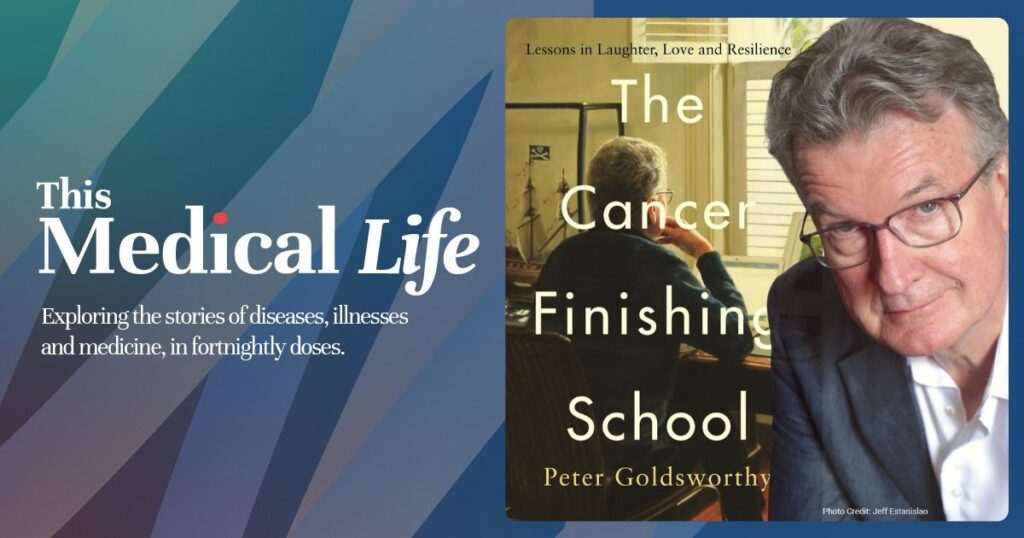
Dr Travis Brown was an intern on night duty when he first certified a death. In Episode 114, general practitioner and author Dr Peter Goldsworthy, diagnosed with multiple myeloma eight years ago, talks about death as a doctor and as a patient.
Death is hard to discuss. Dr Goldsworthy walks through what he has learnt from his patients, his writing and his own cancer.
- Writing: how The Cancer Finishing School began as a journal, and how Tomorrow gathers cancer poems and elegies for Clive James, Les Murray and Gwen Harwood.
- Patient stories: patients he remembered during his illness, including a myeloma diagnosis he once missed in one of his own patients.
- SA Death Festival: Reflections on his participation in the festival, as discussed on The Adelaide Show Podcast – 441 – SA Death Festival Is The Key To Living Well
- Gallows humour: where the term comes from, with examples from Montaigne and Oscar Wilde, and why he encourages it where possible.
- Talking about death: how often patients raise it, and why some want reassurance that the path ahead will not be too painful.
- Practice: returning to work by telehealth after his stem cell transplant.
- Language: the war and battle words used about cancer, with reference to Susan Sontag.
Doctors carry loss. Dr Brown describes how death can feel like failure in hospital medicine. Dr Goldsworthy’s closing advice for doctors is to love your patients, who he says are your family. For newly trained doctors he suggests mentally rehearsing these conversations, then asking, talking to and loving the patient. The episode introduces you to the conversations, patient stories and language around dying that a GP living with myeloma draws on, so you can feel more prepared for the patient who says, “I need you to see me out.”
This is a story about death.
Our Special Guest:
Dr Peter Goldsworthy grew up in various Australian country towns and finished school in Darwin. He graduated in medicine from the University of Adelaide in 1974 and worked for many years in alcohol and drug rehabilitation. He divides his time between writing and general practice. He has won major literary awards for poetry, short stories, novels, opera and, most recently, theatre. His recent books are The Cancer Finishing School and Tomorrow, a book of cancer poems and elegies for poet friends including Clive James, Les Murray and Gwen Harwood. His author page on Penguin Books is here.
Listen:
This Medical Life podcast is available on all podcasting services, Apple Podcasts, YouTube, and Spotify. Members of the RACGP are able to log the hours as CPD (Education) that they listen to the episodes under self record via Quick log. We invite you to help support us on our donation page.
Automated Transcript:
This transcript was generated automatically by Descript. I will contain errors and spelling mistakes, but is offered as a guide and resource to help AI and search tools discover the content on behalf of GPs, medical students, other allied health professionals, and the general public.
TML S07E114
Steve Davis: [00:00:00] Welcome to This Medical Life podcast. These are the stories of medicine with Steve Davis and Dr. Travis Brown. This is a story about death
I loved Tomorrow. From the first day we met, her secret promises, her sweet backward glances. When I needed a hand, hers was always there for me, reaching back over difficult midnights, hauling me across When did we begin to grow apart? When did she start telling me lies? When did I wake to find tomorrow [00:01:00] had no time for me at all?
Dr Travis Brown: So that’s a poem by Peter Goldsworthy, uh, who is our guest today, and it’s about death. So Peter is a writer and a, a, a doctor, and does h- parts and parts. And the reason this topic came up, uh, up is actually because you went to a death festival, uh, one time. What was that like?
Steve Davis: Well, I had a great chance actually to interview the organizers of the South Australian Death Festival, and the conversations we got into were so profound and revealing, with the core message being the secret to coping with all this is accepting the fact that death is in our future.
And when you’re at peace with that, when you’re at peace with our impermanence, you can start to approach death and the process of death, as well as the repercussions of death, perhaps with a little [00:02:00] more centeredness and a little less fear.
Dr Travis Brown: As doctors, we actually deal with death a l- quite a lot. Uh, but in medicine and in training, it’s actually not something we do very well, I think.
I, I remember being a, a s- a student, a medical student, and then a junior doctor, and almost no lectures that I had going through medical school was actually on dealing directly with death. And it’s, it’s probably emblematic of society. We don’t think about, or we try not to think about death probably is more the, the other way.
Uh, and so it’s sort, or looking at it and say, I remember I, I, it was like 2, 3:00 in the morning one time. I was an intern looking after, you know, overnight because, you know, that’s just the job that you get. And I got a call from a floor that I had never had been paged to, you know, level four in, in the hospital.
I’m going, “What is level four?” I had no idea what it was, but they needed me to come up. [00:03:00] And I came up to the floor. Now, if you’ve been in a hospital, there are actually lots of sounds. It’s the worst place in the world for patients to try and get sleep, and yet we tell them, you know, to rest. But there are bells, there are dings, there is, you know, people walking around, people doing stuff.
It is actually really quite hard. And so there is actually a lot of sounds, and I went to this fourth floor. And when I got to the fourth floor, it was quiet. There was not sounds at all. There was no beeping. There was no sounds. And I was, just couldn’t work out what this floor was, and it was the palliative care floor And a patient had died.
And I remember walking around, and the palliative care nurse who was looking after the patient, uh, said, “I need you to certify a death.” Now, amazingly, I didn’t actually know how to certify a death.
Steve Davis: Oh, gee.
Dr Travis Brown: And so I just said, “Well, what do I do?” Now she was lovely. She actually took me through it. But I mean, imagine going through medical school and you don’t know [00:04:00] how to certify someone’s death.
It was just, you know … Was it an oversight? I don’t know. It’s just we don’t deal with these things. Uh, and so, you know, that might have been on me. Maybe they, maybe we had have gone through it and I just didn’t notice. Uh, and so I went, and you walked into a room, and it was a room where it was literally a bed, and the patient was just there.
And I certified the death, and it was just such an unusual experience that you sit there and just go, “You’ve … You know, this patient’s had all kinds of experiences, you know, and now their life is done.” Uh, and I was just, I was just surprised by it because in medicine we often had a few patients that you would put
You know, say, “Okay, well, there’s nothing more we can do for you,” palliative care. And patients go from being completely, you know, monitored, observations every four hours, medication charts, fluid charts, [00:05:00] uh, imaging, whatever else needs to have happened, they’ll, you know. To eventually if they’re put on palliative care, all of that goes away.
There’s no monitoring. You don’t have, you know, if you’re cardiac or anything, all that comes off. Usually medication charts are severely, you know, pretty crossed off ef- effectively except for pain relief and making sure quality of life. But, you know, fluids are normally down. Uh, it, it literally … And you n- you never see the patient again And so this is sort of, you know, from a perspective where I- I
It, it almost feels like an abandonment. Like, you know, “Okay, we’ve given up. We can’t help you anymore.” And so, but the, the amazing thing about that is in medicine, death almost feels like failure, and it’s not. But that’s how it feels and almost perceived. “There’s nothing more we can do for you, do, do for you.
We’re done.” And so this is a conversation I think [00:06:00] doctors in the community deal with it far better than we do. Uh, but it’s one of those things that, uh, it’s an important discussion to have. It’s an important discussion to have with patients, uh, with, with the families, and I, I suspect general practitioners deal with it very well, uh, much better than sort of tertiary hospital type stuff because you do have that kind of feel.
But it’s just an important conversation, and I, I remember when, uh, I was … I think I must’ve been four or five years old, and I had to go to my great-uncle’s funeral. Uh, and walked into… It was in Geelong, and it was sort of all I remember is like this Gothic type church. And I just remember the sadness of the whole environment, and I just remember thinking, “Okay, how do I avoid this?”
And I, I think that might’ve been [00:07:00] the seed of medicine. It naively might’ve been the seed of medicine.
Steve Davis: And maybe even the seed of this episode
Dr. Peter Goldsworthy grew up in various Australian country towns and finished his schooling in Darwin. He graduated medicine from the University of Adelaide in 1974 and worked many years in alcohol and drug rehabilitation. Since then, he’s divided his time between writing and general practice. He’s won major literary awards across a range of genres, including poetry, short story, novels, opera, and most recently in theater.
Two of Peter’s recent publications included the books The Cancer Finishing School, and his latest called Tomorrow, which is a book of cancer poems and [00:08:00] elegies for dead poet friends such as Clive James, Les Murray, and Gwen Harwood. And Peter’s our guest here on this Medical Life podcast. Peter, welcome.
Dr Peter Goldsworthy: Thank you for having me. Pleasure to be here.
Steve Davis: Peter, this conversation will meander in lots of different ways, but let’s start, if we can, with the motivation for writing both The, The Cancer Finishing School and Tomorrow.
Dr Peter Goldsworthy: Well, The Cancer Finishing School came first, and it certainly, it started, uh, when I, uh, well, eight years ago, I was, uh, diagnosed with, uh, the blood cell cancer common in my age group, you know, the us old codgers, um, uh, multiple, multiple myeloma.
And, um, I thought my defense, my, my initial kind of def- we all have defense mechanisms against those things, but mine was an interesting one, and, uh, not unique perhaps, but maybe rare in that being both a doctor and a writer, um- My first sort of thought was after the diagnosis, uh, was confirmed, there was, um, [00:09:00] well, how lucky am I?
You know, um, what better material for a book, um, and, uh, to write about? I… And, um, that lasted quite a while. I s- that’s probably still going, that one- … and s- s- s- some level. It’s lasted me through two books. Actually, speaking of Clive James, you know, my, my, uh, f- late friend, um, when I told him, he’d, he’d ha- had a leukemia for some years, which, uh, uh, finally killed him, but, um, um, after some time.
But he, he… I often teased Clive because he brought out a book of last poems every year for the last several years of his life. And maybe I’m heading in that direction with this, with this book. I almost was gonna call this book of poems Tomorrow, um, you know, Last in inverted commas Poems. Um, but Clive actually wrote to me and said, “You know, how lucky are you?”
It confirmed my, my defense mechanism, say you’re on the golden road. Who better to write about cancer or dying or, than, you know, than someone with your qualifications? You know, as a doctor really- [00:10:00] Mm … and a poet, um, or writer. So that’s kind of, uh, how the… Well, no, no, the, the, The Cancer Finishing School, the first of these books, started as a journal.
And I’d… I thought, “Oh, well, I’ll, you know, I’ll chronicle this trip.” But that soon became a, a giant, you know, a small planet that was just sucking everything in far too long for a book. So I had to cut it back. Um, maybe I should have cut it back more, I don’t know. But, um, I did cut it back rather drastically when that was published a few years ago, a couple of years ago.
Dr Travis Brown: Was it the gift that you thought it was going to be then?
Dr Peter Goldsworthy: Uh, yeah, look, I guess it’s an ambiguous gift, isn’t it? But, um, um, uh, but I mean, I’ve been lucky, I think. You know, when I was first diagnosed, certainly the life expectancy was less than it is now. And, uh, and, and also my stem cell transplant wasn’t that successful at first.
But I, I think one of the, one of the things with myeloma, but with many cancers now is there are wonderful new drugs keep coming down the pipeline. I mean, [00:11:00] I’m on my fifth treatment or fourth, fifth, and this one’s just starting to run out of steam. That’s what happens with myeloma. It’s, you know, theor- theoretically incur- incurable, but, uh, maybe it’ll be incurable, uh, for a long, for much, much longer.
And, um, it, um … But the, I’m, I’m … I’ll probably be starting a new job, a, a new job. Well, it is kind of a job, and I’ve written a poem about that, you know, kind of having cancer is it’s a, it’s, it’s, um, a full-time job, yeah, kind of. Um, a c- it’s becoming a career and, or has become a career for me. But, um, there’s gonna be a new, new drug I think I’ll be starting in, in the new year sometime.
But, um, that’s sort of, uh, I guess, um … But I’ve been lucky also I think in that the drugs I’ve been on have not had, you know, major side effects. I mean, the stem cell transplant was a big one, but since then they’ve been kind of more irritations, I suppose you’d say. I, like, the pr- you lose [00:12:00] feeling in, in your legs and, um, that’s a bit of an irritation, but I can’t
I mean, I’m not gonna seriously complain about- Those, Clive actually wrote a terrific poem about one of the, one of the s- one of the s- one of the, about the names of these, um, uh, agents that we, uh, we take, these chemotherapeutic agents with the tongue-twisting names that always sound to me like, you know, ancient Assyrian or Babylonian sort of demons.
They kind of, bizzer-barboy or whatever. They always, they sound a bit like that, u- immunological agents in particular.
Dr Travis Brown: When we’re looking at being a doctor going through it, and you’ve also experienced patients going through these kind of things, is it sort of a foot in each camp? Is there, is there any stories about patients who are dying that you sort of, that almost reflected your experience or, or made you think these things?
Dr Peter Goldsworthy: They certainly did, and that’s the substance of the can- well, one of the things within the journal, I think, The Cancer Finishing School, is that I would find that I was remembering, um, [00:13:00] patient stories from decades back, some of them, or, or even more recent, and, um, they would pop back into my head. And I s- I thought, “Well, I don’t just want this book just to be about me.”
Uh, I mean, I think in, in the book I talk about maybe what’s the necessary narcissism of illness. I mean, you know, when you have got cancer, you know, it is about you. You know, you, you’re allowed to, you’re allowed to, you have to think a little bit more about yourself, I think. And oft- and certainly as, you know, as a doctor and you kind of often see that, that, that, that, um, the women in particular not thinking about themselves when they’re caring for others and, and, and maybe ignoring symptoms.
But, um, I think, um, in terms of, uh, to balance that in the book, I started setting out these stories of my patients, which could be exemplary stories or cautionary tales, um, stories of their stupidity, my stupid- my, my misdiagnoses. So, and there are at least, oh, I think 26 in [00:14:00] the book that I, I gave and I changed, you know.
For purposes of confidentiality, I, I changed the patients’ names s- you know, from A to Z really, uh, in that book. Um, I remember I had to, you know, had to consult with some of them using their stories. I remember the, the only one who objected was still alive. Um, uh, I called her, um, Gaylene. Her name started with a G.
And, uh, um, and sh- when she read it through, and it’s, her story’s kind of, a lot of things in there that are revealing. Um, but she was quite happy except she, “I will not be called Gaylene.” She s- I called it, I think I called it Georgia in the end just to … Anyway, that’s, there are those issues. I think in a lot of those stories, some of them are moving, I think some of them are funny, you know, in a, in a kind of dark way, and dark humor’s certainly always been one of- another one of my ways of coping with, I guess, medical practice, the death [00:15:00] of patients, but, uh, which is always difficult, but also my own illness.
Certainly dark gallows humor is one way I’ve coped with it.
Steve Davis: Peter, you mentioned the term narcissism earlier because you, you have to be self-focused because you need to focus on survival. Could you reflect on this for me? I, I’m a journalist from a former life, and one thing I’ve noticed is whenever we talk about someone who’s injured or diagnosed with cancer, there’s a glazed sort of slightly patronizing way in which we talk about what they’re experiencing, and it either comes from a, at best, a good place of care, or at worst, completely it’s us and them.
They are now the other. They are now not one of us. I’m not sure what the question is, but I’d love you to reflect on that dynamic if you notice it, and what do you think is going on?
Dr Peter Goldsworthy: Yeah, it’s very difficult I think to… I mean, [00:16:00] obviously families, um, uh, flock, y- y- flock around a member who has cancer, but, um, people even sometimes friends have difficulty I guess asking about it or talking about it, and, uh, or which is, you know, understandable.
You want to, um, wait and perhaps hear from the, the victim themselves. But, you know, I’ve always p- I, I guess I’ve always admired, and, and this is some of the stories I tell in the book. I mean, there may be one in particular, uh, uh, who was a, a very sophisticated patient of mine who had a terminal cancer, and, you know, she’d been…
Oh, she was in her 80s, but by the time she died, but, and, uh, we were entering the palliative care phase. That was back in the times when, you know, the GP did the pal- there were pre really decent palliative care teams. She did it herself. And, um, um, and she, um, well, you know, she was bo- she was a, she was Jewish.
She was born in Alexandria. She’d educated at the Sorbonne. You can’t- don’t get more sophisticated than that you know, kind of really. And, uh, but I remember I was giving her a first shot, a [00:17:00] little intravenous shot of morphine, and, uh, and I, so I go put the tourniquet on, and then I said, “It’s, it’s just, it’s just a little prick.”
And she said, “It doesn’t matter, dear. You have nice eyes.” Well, that is kind of exemplary. I’m not… Uh, but that’s maybe not sort of addressing the question maybe, but I’d like to be like that if, if and when the time comes. I, I had another good friend. Actually, there’s a poem, poem to him. He died in 1995, Philip Hodgins, another wonderful Australian poet.
One of our great poems of the rural world and amongst other things, and, and of chemotherapy out of dying. He, Philip, uh, who was only in his 30s, had been through… You know, this is back in may, maybe the more Wild West days of chemo, but he’d been through a really difficult couple of cycles. He just couldn’t do it again.
And so he decided not to, um, although he had a young family and, uh… But it was just, uh, so he knew he’d probably be gone in a couple of [00:18:00] months, which he was. But, um, so he, he asked through a friend if I’d write his obituary, he, he lived in rural Victoria, for the age. And, um- I said, “Yeah, it’d be an honor.
It’d be a privilege.” And, um, and then he rang me up a couple of weeks later and said could I read it? Oh. So I sent it, I sent it to him, and, um, another week later a parcel arrived from him, a bottle of his favorite wine from his region in Victoria, and a note that said, “An obituary to die for.”
Steve Davis: Oh.
Dr Peter Goldsworthy: Which is sort of one of the great quotes.
I mean, I’m not praising my obituary at all, I’m just saying that’s one of the … Another sort of stoic, black, bit of sort of gallows humor I suppose. I mean, the, the gallows humor, the term arises from the Middle Ages when people on the gallows were allowed to, you know, have a, a parting word. And, uh, in crowd
This is when there were public executions. Um, one of the most famous ones which you, you read in Montaigne, um, the great, uh, French essayist, um, [00:19:00] that at that stage you, you’re supposed to come up with these memorable lines that people go away remembering. And, uh, um, but this particular … Back, back then, uh, you could be pardoned, uh, if say a, um, in those days a single, a, a spinster or a, a widow would accept you as a husband, um, c- with men being in short supply.
Well, this famous ac- famous one that Montaigne, uh, talks about, um, the, uh, miscreant stepped forward to the edge of the, you know, the, the scaffold, l- took one look and said, “No thanks,” and put his head down on the block. Now- … that, I mean, that’s a cruel, cruel, kind of … But that is, that’s sort of where this, the whole idea of gallows humor comes from, last words on the scaffold.
And, uh, I mean, I have a cha- a little chapter in, in The Cancer Finishing School of, you know, famous examples of that, and we all, we all know of many. Not, not so much on the scaffold, but you know, so Oscar Wilde, you know, [00:20:00] “Look, look, either the wallpaper or I have to go,” you know, that, uh, things like that. And there are innumerable countless examples of gallows humor.
I gue- look, I mean, um, it’s not always possible if you’re in severe pain or other side effects to, to, to have that kind of stoic humor, but it’s certainly something I encourage i- in terms of resilience in myself and, if possible, in, in my patients. And there have been a lot of examples of that in the book too.
Mm.
Steve Davis: I think what your patient said in, “It’s just a little prick,” and her quick, uh, reply actually did address the question. ‘Cause what she did was prick the bubble of any potential, you know, patronization that might have happened. Because really, now you tell me if this is true or not, you are both medical people, all of us could be walking with something around inside our bod- th- there is no great necessary difference between our plights, is there?
Dr Peter Goldsworthy: No. No, there isn’t. And I think if I’ve … You know, when I say … I, I look, I, I … In some levels I am [00:21:00] grateful, uh, a- seriously grateful for the cancer that it’s, it’s, um- I, I think, look, uh, I think over the years I, I went into medicine… I got into medicine because I was good at mental arithmetic, you know, maths basically, and like I was a nerd.
And in- initially I found it most satisfying working in emergency departments because that’s like a- that’s m- m- mathematical algorithms really, and you don’t… And also you don’t have time to form or have any need to form emotional attachments, you know, with the, the process. Um, it took me a long time I think to…
And writing helped and, uh, to reali- to, to develop a more empathetic, uh, role and, um, or develop- find those em- empathetic, uh, resources within myself. But certainly the last eight years hastened that. [00:22:00] And, uh, yeah, and also one th- one thing that was interesting, when I had- I had to have six months off after the stem cell transplant, and in fact my hematologist said, “I don’t think you should go back into first-line medicine.
You know, your im- immune system’s not gonna be fantastic.” And, um, but you know, after six months I found, you know, knocked me over with a feather, I really missed that extended family of mine that had, you know, uh, that I’d known for, you know, 30, 40 years. Uh, and, um, weirdly what happened was COVID came along and the, uh, uh…
I mean for all its devastation, but, uh, all of a sudden, um, it was the invention of telehealth. And so after six months I could- I went back and could just talk to people on the phone for quite a while until… You know, my baby sh- Y- when you’ve had a stem cell transplant and you kind of, you’ve lo- you’ve lost all your hair and you’re wearing nappies, well, I was for, for a while, and you’re like a big baby.
And then you start the baby schedule of [00:23:00] exactly the blue book baby schedule of immunizations and, uh, for, you know, the next two years. And by the time I was kind of reasonably immune, I mean, I don’t st- see people with fevers still. That’s just a bit risky but, um, or sometimes it happens, but, you know, I avoid it as much as possible.
Um, but what- by the time I was fully immu- immunized of, you know, the big baby and my nappies were off, and, um, uh, I could see people again. So, uh, a- and so COVID had a weird, weirdly positive side effect f- you know, just for me, uh, i- in terms of t- being able to do telehealth. Uh, um, I’m not, uh, yeah.
Dr Travis Brown: Has there been any patients that have surprised you, either when they’re, they’re going through sort of the stages of grief and, and sort of looking at death or e- even their response to your diagnosis?
Dr Peter Goldsworthy: Oh, well certainly the latter, many, many examples. One, one of the [00:24:00] recurrent things some of the, the, my older patients have said to me, um, is, um, you know, I, I need you to see me out. You know? But so I say, “You haven’t been paying attention.” Um, but there was another one. A lady came in… This was very early and I wa- I hadn’t told anyone then, I think, much.
But, uh, she said, “Have you got cancer?” And I said, “Well, yes.” And sh- I said, “How do you know?” And she said, “Uh, well, you know, Father Brown down at St. John’s said a prayer for you the other day.” And I thought, “How did he know?”
Dr Travis Brown: The Lord works in mysterious ways, eh?
Dr Peter Goldsworthy: Well, yeah. But, uh, the, the, the first question was the, the, the, the responses to their own illnesses.
Um, well a lot of cases of that, of, you know, I guess of denial or anger or the, the, the stages of, uh, of acceptance, uh, a- and you know, th- those processes of grief and acceptance that we see in, in all of [00:25:00] us. And the… I think in, in the book, Tomorrow, there are, there are poems that are examples of, uh, w- well, of, of my own denial or anger or the processes.
The anger, funnily enough, I, I didn’t often consciously feel it, but I would som- When you’re on, uh, dexamethasone, which is, you know, one of the kind of, uh, uh, complements often in, in, uh, in, of chemotherapy, uh, you, you, you tend not to s- you don’t get much sleep on those nights. And, um, and also you’re more prone maybe to irritation or anger.
But I th- I thought I’d wake up in the middle of the night. There’s a poem called Vegas in Tomorrow about this. Um, and you, you wander down and you might a- a- and you might write something and, um, I wouldn’t consciously… It’s a mysterious process ’cause it, it, it makes you feel invulnerable, also, dexamethasone.
But what would happen was I’d, I’d… the next day I’d look at what I’d written and I’d think, “That’s much angrier than I actually feel, uh, uh, consciously feel.” And so I think [00:26:00] poetry sometimes, um, not, not just in this regard, but in e- often in poetry about anything, it seems to tap into your unconscious or your subconscious and, and find things there that, uh…
And the best poetry often does that. It’s, uh, it operates at that pre-conscious level where stuff that, uh, is what we maybe really think, feel, uh, pops out, um, squeezes out. Gets back to a maybe a, a more primordial way of we, uh, uh, uh, or more, a more direct connection to deeper levels in our brains that, uh…
It’s why it s- sometimes speaks to us so… ’cause it speaks directly to our subconscious too before we even understand things consciously. I f- I, I find, I think. You know, that’s why we… It gr- that’s why story grabs us. Stories, I think, great stories, um, speak somehow directly to our hearts or our, you know, the, the hidden pa- the deeper trenches in our brains and, and, and grab us.
Yeah.
Dr Travis Brown: You’ve been writing [00:27:00] now for, well, decades. Is death a recent- topic or has this always been something that you’ve written about, or has it been subconscious i- in the back of the mind?
Dr Peter Goldsworthy: No, I think it’s, I’ve always written about it and, uh, and but that also might be because it unconscious… N- you know, in novels too, stories, your unconscious, you often don’t know where they’re going, but then your unconscious take, you know- Takes over at some stage and, and as the drafts proceed.
So someone, I know someone told me a while ago, another author, that there’s always… someone always, there’s always death in your work, and there’s always, you know, sex or whatever. You know, of course there is. What, you know, what’s, how life’s about? Sometimes it’s births and joy, I guess. But, uh, if I go back now, um, certainly…
Well, the f- m- the first book of s- my first books are short stories, but certainly Little Deaths, a book I published in, I don’t know, about 1990, um, the third, [00:28:00] first book of my short stories of mine that actually made a splash, I think, that… And I look at it, yeah, well, death is everywhere in that book. And, uh, often medical stories of course.
Uh, and you can’t, as a doctor I’ve been very lucky. You know, I’m talking about material of my own cancer, but gee, you know, for the material that you’re given as a doctor or, you know, anyone who deals with, you know, p- people in extremity, uh, those stories, which, uh, certainly that book is full of them, and I guess the, the novels ever since, uh, also have had that in them.
Yeah. So I mean, it’s, uh, for anyone, and it’s… You have to deal with that stuff that you come across, and that’s one, another way of dealing with it.
Dr Travis Brown: Uh, patients, do, do they appreciate the invitation to talk about death much? Is it, is this something that they really come in and actually want to talk to you about it, or is that almost an aside?
Dr Peter Goldsworthy: I think it’s, it’s, uh, [00:29:00] yeah, I think it’s… But look, it certainly varies from patient to patient, and it’s not that common that they want to talk about it. Uh, but, uh, or sometimes there’s the f- they really want to talk about it, and they want reassurance that, um, that the pathway ahead will not be, you know, too difficult pain-wise or, uh, so that’s…
So I guess you’d found the same thing. But, um, and I th- actually I think, you know, if you think about it, most of them, most pe- certainly in extremity or if the, if the end is in sight, people want to talk about that, yes. They don’t, uh… It’s very rare to get complete denial, but there are a couple of stories, uh, in that book about complete denial, and, uh, or the diff- certainly that, uh, w- maybe go to the end.
Uh, there’s stories, a story in there where I think when I was very young and I didn’t deal with, uh, an early patient of mine was dying very well at all, and, uh, I still think about that. [00:30:00] Um, and, um, actually one of the supreme ironies in that book, I, I talk about some of the mistakes I’ve made, and, uh, weirdly, I think the…
Well, I’m, there may be worse mistakes I can’t remember or I’ve suppressed, but I think the worst one that popped back into my mind one of those nights, I was think- remembering f- some, uh, some time back I didn’t d- I missed a diagnosis of myeloma. Now that’s weirdly sort of karmic. I mean, I don’t believe in karma.
I don’t believe I got my myeloma as a punishment because I missed a diagnosis of myeloma, but that’s a kind of weird secular connection coincidence. Uh, but I, I ne- when I thought about it, well, actually when, when I thought about it at the time, when I finally did diagnose it, I th- I thought, “How did I miss that for so long?”
You know? It’s kind of, I was, uh, at the time I thought, uh, I looked at it and I thought that should, should have been obvious to me. Um, but anyway, that, that’s sort of the kind of, uh, that’s getting away a bit, but from maybe that [00:31:00] question. But, uh, he, he, oh, he made it to 90, but he would probably would’ve, I, I think I might have cost him a year or two and I, I, you never know, but Uh, it was just the connection came back and I thought, “That is very…”
‘Cause of the, of all of the diagnoses I’ve missed over the years, and we all miss them, but hopefully not many. And, um, that one was the strangest. Um, per- may- and, and certainly maybe the worst or the most obvious that I’ve missed. Yeah.
Steve Davis: Travis’s question was about the invitation of patients to talk about death, but you were at the SA Death Festival recently.
What sort of questions arose there of people who have gathered specifically to reflect on death? You’re there as the writer. What, what, what bubbled up from the floor?
Dr Peter Goldsworthy: Oh, a lot, I think a lot of people shared… I mean, I’ve, I’ve spoken about that, the [00:32:00] cancer… Actually, I’ll go back a bit. When Cancer Finishing School comes out, I, I remember, uh, I ref- I received more correspondence about that book than maybe any other I’ve written, and from cancer patients.
And generally, well, I, I don’t, I can’t remember any who thought it was too flippant or too… That most have found solace in it w- in- of some kind. But one of them that really struck me, and this was in person at a different, earlier where I was in Glebe Books in Sydney and, uh, and one of the questions, uh, was from a man who had terminal cancer of the pancreas.
He’d come along, and this was back when, you know, def- I mean, pan- there’s slightly shifting the, the maybe the horoscope for pancreatic tumor now, but with some new agents. But back then it was three to six months and, uh, had, as it had always been. And, um, so he, he knew he was dying, but he came up to me and said, “Thank you.
Uh, I found, uh, the book, uh, really gave me a strange [00:33:00] solace.” And, uh, that was quite moving ’cause he… Y- you know, I knew there was, uh, he, do it… You know, he wasn’t going to be in any of the new trials of the new drugs. And, and, uh, so that kind of, um, I thought… Well, it really kind of was quite moved by that, and we chatted for a while and, uh, but all I could do was wish him well and, um, he wished me well but my s- my future was much more hopeful.
He- he- that’s when you’ve reached the point there is no hope, and, uh, that’s a difficult s- difficult one when you get to that point, I think, and we’ve all seen it in our patients, but how they cope is, uh, variable. But generally you kind of are very impressed. Generally I’m very impressed by You know, my patients in that extremity, I…
Some of them… And it’s not just cancer, uh, the stories in that book. Um, there’s one I didn’t tell of an old friend, uh, or my brother’s best friend from childhood who had [00:34:00] motor neuron disease, and, uh, he was on his own. Uh, uh, and I remember going to visit him when he was in his wheelchair up in his… Had a house up in the Adelaide Hills, and he just bought himself a drone.
He was in a, uh… And, uh, he’s always loved photography, and all he could do now is he could maneuver the drone. He could set the drone from his balcony, which overlooked, you know, the Eden Valley. Uh, I wouldn’t know what, whatever the valley is up there. Um, and, um, and he’d be flying his drone out, and it was this, this, this sort of…
He’s in his wheelchair by now, and, and in a little while speech was gone, and he’d just be, you know, using the, um, uh, using the pad to communicate. Um, but he could still control the drone, and it was a wonderful sort of freedom to use photo- photographing great areas of the hills with his drone, and I was very, very moved by that and, and how we, we find, um, we find wings, I suppose, of a cert- to use, uh, the words more [00:35:00] metaphorically, of a certain kind.
Yeah.
Steve Davis: And you’re gonna leave me with an image that we all have this little flame of hope, uh, with, with all of us, and our, our job and the job of those who travel with us is just, just try and keep that alight as long as possible.
Dr Peter Goldsworthy: Well, certainly religion keeps it alive for a lot of people, and, um, I mean, I don’t…
I’ve written… There’s some poems in that book about, I guess I’m an agnostic about all that. I mean, I’m, I’m interested. Uh, I mean, I believe in them. I don’t believe in any formal religious constellations, but there are great mysteries still, uh, unexplained. The mystery of consciousness, the mystery of why is there anything at all.
You know, those mysteries first began bugging me when I was about 12 or 13, and now, you know, I kind of, uh, well, and, you know, uh, uh, well, it’s a mystery. It kind of… But I mean, I don’t particularly think… I think, I think I’m extinguished when I go, but, well, you know, it’s, uh, you kind of got to [00:36:00] find out sort of.
And, uh, the, these mysteries are inexplicable, and I, I’m content for them to remain mysteries ’cause I… We can’t explain them, and I, I can’t explain them formally with the invocation of any formal religious religion, but jeepers, the, the universe is a beautiful and myst- a mysterious place, and I think I’ve got a, got a great appreciation of that by, you know, the focus…
You know, the knowledge that we’re… I don’t know who said, “The knowledge that we’re about to die focuses,” you know, tomorrow, say, “Focuses the mind,” um, uh, certainly, um, uh, and on, on some of these questions that are, that are implacable mysteries.
Steve Davis: Let’s allow one moment to reflect on those mysteries, and we’ll resume in, uh, in about 30 seconds.
Dr Peter Goldsworthy: All right.
Steve Davis: We continue our discussion with Dr. Peter Goldsworthy now as we turn [00:37:00] our attention towards some of the lessons we can learn as doctors, and I say we on behalf of Peter and Travis. Navigating the system from both sides, are there any lessons you’ve learned about how doctors and patients deal with death, Peter?
Dr Peter Goldsworthy: Well, look, I, I think it, it, we need… It’s, it’s wonderful if we have loved ones about us, and, um, and that’s, so my, my heart goes out to those that are going through things, well, not so much what I’ve gone- well, uh, yeah, things like I’ve gone through, like a stem cell transplant for instance or whatever, who are on their own in the world.
I always endeavor now to ki- to, um, give as much support as I can to those, those particular people. Um, and, uh, uh, to have love around you is, is certainly, uh… I mean, I remember when, uh, and this is something I kind of advocate for patients now. [00:38:00] When I knew I was gonna lose all my hair as people do, I thought, “Well, you know, look, I, I wouldn’t mind being in control of that.”
So my son, uh, who shaves his own boys who are kind of got African, they’ve got half-African and they’ve got difficult, difficult curls to control. Yes. We had a, we had a family, uh, um, uh, lunch up at his place, and everyone came, and my mum, and she hadn’t seen me bald since I popped out, you know- … 75 years ago.
And, uh, um, and he shaved me. He shaved them, and then he shaved me. Uh, he gave me a mullet first as a bit of a joke- … but, uh, then had me done. And I thought, you know, that kind of thing making the… But that’s sort of, get- getting back to your question, I think those kind of, I th- I think you, you want to have a be- Okay, you can’t be in control [00:39:00] of, you know, what’s, what’s happening.
But as a doctor, of course, you don’t, you know what’s coming, and it doesn’t hold any surprises. But you can have those, you can have a little bit of control over things. You don’t want to be pulling it out in tufts. So I think it’s not a bad idea, those, those sort of things. But that’s kind of more… I know that’s not the deepest lesson.
I think the deepest lessons I’ve learnt are, um, are about love, and also about loving the world that you’ve been given, this miraculous, infinitely, infinitely fascinating and wonderful place, and, uh, uh, and this, this life, this brief life, uh, that, so you, you can… It does maybe devolve back upon maybe in the end a few cliches like, uh, you know, carpe diem or whatever, and making the most of it, uh, seizing every moment, and appreciating what you’ve been given.
Um, but then I always, for long, like 40 or 50 years ago, I [00:40:00] wrote in a short story that- Uh, cliches can always, uh, you know, rise again. They’re, they’re a democratically elected truth. There’s always, they’re always capable of getting some revivification, I think, so. And certainly they, they often offer solace, I think, to people, uh, comforts in, you know, well, well-worn, well-worn truths.
Yeah.
Steve Davis: Did they teach you this aspect of love in relation to dying at medical school?
Dr Peter Goldsworthy: Uh, no. They didn’t when I was… They might now. I mean, I think, you know, having had a daughter go through, uh, was a while a- for her now ago, who’s, she’s now a psychiatrist. But, um, I think things have changed a lot in, in medical schools.
I, I suspect, I haven’t, I’m not sure, but I mean, we would do, we did psychiatry and, you know, electives and medical rotations and stuff, but we didn’t… I’ve, there, actually, there are stories in there of my first dying patient. Um, it’s a story of [00:41:00] him and, um, but it’s more a story, I think, of my difficulty with those first dying patients, which is, it’s certainly, I mean, the deaths of children, you never, ever, ever, uh, I think recover from those at some level, um, you know, child pe- pediatric patients.
But, um Uh, yeah, others… So y- y- it’s, it’s always a learning experience. It continues to be a learning experience, I think, forever. Mm.
Dr Travis Brown: What would you tell a medical student who comes to your clinic about, that was sort of a newly trained person, what would you sh- what would you, be your advice to them?
Dr Peter Goldsworthy: Oh, well, maybe it goes, that goes back to another…
Maybe that goes to Boy Scouts, you know, be prepared. I- I think you mentally re- have to mentally rehearse things. I guess there’s a lot you can read now and, uh, that, about that. But, um, uh, I think, I think I’d say, uh, I must, I might say self-interestly say reading, read the last couple of [00:42:00] chapters of The Cancer Finishing School.
But, or, I mean, I think we all, uh, I mean, and that, you know, w- black humor can only take you so far, then there has to be, um, you know, think about, talk to, talk to p- talk to them. You know, ask them, talk to them, love them. Mm.
Steve Davis: That title works on so many levels, Peter, as I’m sure you’re aware. It’s, it’s a beautiful…
It should be a medical textbook, shouldn’t it?
Dr Peter Goldsworthy: Oh, uh, let’s… I did have, yeah, I did have kind of a, um, weird fantasies. Some of the stories in there, certainly of patients with their, uh, their stories is, you know, that when… And I was grateful they came back to me. Some of them I’d for- you know, you’d forgotten or repressed them yourself, but they popped back and, um, I mean, there are, there are terribly sad stories in there, but, uh, I think stories of courage and, you know, human, uh, exemplary stories as I mentioned as well, I think.
Yeah. I hope, anyway.
Dr Travis Brown: Having written [00:43:00] about death and having to deal with death, and now you’re sort of looking into that area, uh, what is your, what are you wanting to leave as your legacy? Or as what are you wanting to leave behind?
Dr Peter Goldsworthy: Well, I suppose maybe my, well, I suppose with my family a ex- a personal example, but, um, when the time comes, but, um, l- along the lines I think of, uh, of some of the stories I mentioned.
But, uh, uh, look what, what my books leave, I don’t know. But, um, that’s, that’s time. Who knows? But, um, that’s not up to me anymore. They’re… Well, I mean, your books are like children, and, you know, you have to let them go. Like, you know, even flaws and all, you let them go out in the world and you can’t control their destinies anymore.
But I’d like a few poems of mine to be read and a few stories, maybe a couple of the novels, um- They are hopefully… I’m always grateful when they, they come back a couple of decades later in so-called classic editions, w- or they come back as plays or the couple now looks like they’re gonna be shot as [00:44:00] movies, like decades later.
So that’s sort of a, a, a wonderful privilege and honor and, um, but a surprise still. You know, I don’t, uh… Most of us, uh, reach a time when we, we, we’ve reached it as writers, we’re past our use-by dates, you know? So people don’t tend to read us anymore, but if that happens, it happens.
Steve Davis: Just before we wind up, uh, I was watching a documentary on the American comedian Norm Macdonald, and they played a piece in which he reflected on the way we talk about dying with an illness, saying, “They’re fighting.
They’re in a battle against cancer. They’re fighting.” And he said, “I went to see my uncle who was in hospital with that.” He said, “The fight, he was laying there with a thing in his arm watching Matlock on TV.” It was not, not like some grand warrior, and then they say, “Oh, he lost his battle with cancer.” And then he finished off by saying, “But I suppose the cancer dies when he go- dies, so maybe it ends in a draw.”
And [00:45:00] he had this stream of consciousness. Do, can you reflect on that too, the language we use around this
Dr Peter Goldsworthy: Yeah, I did it there. There’s a bit, a lot in that. I mean, I talk about Susan Sontag who, you know, uh, wr- wrote The Book of Illness as Metaphor. But she had, she actually didn’t die very well in the end, but, you know, she had to be sort of dragged kicking and screaming to it.
But, um, let’s say according to her son, but the book is, uh, talks about that this, these metaphors like war and battle are kind of wrong. But actually, I, look, I might finish with a little poem of mine along those lines. It’s one of the darkest poems in the book. It’s called Parasite. I mean, c- cancer is a parasite and you’re the host, and, uh, it goes like this, “I’m not your host, cancer, I’m your suicide vest.
If I go down, I’m taking you with me.” Now, that’s one of the sort of most, I guess, darkly kind of darker, darker little poems, um, uh, about that, about that process that, you know, [00:46:00] you’re gonna have your own… You’re gonna have this kind of weird revenge on the cancer in the end. It’s not gonna survive you. Um, but I mean, that’s just a, that’s kind of a very black joke.
I mean, there are- … funnier ones.
Steve Davis: That is you and Norm Macdonald doing the same piece.
Dr Peter Goldsworthy: That’s the thing you brought him up. I
Steve Davis: forgot
Dr Peter Goldsworthy: that.
Steve Davis: But, but your word economy, wow. Um, Peter, just in closing, do you have any final thoughts or advice for doctors who are listening, given that this podcast is for them?
Dr Peter Goldsworthy: Well, yeah, I mean, love your patients.
I think they are your family. And, um, I, um, I certainly… Look, I don’t love all of them, but I’ll, I’ll, I’ll tolerate the ones I don’t, I’m not in love with. But, and, uh, and, and I’ll be interested in their stories. They, the stories are… They’ll, they’ll talk, and I… The infinite creative creativity of the human, you know, our, our brains with telling stories, with telling our own stories, with the, the, the [00:47:00] humor that is in everyone, even if it, if sometimes it’s impossible to, to push out against the pain or, or, or the suffering.
But I think there’s, uh, there, uh, just the, the, our… Each of our consciousnesses is, is, is a universe. And, uh, and, and merging those is kind of trying to get inside other universes is, is really, really important, I think. Yep.
Steve Davis: And a tip for maintaining that love when you’re working on a six-minute billable cycle?
Dr Peter Goldsworthy: Yeah. Don’t know what the tip is if you, if, if you’re working that hard and I don’t see… It’s much easier for me. I only work part-time now, and I have plenty of time to, uh, indulge my patients more and then indulge my curiosity about them too. So I, I, I don’t know how you’d get, get around that. But some of the…
Obviously, you have to set aside longer for some of those patients. Yeah.
Steve Davis: Yeah. Dr. Peter Goldsworthy, thank you very much for being part of this medical life, and we’ll make sure there are links to your, your publications in our show notes. Thank you.
Dr Peter Goldsworthy: Thank you. It’s been a real pleasure and, uh, thanks for the questions and, [00:48:00] and, uh, the prods, uh, uh, that have been very creative for me just to think about things too.
Yeah.
Steve Davis: This Medical Life is recorded in the Talked About Marketing Studios in Adelaide. For show notes and more information about the podcast, visit thismedicalife.com.au. You can contact the hosts on social media. Dr. Travis Brown can be found on X. His username is @drtravisbrown, that’s D-R Travis Brown. And Steve Davis can be found on LinkedIn.
Go to linkedin.com/in/therealstevedavis. This has been a Pathnotes Proprietary Limited [00:49:00] production