
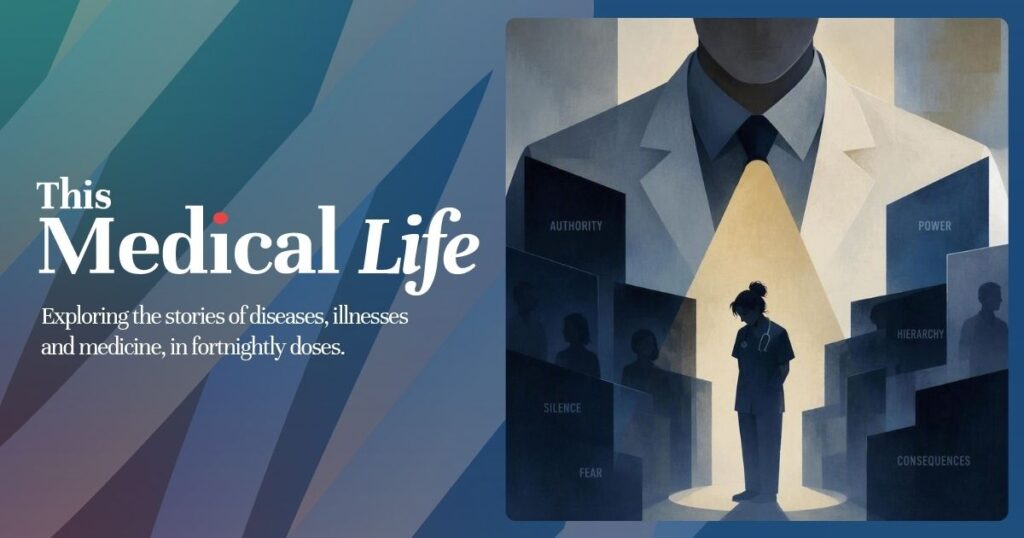
Sexual harassment in medicine is almost universally perpetrated by men, and in over half of doctor-on-doctor cases, it happens in the workplace itself, not at a conference or a staff event. That is one of the findings from a decade of research by Dr Louise Stone, who began this work in 2014 after a young intern disclosed a sexual assault to her in consultation.
Dr Travis Brown speaks with Dr Louise Stone, a professor of general practice with expertise in doctors’ health, sexual safety and professionalism, about what her research uncovered.
Dr Stone identifies two distinct groups of perpetrators: persistent predators who choose careers with access to power, and a smaller group of senior doctors, often isolated by decades of on-call work, who form inappropriate attachments without the same pattern of repeat behaviour. She explains why junior doctors on rotating three-month terms are especially vulnerable, why specialties such as surgery, psychiatry and pathology carry disproportionate risk, and why zero tolerance policies tend to drive the problem underground rather than reduce it. She also sets out what she has found does help: peer intervention from someone at the same level of seniority as the person behaving badly, and giving survivors clarity on what they actually want from a reporting process, whether that is justice, protection of others, or simply healing.
What to listen for: The early warning signs Dr Stone flags for junior doctors and medical students, and why a colleague’s discomfort is worth naming rather than dismissing.
This is the story about sexual harassment in medicine.
Our Special Guest:
Dr Louise Stone is a professor of general practice, previous lead medical educator for GP training in Australia, and author of Sexual Harassment Between Doctors: Healing Medical Cultures Around the World, available from her website: https://www.drlouisestone.com
Listen:
This Medical Life podcast is available on all podcasting services, Apple Podcasts, YouTube, and Spotify. Members of the RACGP are able to log the hours as CPD (Education) that they listen to the episodes under self record via Quick log. We invite you to help support us on our donation page.
Automated Transcript:
This transcript was generated automatically by Descript. I will contain errors and spelling mistakes, but is offered as a guide and resource to help AI and search tools discover the content on behalf of GPs, medical students, other allied health professionals, and the general public.
TML S07E109
Steve Davis: [00:00:00] Welcome to This Medical Life podcast. These are the stories of medicine with Steve Davis and Dr. Travis Brown. This is the story of sexual harassment in medicine
Travis Brown, we normally talk about diseases on This Medical Life, and this time we’re talking about something that’s rather, well somewhat might argue, endemic at a systemic level. What brought this topic of sexual harassment onto the radar?
Dr Travis Brown: This was a article that I wrote, uh, that I read from Dr. Louise Stone.
It was in Insight, and this was talking about sexual harassment in medicine. Uh, and this is something that- [00:01:00] Occasionally crops up in medicine in, in some of the journals, and you just see either some horrific case that’s gone into the, into the courts, into the legal system, then s- it’s caught on and, and society then turns its eye and says, “Well, what’s wrong with medicine?
What’s wrong with…” Something’s happened, a, a junior doctor has been harassed, uh, and y- the, the whole hierarchy comes under the microscope. Uh, and it was one of those ones where Dr Louise Stone, she’s written a book, it’s called Sexual Harassment in Medicine. Now, this has taken over 10 years to write. It’s a worldwide collaboration with colleagues, and it’s looking at sexual harassment specifically in medicine with, with regards to doctors.
Now, this is… When you, when you read through it, it’s predominantly, uh, one of those things that it is perpetrated by males, uh, usually in position of powers, and more often than not, it [00:02:00] targets a, a woman. And usually, uh, either the woman is a, a junior, uh, or even in a position of less power. So this can be s- overseas trained is actually quite a useful example for these people are extra vulnerable because they’re not from that, the country.
Steve Davis: Or they don’t have all the social fabric around them.
Dr Travis Brown: And that’s right. And they’re also usually on sort of some sort of probation where they’re needing to get, y- go through and not cause problems for themselves that get asterisks next to them, and then they might not continue training, as an example, in Australia.
And so when you looked at this, the, the article, like 88% of, of harassment cases is caused by men, and that’s just a, a, a startling statistic. And, and when you’re looking at it, the circumstances are very similar when you read a number of the cases that were brought up, and this is where a man of position of power, uh, has either a, an [00:03:00] underling or a, a subordinate or a junior doctor, and there’s, uh, something of a, an interest, probably a little bit more than interest, and then there’s an invitation to study under them or have tutorships, and then it goes to the point where there’s a, there’s a, an event that the, the, the young woman is taken advantage of, and this makes it uncomfortable for her.
Not just uncomfortable, distressing. Uh, and this causes them to go down a, a, a path that is mental health deterioration, uh, and causes a huge amount of distress.
Steve Davis: And we all lose.
Dr Travis Brown: And that’s right. And then not only the person who has been the recipient has issues with what do I do? Do I, did I bring this on myself?
There’s this guilt. And then if they do, the system, whilst there’s lots of avenues for people to complain to and say this happened, it can sometimes be confusing as to who that is or what happens, and then it can be a really [00:04:00] drawn-out process, making things even worse for the person. Uh, and so the, the amazing thing of these studies is it shows that in 32% of cases of doctors, it’s colleagues, so not just people who are subordinates, and in 54% of the cases, the abuse happens in the workplace.
And so-
Steve Davis: In the w- not, not at a, not at a staff party or-
Dr Travis Brown: No, no, in the workplace. And so It’s just incredible. Now, a lot of discussion these days is talking about, uh, the, the numbers. So predominantly, uh, medicine has been a male-dominated profession. Well, that’s starting to change a bit with, with doctors, uh, and, and the ratios of male to females in medicine going up.
Effectively, a lot of countries like Australia, um, female to male ratio is about 54, 50f- 55%. So the numbers are increasing. North America, it’s a bit over 50%. UK, it’s actually creeping up to [00:05:00] 60%. And if you go to some of the Nordic countries, it’s actually 70%. And you look at Latvia, Estonia, Russia, they’ve got 70 to 74% of women being trained.
The problem is there’s still disparity in the l- medical leadership, and this is because women are much more likely to leave the workforce during their training. Uh, this is because they’re more, much more likely to be carers. Uh, they’re much more likely to have family, have children, and that takes them out of the workforce.
And so you get, again, just more men going into leadership positions, which puts that power disparity happening. ‘
Steve Davis: Cause it is about power.
Dr Travis Brown: Well, it is about power, and this disparity causes problems. But not only that, the interesting ax- aspect of this book is sexual harassment is almost culturally based as well as country based.
And so there are countries where they don’t have so much trouble with this s- sexual harassment, as we’ll go into with, with Dr Louise Stone. But there are some countries where it’s, it’s really bad as regards to [00:06:00] Iran, like is a, is a good example, where women are not actually invited much into the workplace culture.
So even if they do happen to go in there, there’s no safety. If they’re harassed, the society doesn’t really welcome them in, so there is no a- avenue for them to get redressed if there, if there is an issue. So it’s sort of almost a, you know, incentive for them to be, uh, harassed. It’s just… Th- there is one, uh, case in the UK which we will, we will discuss where the actual victim became even under the mandatory, um, reporting laws because her health deteriorated as a result of the complaint.
And so this is, uh, it’s a challenging issue, but it’s one that as doctors, I think is important to discuss and start to really raise the awareness for medical students, for junior doctors, uh, and for just doctors in general is to say, “Well, look, what can be done? Where… [00:07:00] What is our role? What is our role as a colleague?
What is our role as…” You know, listeners will be senior colleagues. Uh, and where do we fit in this whole discussion and how we deal with it?
Steve Davis: Dr. Louise Stone is a professor of general practice with clinical research, teaching, and policy expertise in mental health, doctors’ health, health service design, sexual safety, ethics, and professionalism. She’s been the lead medical educator for GP training in Australia and had policy roles in local, state, and federal governments.
She’s a fellow of the RACGP, ACRRM, and Australian Society of Psychological Medicine. Dr. Stone has appointments at the University of Adelaide, Australian National University, [00:08:00] the University of Melbourne, and practices as a GP in Canberra. Louise is our guest here on this Medical Life podcast. Louise, welcome.
Dr Louise Stone: Thank you. Thank you for having me.
Steve Davis: This has been … Well, this book has taken over a decade, uh- Yes … to, to study and write. What started you on this journey?
Dr Louise Stone: Yes, it feels like a very long time ago, and I guess it was. Um, I think I could probably write you a whole book on how not to write a book, but there you go.
Um, in 2014, I looked after an intern, and the intern in, in, uh, in my room told me about a sexual assault that she had experienced while going to the car park after a night shift from her supervisor And as a GP who’s done mental health work all my life, I’m not unfamiliar with dealing with survivors. But that consultation is one of the hardest I’ve ever done.
And [00:09:00] unusually, I went looking for literature, uh, to see if I could get some ideas about how to go about doing this, and there really wasn’t any. There was a whole lot of minor stories about individual cases, but nobody had actually looked at things in any depth. And so I decided the usual story of a GP, well, someone ought to do it, and I guess it ended up being me.
So I did a qualitative study and interviewed a few survivors, and I realized that context was really important. Now, as a qualitative researcher, context is always really important. But it struck me that a lot of people were coming up, as usual, with simple solutions to complicated problems like, “Well, we just need to make it illegal.”
And I thought, well, making rape illegal hasn’t worked over how many millennia. I doubt that making this illegal is going to make it go away because it’s all hidden. So I decided that seeing as context mattered and stories matter, that it was [00:10:00] my responsibility to go looking. Um, so I went to a conference, a women’s medicine conference in New York, and it troubled me that there were a lot of American women talking, standing up talking about being women of color, but there didn’t seem to be many African and Asian women talking.
They seemed to be sitting and listening a lot, and I thought that wasn’t okay. So I decided someone, again, ought to do something about this and, and here we are. Unfortunately, I, I did the thing of trying to get a whole lot of international authors, and then we had COVID, and some of them had the audacity to do things like go and run obstetrics in Italy.
I thought that was very rude. Yes. And they ran out of time, which is not surprising. So we lost a number of our international authors, and I really had to regroup and do it again once COVID had faded. So that’s probably why it took so long. But it also took a long time for me to put together what needed to be in the [00:11:00] book.
I’m an academic. I’m not a journalist. I didn’t want it to be a book of sad stories. I didn’t want to have outrage, although I did feel outrage. That’s not the point. I wanted to look at why this problem is so hard to solve and why simple solutions like writing new policies or developing new laws or putting together new edicts or putting women in power, why all those solutions still didn’t seem to be working.
Dr Travis Brown: From your research, could you tell us- How common sexual harassment is in medicine?
Dr Louise Stone: That’s such a good question and such a hard answer. One of the things that always happens when I present this is that people find it very difficult to believe because they’re not bad people. It’s because if you try and imagine s- you can imagine sexual harassment, but serious sexual assault in a hospital is very difficult to imagine.
And so people have this cognitive [00:12:00] dissonance where they, you know, rape is supposed to happen in dark alleys, isn’t it? Now we all know it doesn’t, but that’s what people believe. And every time I present, I get the prevalence question, but how common is it? It’s not a bad question. It’s a good question, but it’s almost impossible because again, context comes into play.
Do you mean, uh, what do you mean by sexual harassment? Around the world it’s defined differently. What do you mean by assault? That’s defined differently. Are you talking junior doctors? Are you talking women? Are you talking the whole, um, breadth of medicine which reaches into small community clinics or research labs, or what do you think?
And so we end up with slightly futile numbers of 3% to 80%. Um, if I looked at the most common, it comes out at about a third for women, but it’s more common in women and people who live with marginalizations. I should say I try and keep, [00:13:00] I try and keep gender out of it a bit because the victims are not always women.
The victims are of all genders. Uh, the perpetrators though, are almost universally male But it’s interesting whenever I present that people say, “Oh, you’re just making this a problem about women,” even if I never mention the word woman in a talk. So, uh, the other questions I always get asked if I don’t address them straight up, apart from prevalence where I give them a list of, you know, um, readings to do afterwards, um, is, “Well, I’ve been in this game for 20 years and I’ve never seen it.
Um, do you think the young women just need more resilience training?” And, “Well, if they don’t report, what do you expect?” And they may be phrased a little less harshly than that, but people need to get over those ideas before they’ll really engage with the complexity of the problem. Again, not bad people, st- just struggling to understand that something as horrific as this can actually [00:14:00] happen, and especially with a senior doctor who is held in high regard.
It’s hard to imagine that someone like that could be a risk.
Steve Davis: It’s interesting you mention a, a senior doctor because I’ve often thought that this is, these situations are about power more so- Mm … than about the, the sexual aspect. Which- Of course … leads me to ask then, is medicine better or worse in this area compared to other professions?
Because we do seem to have very clear hierarchies.
Dr Louise Stone: Yes, we do. And no, I don’t think it’s any worse. My position on medicine is that predators will pick positions of power. So we seem to find that there’s two groups in the research done by Rosalind Searle, who’s a professor in Glasgow and one of our editors.
There seems to be two distinct groups. There’s the group that are predators, were always predators. They may have been unconscious predators, but they [00:15:00] were still predators, and they choose medicine, law, politics, all the places y- um, the church it used to be, because they’re going to choose positions where they can predate.
That’s the way it goes. And so medicine, of course, has always been one of those positions. Interestingly, one of the countries we did not include, which was interesting to me, was Egypt. And in Egypt- People who want positions of power don’t choose medicine. So I rang my contact in Egypt and said, you know, my usual spiel about what I was trying to do, and she said, “I don’t think I’ve seen this.”
And she must have heard me roll my eyes, it was a phone call. She said, “No, no, no, no. I’m the head of gender-based violence. If anyone would’ve heard about this, I would’ve heard about this because that’s my job, and I haven’t. How strange.” And so she said, “Give me some time. I’ll go looking.” And she didn’t find a lot, and she came [00:16:00] back and she went, “You know, I think it might be that in Egypt if men want power they go for business, not for medicine.”
Because medicine is almost overwhelmingly, she told me, um, populated by women in power, and so this behavior has moved sideways. But the other thing about medicine is we have this second group, and I think we’re re- a bit responsible for this. We have the, the group that get involved once. Now, we know that with predators it’s a recurrent behavior, and it’s very difficult to stop this sort of recurrent behavior.
It’s almost unremediable. But there’s this other group that sincerely believe, or perhaps sincerely believe, that they’re in love with someone and attach themselves to someone inappropriately, and they are remediable. And I think about them, and I think, well, we [00:17:00] put senior doctors in positions where they have no social life.
A lot of them are divorced. They are almost 24/7 on call in some positions. They are in an awkward social position where everyone looks up to them, but also everyone blames them. When you get into, uh, high-stakes environments like surgery, neurosurgery or obstetrics, you’ll find that when things go really south, when things are very traumatic, everyone will stand back and defer to the senior consultant.
And so the senior consultant carries this. They also carry the responsibility of all of it. They carry usually the responsibility of, of talking to the person and taking the responsibility of wearing the flood when something goes wrong. And we leave them there for 40 years, and without social environments, without social support, [00:18:00] without a lot of humanity, and we wonder why it is that their approach to intimacy might be to choose someone inappropriate.
That group are really sad, and there are significant numbers of them, and they’re often divorced. They might have married early, but the marriage didn’t survive the long hours. And, and we as a community, I don’t mean as a medical community, I mean as a whole community, bear some responsibility for doing that.
And I think that is a point at which we need to, um, intervene because having been a rural GP obstetrician, I know what it’s like to be on 24-hour call, and as a GP it’s not so bad. But I can’t imagine what it’s like to be a consultant who is constantly picking things up when things are going south. I think it would be very hard.
So I think it’s important not to put that group in the same one as the predators. Sorry, that was a [00:19:00] long answer, but that’s sincerely what we know and what we believe. Um, I often get asked, “Well, why don’t we just select the predators out?” And the answer is, well, if they’re smart enough to get into medicine, they’re certainly smart enough to, um, obscure their predatory behavior and to, uh, successfully perform good You know, communication while they’re in training and keep their predation under wraps
Steve Davis: Was there any pressure not to allow this nuance into the book?
Dr Louise Stone: Oh, of course. And w- it’s actually really good that when I look back, it’s good that I’m a GP in Australia because I’m not employed by a hospital, so I’m actually not in a position of any power whatsoever. So it puts me… You know, if I’d been a surgical registrar, I’m sure I would’ve had pressure brought to me.
Um, but being- apart from the fact that really Australia’s pretty good about having open discussions about [00:20:00] things, um, what I have found is a more subtle form of power. So I remember asking for some funding because all of this was self-funded. We funded it through our own blood, sweat, and tears, I suppose, but also through what one of my, uh, authors calls white collar begging.
Um, and eventually we finally got funding through, um, asking over, you know, various forms of social media and those sort of things for donations. But I remember going to a public servant and explaining that I needed some money to meet with the professor in Glasgow and to go to England ’cause I’d been asked to, uh, talk to the equivalent of our AHPRA in England.
And she said, “Well, look, I’m prepared to fund something if it’s gonna come out with something useful. But if it’s not, i- as long as it’s not more whining women just complaining about things.” And so I find, [00:21:00] although I’m not blocked publicly, that concept of, you know, I’ve had good people who’ve questioned whether or not I’m just a bit burned out because I’m angry.
I’m, I’m not… Well, I probably am angry somewhere de- deep down, but I never present angry. I preve- I present very, very straight. And I think it goes back to Sarah Ahmed’s book on complaint, where she says, “If the complaint is unpopular, then the complainer becomes the complaint And I certainly have faced an awful lot of that.
I’ve had to work very, very hard about the way that I present, the way that I write. Um, but no, the book was kept quiet, I think, more than it was opposed, and we took us a long time to find an ed- to find a publisher who would take it on.
Dr Travis Brown: You did put some cases in the book, and if you go through them, there’s actually very similar [00:22:00] circumstances for these- Yeah
these to occur. Can you tell us about the dynamics and the, the situation set up that allows this sexual harassment to occur?
Dr Louise Stone: Yes. So I think it’s, it’s usually a junior doctor, firstly. The biggest risk is in that sort of resident environment. So you’re past your medical student days, um, you’re not at the point where you’re nearly a consultant.
In the middle seems to be the worst risk. And there’s a few things. Um, doctors are essentially itinerant workers. They usually take three-month terms, unless you’re rural. Three-month terms. So you’re constantly a new member of a team, and what that means is you don’t have a solid social structure behind you.
You’re very vulnerable in that space. Um, and I think that’s getting harder. I think the complexity of team relationships is getting harder [00:23:00] And I will say that even I found as a female doctor, you know, you have to get on side with nursing staff more than the male doctors perhaps do. I think that’s very unconscious, but I do think that, um, certain behaviors in male doctors or male learners are tolerated more than female learners, and I’m told that that still persists.
So we’re still the ones who have to bring the morning tea or are expected to be nice or all those, you know, social norms that occur. Do the emotional labor, you know. And I think that puts women doctors particularly in a more vulnerable space in terms of their allies. Nurses have always endured sexual harassment, but they’ve always endured sexual harassment in teams.
They’ve always had others around them. They’ve always had seniors who aren’t the harasser to, um, that they can go talk to. Um, it hasn’t been in any way enough, and it should never [00:24:00] have happened, but it’s more than the junior doctors have. They not only move around teams, they often move around hospitals, and what we have realized is the policies are never consistent.
So when you’re in Bourke, you’ve been out placed to Bourke, let’s say, and, and someone is behaving inappropriately, do you report that to Bourke? Do you report it to your university, to your college, to the police, to, um, the Doctor’s Health Advisory Service, to AHPRA, to, which is our medical board. Where do you, where do you go?
So there are multiple intersecting policies that make reporting very difficult, and it’s easier in many ways just to endure the three months and move on. So there are a lot of things about doctoring, and also medicine chooses compliant type A personalities who haven’t done much often but study. And so their social abilities to tolerate unusual behaviors may not as be as highly developed as a person who [00:25:00] has knocked around in another industry or spent time doing other things.
So I do think it is easy for doctors, and of course not all, but it is very easy for doctors to get to quite a senior level with more rudimentary social skills. Not communication skills. They’re often very good with their communication skills, but, but not with the social skills to manage this To tell someone to back off who’s more senior than them.
I think first year retail assistants learn that very fast. If my daughters are anything to go by, they cope with that quite young, but doctors may not necessarily, and so there’s that side. And also they rely of course, back to your point about career progression, they rely on the hierarchy for career progression.
Um, a lot of our assessment criteria are quite soft, like communication skills or, or ability to work in a team, and those were often in [00:26:00] our experience manipulated. So someone would do very well, but then fail, in inverted commas, their, uh, term because their communication skills or their team building skills were considered poor by the person who was harassing them.
So there’s that complexity as well. They know that it’s a very… Especially if they’re in a small profession, so if they’re in something like neurosurgery for instance, like Caroline Tan was, there’s very few people. It’s a very small world, and it doesn’t take long for the gossip. So it’s very difficult to raise anything in that space and not be tainted in the profession that you choose, and it’s 14 years of training.
So you’re not going to want to, as a GP, I’m, I get it easy, I have 11 years of training, but, but a neurosurgeon it’s 14, and that’s a lot to potentially throw away. So there’s a lot of things keeping women silent.
Dr Travis Brown: You have mentioned a few specialties, and there seems to be a [00:27:00] disproportionate amount of, well, some of the specialties have an increased risk it seems of sexual harassment.
Yes. What departments did you find were actually had disproportionate number of cases?
Dr Louise Stone: Yeah, it surprises me, because I’m told around the world general practice does, and as a person who’s led GP training, I’ve certainly seen plenty of sexual harassment, but not at the degree that I would have expected, which makes me think, am I not seeing it?
But the specialties that are at risk, psychiatry is at risk, and the reason psychiatry is at risk, and remember we’re talking doctor on doctor. Psychiatry is at risk because psychiatrists work in small rooms on their own and have deep discussions over long periods of time, or some of them do. And so the risk of sexual harassment of patients is very high in psychiatry.
Um, I’m sure it’s got something to do with power because I [00:28:00] don’t think you could find a bigger increase in power than surgery and psychiatry, to be honest, because the victim is very vulnerable. So surgery as well, there’s a flamboyantness. There’s a reason a, a surgical place is called a theater. It used to be a theater, you know, and it is a very formalized type interaction, and everyone is gowned, and, you know, people are touched because you stand very close together.
And this is one of the quite confusing things, I think, for students as they’re developing their professional identities, is what is normal in this culture? So for instance, in an area where you might be working in a small space like urology, you’re working very close together It would be very easy to misinterpret touch both ways.
To think, “Oh, well, that’s just goes with the territory. We’re standing really close together. He didn’t mean to, you know, put his bottom [00:29:00] next to my bottom. It just happens that we’re both in a tiny space, and he hasn’t really got an option,” which could very well be true. Um, then again, it might not be true.
And so the escalation can often happen without people being aware because they are saying, “Oh, well, maybe it’s not harassment. Maybe this is just his way.” The same goes for talk. So tearooms, where people start having slightly off conversations or talking about sex. We have to talk about sex. We have to talk about intimate parts of people’s bodies.
Students can really easily get into a position where they think, “Oh, well, that guy’s obsessed with talking about whatever. But he’s a urologist, of course he is.” You know, that sort of thing. So it’s very easy for things to escalate. The other one that was surprised me was one of the people I interviewed who was in pathology, where of course you’re always working in dark rooms.
So I hadn’t thought of that, but of course, um, [00:30:00] with patients it’s mental health, uh, because people are disordered, and aged care, so geriatrics, because people have dementia and are disordered, um, and emergency, because you’ve got people who are on various substances or are dysregulated or are, you know, generally not behaving the way they would normally behave.
They’re the environments that it seems… And psychiatry, uh, doctor-patient relationships.
Dr Travis Brown: You have mentioned that some of the s- strategies that we’ve employed haven’t worked, such as things like the zero tolerance and everything like that. Has any ac- anything actually worked and shown improvement in this area?
Dr Louise Stone: Yeah, it’s gotta be multidisciplinary. So one of the things we saw in England was England has, and I say England, not the UK, because I don’t know whether it reaches into Wales, Scotland, um, is that they had an organization that was sort of [00:31:00] over the top of all the NHS. Now, it’s specific to the NHS because they overlooked training and work.
We don’t have that in Australia, so training is usually managed by the colleges, and then employment is managed by the hospitals or independently by the general practices, and so you have this split. So they were more able to see the whole, you know, beginning to end and see where policies split. I found it very interesting.
We ran a summit- In 2023, and we brought together people from all the disciplines. Took forever. I invited everybody individually because I wanted someone very senior, I wanted someone very junior, and someone who knew their scope. And it was interesting that we went to law, to universities, to, you know, boards, to all the different organizations I could possibly think of, and none of us could really map from the beginning to the end of a [00:32:00] policy.
So at some point we got to the question of, but then what? Then what happens to them? None of them could answer questions like, how long’s it going to take? What’s it going to cost? Will I remain confidential? Um, what, what is the load on me? Those sorts of questions. And so the policies don’t intersect, and I think what we most need is someone or a small group of people over the top of all of this giving advice, because it’s up to the survivor what they want to do.
And in that summit we realized that they had three goals, survivors probably. The first one was obviously justice, that we want to see this person actually have to face what they’re doing, ’cause they won’t be the only person involved. The second one was protecting people who come after me. I don’t want anything for myself, but I wanna make sure that other young women don’t [00:33:00] have to put up with this.
And the third one, of course, is healing, and I just want to get past this and live my life. I don’t feel responsible for this. And so depending on which one of those buckets, if you like, you sit in, depends very much what you want out of the reporting process. It may be that you want therapy, and when we talk to the therapists at the summit, you know, there is a long tail often before people are wanting to report where they have to do their own healing depending on the severity of the trauma.
The people who want to protect people after them, they might be leaning more towards, um, peer groups to doctor’s health groups to more informal advocacy-type organizations. And then the group that want justice, of course, are gonna have to go down that barrel of a very high bar of law. And whether that’s civil or criminal or industrial, you’ve now got several layers in Australia [00:34:00] of places you can go When we went to Argentina, it was interesting because we talked to a woman from Argentina, and Argentina’s medical school is brutal.
I thought ours was bad, but theirs is terrible. They have a, a situation in Argentina where there is a law that says anyone can go to university, and so there’s no entrance into medicine. So they have tens of thousands of people start, but they then have these sudden death exams. It’s a bit like Game of Thrones every six months for nine months, and at the end they put you in rank order on a board and start at the top going, you know, “Dr.
Jones, what job do you want?” And he would say, “Oh, I want pediatrics in wherever.” And so they’d cross that off the list, and when they run out of options, you’ve failed and you go home. And I went, “Oh, okay. The power differential is really big.” But I talked to this Argentinian woman and she went, “Well, one of the issues with us is [00:35:00] Argentinian women travel in packs.
We very rarely are on our own.” And so of course that made her very vulnerable in Australia, where that’s very common that you’re on your own and you’re placed rural. But in Argentina, there is a social connectedness that makes that very, um, powerful. Uh, zero tolerance. People carry their own expectations.
They have to trust the organization in order to report, and a lot of our organizations, dare I say, are not trustworthy. We’ve seen plenty of examples where they’re not trustworthy. And so if you’re an international medical graduate, and you come from a place that, uh, governments are corrupt, there is no way.
And I thought I was doing a good thing, can I say, in general practice doing things like putting Indonesian young doctors with Indonesian supervisors. But then I found out in Indonesia you have a patron, and you have to pay them, and you pick up their washing, and you care for their [00:36:00] children, and you wash their car, and you do all these other sorts of things, and therefore you’re not going to be the person who reports them.
So I think there’s a lot of social things that the zero tolerance policy, I think it just drives it underground. I don’t think it works.
Steve Davis: My goodness. We’re almost about to take a breather, but before we do, Louise, if someone is, is seeking help or advice about a situation they’re dealing with, is there somewhere or someone they can contact to discuss this further?
Dr Louise Stone: Yes. But what I would suggest is that there are plenty of people to talk who will be, who will help you with healing. But there are not so many people who will talk to tell you about structure. Because it’s not just healing. There’s plenty of people who you can ring up who will help you cope with this awful thing that’s happened to you.
But you need to find out what you want out of this [00:37:00] process, and I would just suggest not signing up for whatever you’re told you have to do. So to give you a quick example, in England again, a junior surgeon reported to the GMC, which is our equivalent of AHPRA, and remember as g- as doctors, we’re under mandatory reporting obligations for misconduct.
So she reported, and the process went on, and it became too traumatic for her, and she tried to withdraw and was told, “Well, if you withdraw, you will be held as unprofessional because you’re under mandatory reporting legislation. Of course, if you’re sick, you can withdraw, but then you can’t work.” So there’s no structural reason why that wouldn’t be the case in Australia.
I don’t think it’s happened, but if you’re a survivor, there’s a lot of people telling you the things you should be doing. You should be talking to the hospital. You should be talking [00:38:00] to your college. You should be talking to whoever. But before you do that, I think you need to have a think, and that’s one thing I hope the book does, is there’s a good description there of the various organizations that you can think through, and you can always ring them up and talk about your friend and what the options are for your friend before you decide to disclose.
And I would just be careful on the disclosure point of choosing the right person. By all means, reach out. GPs, we are not part of the system. It’s lovely. I can support you any way you like because I’m not beholden to the hospital. They don’t own me. I’m completely separate. So GPs are very safe. Um, but within other organizations, maybe not so much because they have unconscious biases.
Steve Davis: Were you surprised your book intersected with Joseph Heller’s Catch-22 in parts?
Dr Louise Stone: Yes, I’ve always tried to avoid reading that book because it’s too [00:39:00] depressing. I’ve got through a few chapters and- Yes … but no, because human behavior is human behavior, and bureaucracy is like duct tape, isn’t it? We put another layer of policy on things to duct tape something that leaks, and it just leaks further down, so we duct tape that.
You know, it’s, it never… And I always talk about this thing called, unfortunately, desire lines. You know, when you go, civil engineers will tell you they’ll build a pathway, but the bit of, you know, path that everyone travels is not the concreted bit. There’s always this pathway that goes to the side, and I think you need to really understand the way things really work around here and not necessarily believe the written policy.
Steve Davis: Let’s take a breather and come back and continue with topics like grooming, guilt, and withdrawal
We [00:40:00] continue our discussion now with Dr Louise Stone about sexual harassment in medicine. Louise, reading report after report of cases of sexual harassment and sexual assault, one of the, the common themes that arises is that of victim insecurity, uh, victims blaming themselves, guilt, either imagined or I brought it on myself, uh, withdrawal, and mental health deterioration.
What is the best strategy to combat these?
Dr Louise Stone: Well, I think we’re doing much better in terms of getting things out in the open. I think it was a lot harder 40 years ago than it is now. Mind you, I think things are more subtle. At least when I was young, people were up front. I grew up in an industrial town where people told you that they didn’t want to see a woman doctor ’cause women doctors are useless.
Now, the bias is a lot more hidden, although I wonder with our shift to right [00:41:00] wing whether it’s coming back. Um, but I think, I think one of the things that would be helpful in medicine particularly is for us to spend a little bit more time on the team dynamics and interpersonal interactions. So when I trained, I trained under what was called the Family Medicine Program because it was thought that we as GPs were seeing whole families and that family dynamics were very important.
That’s broken down now and we don’t do that but one thing I learned that we often don’t learn now is a lot more about relationships and sex. And theory is a really useful thing to have in your belt because you can stand back and look at, hang on, what’s really going on here? If you don’t have the words and you don’t have the frameworks, it’s very difficult to deconstruct something that feels uncomfortable The second thing is there’s no time to reflect [00:42:00] in medicine, and I think IT has got a lot to do with that.
I at least, when I was training as an intern, I would have to run down 10 flights of stairs to pick up the photocopy of the blood test results and then run up and write them in the notes. These guys who are training now have no time. They have no break. They have no capacity to reflect, no space to reflect, and that makes it much more difficult for them to try and think through something or discuss with their peers.
And I think the overwork of young doctors has been a perennial problem. Uh, we are getting better at that. I think there’s a lot more said about mental health and so on, but it is still one of these dirty little secrets that people don’t talk about, and I think we do need to talk about discomforts. We doctors get very ashamed when we’re young about things like emotions like disgust.
So [00:43:00] everyone feels disgust, um, and it’s at different things. You know, it might be earwax in… I hated earwax when I was young. I don’t care now, but I did when I was first… You know, it was, it was a thing. Some it’s blood, some it’s the smell of an old man’s toenails. Whatever it is, we feel terribly ashamed of that.
We think we should be able to cope. But of course, it’s just a human response, and you get used to it, and it’s fine. It doesn’t make you a bad person But I think that not deconstructing things that make you uncomfortable, that you may not be proud of, that you feel bad about, that you realize that, you know, I say to medical students, “I know I’m racist,” and they all take a terribly deep breath.
And I go, “Look, you know, I’ve spent my whole life trying to battle the early training I had in the middle of the White Australia policy. Of course I’m racist. It’s bred into my bones. It’s my job to look at it, bring it out to the light of day, set it aside, and work. And it’ll be my [00:44:00] whole life. It’s still there.
I still … I’m sure I’m, I’m sexist too. I’m sure I have assumptions about people on the basis of gender that I’m not proud of.” We have to allow young doctors the space to be able to examine those things, to, to understand that they might be prejudiced against larger bodies, that they might have a instinctive reaction to the way someone talks, that they might make assumptions about someone’s level of intelligence.
Those sorts of things we’re not proud of. We like to think of ourselves as eclectic, but we’re not. And this is another one of those, that maybe I’ve invited this behavior, um, because we tell medical students that they have a lot of power with their communication skills that, you know, they can solve. And we, uh, a- as a trainer and sitting in with people, I was often coming across young women saying, you know, “This bloke exposed himself to me in the consultation room,” and you [00:45:00] know, “and I should have managed it better.”
To which I say, “No, you shouldn’t have. You should’ve got your supervisor and got him out of there, and you’re not responsible for that.” You know? I should say there that it’s not uncommon for, you know, particularly young men if you’re examining them, for them to become aroused, and that’s part of life.
That’s very different to, and that is acceptable because it’s got nothing to do with them. It’s just biology. Um, that’s acceptable. But somebody deliberately, um, pushing against you or asking to be examined or doing something else creepy is not. And learning that boundary for young doctors is really hard.
We need to spend a little bit more time talking about those discomforts, not just pretending that they’re not
Dr Travis Brown: there. There’s, uh, a few warning signs in sexual harassment because it seems to build up to a, uh, a, pretty much a- an encounter. Mm. [00:46:00] Is there anything that, that either junior doctors can know about that is, uh, early warning signs to say, oh, this might become a problem or this might become a situation that I really would like to avoid?
Is there anything that’s a, a useful warning sign?
Dr Louise Stone: Yes. Um, one of the things is being treated as special So we say this about patients, if you can’t stand a patient or you really like them, you’ve got to be very careful. If they remind you of your grandma and you’re really doing special things, then. So when a, a senior starts treating you as special, you should
Now, of course, some seniors will treat you as special because you are special. You might be, um, a very good registrar who they want to, in a good way, mentor. Um, I think it’s, there are certain environments, so conferences, just don’t get drunk at a conference. Like, just don’t. You’re at work. We know you’re at work.
You know, you’ve got plenty of [00:47:00] opportunities to let your hair down. Do it on the last day. Don’t do it when you’re around other people and make yourself vulnerable. So being off-site. Um, when you’re rural, make sure that, um, you know, we had one of our participants in our study who was assaulted after a team dinner.
And it’s really interesting, just on a slight diversion, listening to her story. She taught me so much. We called her Helena. And at the end of this interview, where she pretty much apologized all the way through for, “Oh, well, it wasn’t that bad. You know, he just felt me up. It wasn’t that bad. It wasn’t that bad, and he was drunk.”
And I said, “Well,” this was a registrar on a student or intern, I think. And I said to her, um, at the end, “What if this was your daughter that it happened to? What would you say?” And she said, “Oh, well, it’s wrong. It’s illegal, you know.” “And what about you?” And she took a [00:48:00] breath, looked me straight in the eye and went, “Maybe I should’ve been more professional and not smiled as much.”
So that self-blame, going back to your previous question, is it’s just pervasive. So structurally you need to protect yourself. You are strong. It doesn’t make you weak that you’re going to a car park. However, go to a car park with someone else, or make sure your car is parked somewhere where it’s light. Or I mean, all the protective behaviors unfortunately that we have to implement are still in place even if you’re a doctor.
And the same goes for rural, just make sure that you’re, you know, you’re in a, a place where you’re safe. Because you’re not known. You don’t have the social cachet to surround yourself, and everyone knows you’re gonna be leaving in a few weeks. So if there is a predator, it is going to make, [00:49:00] um, you a particularly good target.
One thing that’s always fraught is predators, sociopaths, psychopaths, those sort of people, are very, very good at reading cues. We humans stay alive because we’re good at social cues. It is not your fault that you have a past history of assault. That does not make you behave badly, but they can read it And as a GP, I can read it.
I don’t, I can’t describe to you how I can read that someone has a past history, but I can read it. So why should someone else not read it? That does not make you wrong or misbehaving or responsible for anything. And certainly being an international medical graduate doesn’t make you responsible, but it does make you more of a target.
Um, as does, we don’t have the data, but we, we expect that being part of the LGBTQIA [00:50:00] community, I’ve got those letters in the wrong order for once in my life. I work in youth mental health, so I always have those letters come off the tongue, but not then. Um, being part of a community that is marginalized will always put you at higher risk.
Dr Travis Brown: From your research, you’ve shown that clearly this is the inst- instigators or the perpetrators are men. Mm-hmm. How do you, you target addressing that, as in talking? Now, certainly one, one segment of the popula- population that you talk about i- not able to manage predators being predators, but the people who will probably find themselves in an unusual situation where they are in a position of power, but may not know they’re about to do something inappropriate.
How do you target that?
Dr Louise Stone: Well, there’s a few methods. I mean, the first one is the old-fashioned guy who doesn’t realize it, that he’s being inappropriate, and there are them. There’s plenty of them. And the one I always think about when I [00:51:00] put in, you know, role plays and that sort of thing, is the old urologist, the crusty old urologist who constantly works with men, and they make sexist jokes all the time ’cause that puts blokes at their ease.
And that sort of guy works in a world of men all day. That’s what he does. Now, if you get a young female in my role play, Malaysian student who’s just arrived in Australia, that’s gonna feel incredibly threatening. And they, but they will often respond, it might take them a while, but they’ll often respond quite well to feedback.
So the first thing is that some blokes are just inappropriate ’cause that’s the world they grew up in, and that’s their manner of communicating with their patients. And often I’ll find that in mining towns or, you know, Broken Hill. I’ve worked in Broken Hill. That’s normal. You know, that’s the way people talk.
But if you’re young and vulnerable, that might not feel safe. So there are different … That’s the easy group [00:52:00] The predators, um, who in a hospital is gonna sack a senior surgeon? Let’s be honest. You can have all the policies in the world, but if you’ve got … I mean, if we look at the John Kearsley case, for instance, which was our first criminal case.
So that case was, um, an amazing radiation oncology registrar, and he invited her to his home. And it made me think because we did that all the time in country practice. We would always have the students and the registrars at our home for a barbecue, for a family barbecue. We’d invite everybody because the only other alternative was the pub.
So, you know, it was normal. I never had, I never thought about it. But he and I probably set up a situation where she thought it was okay for her to go to his home, which was not safe. So, you know, we, we need to think about social stuff. But anyway, he invited h- her to his home, spiked her drink, and she woke up half undressed on his couch, [00:53:00] drove home.
Fortunately, went to a GP. Fortunately, had a friend that got a sample of urine which found that she was drugged, and he was the first criminal conviction that, that came. Uh, mind you, his sentence was truncated. He did, did get jailed, but on appeal they decided that he was depressed and therefore, um, you know, there was a reason for it and he was, he was allowed to go free with his reputation in tatters.
But nevertheless, he was, he was in his 70s, so it wasn’t like his career got limited much But going back to that question of where that started, she, she looked up to him a lot. She came from a culture where she had tremendous respect. And one of the things that’s Dominique, and she’s now written her own book, um, so she’s been part of our book.
She opens our book, but also, um, Dominique Lee, she’s written her own book about this experience. And one of [00:54:00] the things she says is that, you know, she had this ideal of medicine, that she could think of nothing more honorable. And I agree with this. If you dig down too deep, you’ll find I’m an idealist. I love the job.
It’s, it’s such an honor and a privilege to be this part of people’s life. And so we do tend to idolize our bosses when we’re young, and because we want to be that. We want to be that person. He cured people. He wasn’t all bad. And that’s the other thing. People think people are evil or good. He wasn’t, of course.
He was a good man. He did a lot of good and at the same time he was a predator. And he was a, he, he, he was a cancer doctor. He saved people’s lives. He made an enormous difference at the same time, you know? And that moral, that’s what we call moral licensing. People who do a lot of good, um, can easily wallpaper over the harm, and we forgive [00:55:00] them the harm.
We forgive doctors being arrogant. We forgive them being less good communicators than they ought to be because they’re doing a world of good. But we shouldn’t.
Dr Travis Brown: This was a discussion that I never had during my training. Uh, and I was wanting to say probably for, for someone like yourself who’s, who’s gone in and studied this area, if you were in front of either junior doctors, medical students, or even talking to some colleagues, what was something that you would say to, to them to say, “Look, look out for this or be aware of it”?
Is it because these are the people who are vulnerable. What, what could you say to a, a, a group of people who are the people who are probably going to experience at least some of this during their training?
Dr Louise Stone: To be really honest, I would say medicine is full of environments where you feel uncomfortable It might be you feel uncomfortable with a patient, it might be you feel [00:56:00] uncomfortable with your reactions, it might be that you feel uncomfortable with the way medicine occurs.
There are safe people everywhere. Um, there are plenty of safe GPs, there are a lot of doctors health advisory services now, and you can ring them free of charge. And I would talk about that discomfort. If you’re having a discomfort with somebody in the organization, you’ll feel it. It’s not that when I look at the early stages, people knew it was uncomfortable, they just dismissed it because they thought it was their deficiency.
Remember, these are young doctors, they’re learning to examine breasts, they’re learning to examine, uh, talk about intimate things. They feel uncomfortable, and they have to overcome that. They are overcoming discomforts all day. So we have to recognize that this is yet another [00:57:00] one. They’re still developing their professional identities, and they need space to process stuff that feels uncomfortable.
But you can’t learn if you don’t reflect, and so there are good people. The other thing I would say is that with the hardened, awful people, the predators, um, it’s not up to you as a medical student to expose them. You know, you can’t. You do not have the power. One of the, one of the things I’ve noticed is the power, for instance, of anesthetists.
There’s been a number of cases where anesthetics registrars or anesthetics consultants have drawn aside the person and gone, “Are you okay? That didn’t seem fair to me. Like, I thought he, he spoke to you really harshly. How are you doing?” That’s so important because the anesthetist can talk to the surgeon because they’re on their level, and they’ve got the same degree of power.
And so don’t forget the good guys, you know, the [00:58:00] fatherly physicians. They’re, they’re out there. There’s a lot of them. You know, men are appalled at this behavior, and there’s plenty of men who have been, and a lot of them are in the book, who’ve been extraordinary mentors and have worked very, very hard. I remember presenting at an obstetrics conference and about this, and this I think it was a GP obstetrician stood up and said, “Well, in Scandinavia we’re told that you should never touch a woman where their underwear goes.
What do you say about that?” To which I thought, “Well, that’s a bit silly when you’re a gynecologist, but let’s keep going.” And I was still trying to formulate my thoughts, and the president of the college stood up and went, “We are a college for women. We are not going to have this behavior. It is our responsibility.”
And I just, I was so grateful to him. He was amazing. So there’s always the good guys. Find a good guy and find out, is this normal or is this not [00:59:00] normal? You know? And I think, I think that’s where we need to work because I think we need to have some emeritus people who can go and visit Mr. Jones, the eminent neurosurgeon, and tell him to pull his head in, and there’s no way a student’s gonna do that.
It’s got to… Or a manager of a hospital, to be honest. It’s gotta be a peer. Because the only thing that’ll hit them hard, I think, is reputation Or law, but law is almost impossible. It is so hard. Dominique did an amazing job, and the only reason she got it through was because she had objective evidence, and that’s rare
Steve Davis: Louise, the thoroughness of this book, the balance, the nuance.
Um, one of my daughters who’s 18 has a friend, gung ho, heading down the medical path. I’ll be buying a copy of this book for her. I, I feel like- … that just as we get certain vaccinations before we go overseas, I think this is a wonderful [01:00:00] inoculation for anyone young heading down that pathway, and I’d feel remiss if I didn’t do that.
So thank you. In closing, do you have any final advice, final thoughts regarding sexual harassment in, in medicine, uh, for doctors, for other healthcare professionals, even for victims themselves?
Dr Louise Stone: Yes. The first thing I’d say is there’s a reason I wrote on medicine only. A lot of people challenged me on that.
Why didn’t you look at health professionals? And the reason I did medicine only is because it’s a deep dive in a shallow field, and the solutions that work for nurses won’t work for doctors, or lawyers won’t work for doctors. Yeah? And also, if medicine can’t fix it, who can? We’ve got the psychiatrists, we’ve got the occupational physicians who are good at returning to work.
We’ve got the GPs who have a holistic… We should be good at this. The other thing to say is it’s not simple. A lot of people will say it’s simple. It’s [01:01:00] not. We chose to structure the book with a introductory sort of history of various things, and then we have a whole section in section two where we get law.
Why doesn’t law fix it? Medical education. Why doesn’t medical education fix it? You know, uh, regulation. Why doesn’t regulation fix it? So it’s not simple. Seeing it as simple makes you vulnerable. We are used in medicine to deal with complex issues. This is a complex thing. We then looked at, you know, different countries, and each country deals with it differently.
And so we can look at those countries and go, “Okay, why is it that it behaves like this in Japan?” In Japan, you got a 5%, they didn’t know this until recently, a 5% handicap on your scores in entrance if you were a woman, because you had an unfair advantage because of your communication skills Which is extraordinary, and the average age of leaving medicine is 31 in Japan.
[01:02:00] So I didn’t expect that. So firstly, it isn’t simple. It’s not that you don’t understand it. It’s not simple. Human life is not simple. The second thing is it is not your fault. You are not responsible for inviting behavior. And in medicine we can get deluded about that because we’re taught all the time how to communicate so that we calm people down, so that they understand, so that they are able to make good choices.
It feels like we’re saying you can help people feel a certain thing or do a certain thing, and therefore we can feel we’re responsible when they don’t People still have choice. And I guess the last thing I would say is you’re absolutely not alone. Humans are humans. I don’t think this is ever gonna go away, ’cause humans are humans.
We haven’t solved murder. We haven’t solved rape. We haven’t solved, you know, any form of crime. [01:03:00] We’ve managed them. We haven’t solved it. I think the idea that it’s all gonna disappear is such a myth. Humans are humans. They will behave in human ways, and some of those are awful. And you will, will be exposed to the worst of humanity in medicine.
That just goes with the territory. So that is a form of learning in the same way that learning how to examine a knee is a form of learning, and we need to see it that way, not as a fault in you that you don’t inherently understand it. I think of it like tax, you know. I’ve always felt guilty that I don’t understand tax.
Well, I never learned how to understand tax. Took me years to go, “Hang on, it’s something I don’t know. It’s not something I’m inherently deficient in. I just haven’t learned how to do this. Now I need to learn.” Same deal. Communication is a behavior. It can be learned. It can be understood. It’s a life’s work.
It’s not easy. But you can find [01:04:00] ways of working around this. Um, you just need to stop assuming that you have the power to change a predator, ’cause the, the only thing … And Dominique puts it best. It might not have been Dominique. Someone did in the Surviving in Scrubs website, said, “There is nothing you can do or be or wear that will stop you being a victim.
The only thing that makes you a victim is being in front of an unchecked predator.” It’s not my fault I was crossing the road when the truck hit me, you know. I was just there. So think of that, and then go and ask for help.
Steve Davis: We noted the intersection with Joseph Heller’s Catch-22 at the end of last section.
You branching that mythological depth of the humanness of it all. I’m reading the Iliad at the moment- Yes … by Homer, and you definitely do hit the nail on the head. This has [01:05:00] been part and parcel of the human condition, but it doesn’t mean we sit with how it is. Yes. The, the book is Sexual Harassment Between Doctors: Healing Medical Cultures Around the World.
Dr. Louise Stone, thank you for being part of This Medical Life.
Dr Louise Stone: You’re most welcome
Steve Davis: This Medical Life is recorded in the Talked About Marketing Studios in Adelaide. For show notes and more information about the podcast, visit thismedicalife.com.au. You can contact the hosts on social media. Dr. Travis Brown can be found on X. His username is @drtravisbrown, that’s D-R Travis Brown. And Steve Davis can be found on LinkedIn.
Go to linkedin.com/in/therealstevedavis. [01:06:00] This has been a Pathnotes Proprietary Limited production