
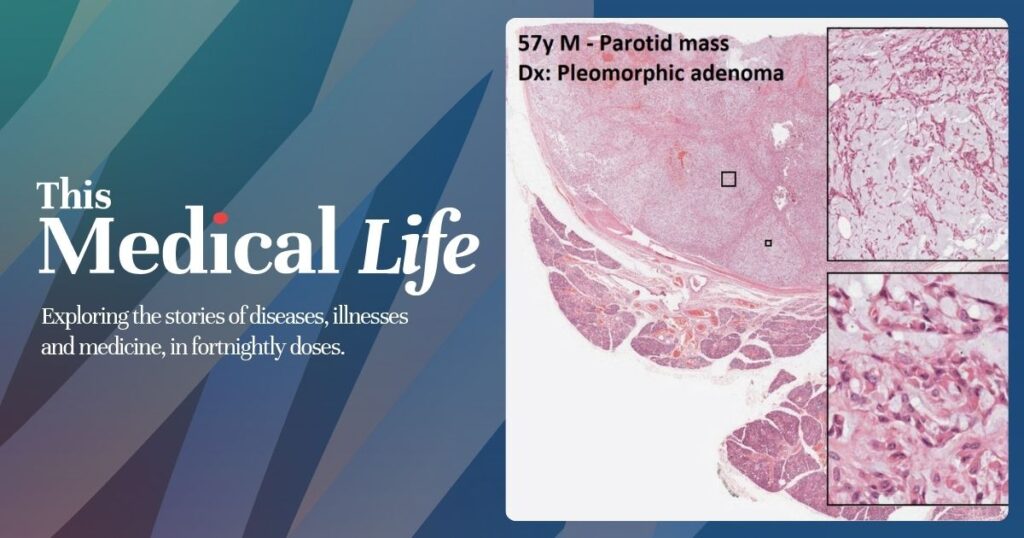
Pleomorphic adenoma is the most common parotid gland tumour. It is benign, usually presents as a painless, slow-growing lump near the jaw, and was first described by surgeon Theodor Billroth in 1859. In Episode 112, ENT surgeon Dr Rowan Valentine explains how it is assessed and managed.
Meet the mixed tumour. In 1859, German-born Austrian surgeon Theodor Billroth gave the first medical description of a slow-growing, painless, encapsulated tumour that occurs mainly in the parotid gland, beside the jaw. Under the microscope it showed a mix of tissue types, so he called it a “mixed tumour”. Today we know it as a pleomorphic adenoma.
Billroth also performed the first laryngectomy and the first successful partial gastrectomy for gastric cancer, and he was a friend of the composer Johannes Brahms. Dr Travis Brown tells his story at the start of the episode.
Jaw lumps raise worry. Dr Valentine walks through what he asks, what he examines, and what he recommends when a patient presents with a parotid lump.
- History: how long the lump has been there, whether it hurts, whether it changes in size, and whether the patient has noticed any weakness of the face.
- Examination: mobility of the lump, the overlying skin, tenderness, sensation near the ear, and the function of each branch of the facial nerve.
- Red flags: pain, skin involvement, a history of skin cancer excisions on the head and neck, and facial nerve paralysis.
- Biopsy limits: in Dr Valentine’s words, fine needle aspirates and core biopsies have about 90% accuracy in separating benign from cancerous lumps.
- Surgery: what the operation involves, how the facial nerve is protected, and the risks Dr Valentine quotes to patients.
- Follow-up: why recurrence can follow if the capsule of the tumour is breached, and how that shapes surveillance.
Long-standing lumps are easy to set aside. Dr Valentine explains why a lump that has been present for years still deserves a plan, and his closing advice for doctors is that a parotid lump is cancerous until proven otherwise. The episode introduces you to the questions, examination findings and red flags an ENT surgeon looks for, so you can feel more prepared for the patient who says, “I’ve had this for years.”
This is the story of pleomorphic adenomas.
Our Special Guest:
Dr Rowan Valentine is an adult and paediatric ear, nose and throat (ENT) surgeon. He trained in Adelaide, completed a PhD during his surgical training, and spent a year at the University of Florida on an anatomy fellowship. He supervises surgical trainees and medical students, and he is a regular guest on This Medical Life.
Listen:
This Medical Life podcast is available on all podcasting services, Apple Podcasts, YouTube, and Spotify. Members of the RACGP are able to log the hours as CPD (Education) that they listen to the episodes under self record via Quick log. We invite you to help support us on our donation page.
Automated Transcript:
This transcript was generated automatically by Descript. I will contain errors and spelling mistakes, but is offered as a guide and resource to help AI and search tools discover the content on behalf of GPs, medical students, other allied health professionals, and the general public.
TML S07E112
Steve Davis: [00:00:00] Welcome to This Medical Life podcast. These are the stories of medicine with Steve Davis and Dr. Travis Brown. This is the story of pleomorphic adenoma
Dr. Travis Brown, in all our years of doing this medical life, I don’t think we’ve ever talked about a disease or a condition that I hadn’t at least heard of. I’ve never heard of pleomorphic adenoma
Dr Travis Brown: This one goes by a few names. Uh, pleomorphic adenoma or mixed tumor is sometimes used. But look, it’s not something that you will have encountered unless you actually have one yourself or, uh, someone you know has this.
Now, they’re actually [00:01:00] quite common. These are jaw or salivary lumps. Uh, and they’re… Look, they’re benign, uh, and mostly co- occur in the parotid gland, so just on the outside of your jaw. Uh, and this is, uh, something that, look, it is pretty common. Doctors will come across this, uh, with patients who are, yeah, often between the ages of 30 and 60, and they will have…
patients will just present with this painless, maybe slow-growing lump, just that’s, that’s occurring on the side of their jaw.
Steve Davis: So if it’s benign, painless Why do we focus on it?
Dr Travis Brown: Well, and th-this is because it is benign, but it is also a lump. So people get very worried about lumps, particularly in the neck area.
And so it’s not only just in the parotid on the side of the jaw, but it can also occur under the chin in some of the major and minor salivary glands. And so these are lumps, and people get very worried about lumps. Now, it’s benign, but it’s known to [00:02:00] be benign when we actually look under the microscope.
And the clinical presentation’s quite classical, which we will talk about today with our, with our guest. But look, the first description of this actually comes from the 19th century. So this is from Theodor Billroth, who was a German-born Austrian surgeon. Now, he was quite a remarkable person. He actually was a
Being the surgeon, he did end up first doing the first, uh, esophagectomy, so removing part of the esophagus of someone, first laryngectomy, removing larynx for throat cancer, and also he was the first to do successful partial gastrectomy on a patient who had gastric cancer. And we now actually have a procedure that’s called the Billroth procedure.
Steve Davis: When was, when he, when was he doing this?
Dr Travis Brown: In, in the 19th century, so 18- 1800s, 1850s, 1860s. And so this is a remarkable person, and not only that, he was a talented pianist and, um, a- and played the violin. And- And all surgeons. And so he was [00:03:00] friends with Johannes Brahms, which is a composer, and they ended up compos- like being involved in the music scene.
And so the, the really, one of the really interesting things, and one day if I ever get a chance to read an interpretive version, he ended up starting writing an essay called Who is Musical? And he thought you could apply scientific methods to find out if someone had musical talent. And so he had quite an interesting perspective on the play between science and music.
Steve Davis: It is one of the superficial judgments of our time to see science and art as opposites. Imagination is the mother of both.
Dr Travis Brown: This is a remarkable person if, if you’re looking at what his, he has been able to achieve. And he ended up writing also an article, it was in 1859, where we have these observations of tumors of the salivary glands, where he describes this slow-growing, painless tumor that was encapsulated.
Sometimes it [00:04:00] was ha- uh, it was hard, and sometimes it was soft. A- and, and even under the microscope, this was actually quite a difficult … It was a very challenging, uh, tumor to look at because it had, could have cysts and tubules, epithelium. It could be, have stroma, such as cartilaginous areas and myxoid and myoepithelial cells.
And so it could look really different even though it sort of presented the same things in, in, in different patients. And so that’s why I ended up calling it the mixed tumor Because the way it looked could be very, very different, which again is why we give it the name pleomorphic adenoma. So it is a varied appearance tumor.
It is an adenoma, so it is benign. And so what we know today is patients generally present between the ages of 30 and 60. It’s more common in women than it is in men. Uh, and it is benign, but it can cause some weakness in the facial nerve. And [00:05:00] so m- 85% of them ca- occur in the parotid, about 10% in the, the salivary gland, and about 5% in submandibular.
So it is the most common salivary gland, and this is where it’s, it’s just really good to revisit and actually say, “Here’s how we manage it,” or, “Here’s how it presents.” And so that’s why we’re, we’re going to discuss it today with, with, with Rowan.
Steve Davis: If you were a patient in the 1800s who presented with one of these and you got a doctor who understood it was benign, you would have to buy a lottery ticket.
Because I imagine back then, without the pathologists of the world, how would they know? Wouldn’t the initial reaction be, “This looks dangerous. Get it out”?
Dr Travis Brown: Well, and, and that’s the thing. The, the main thing is he was a remarkable surgeon. And not only that, he was– he’d noted that this was, uh, something when they cut it out, if it wasn’t fully cut out, it would, it would commonly recur, but it rarely metastasized.
So this would’ve been reliant on the surgeon’s [00:06:00] clinical skills and expertise to know, uh, this is what it is.
Steve Davis: Dr. Rohan Valentine is a pediatric and adult ear, nose and throat surgeon who studied and trained in Adelaide. During his surgical training, he completed his PhD and spent a year at the University of Florida undertaking an anatomy fellowship. Rohan supervises surgical trainees and medical students, and has a passion for working in rural areas.
He loves antique cars, and patients may see his 1965 Kombi or his 1939 Packard parked outside of his rooms or in the hospital car park. And Rohan is a regular guest here on this Medical Life podcast. Welcome back.
Dr Rowan Valentine: Thank you very much for having me.
Steve Davis: And Rohan, you’re recording in one of your vehicles. Is, is it either of [00:07:00] those that you’re in at the moment?
Dr Rowan Valentine: No, unfortunately it’s a very boring, uh, vehicle. It’s nothing exciting at all.
Steve Davis: Okay. Well, let’s turn to pleomorphic adenoma. How common are jaw lumps?
Dr Rowan Valentine: That’s excellent. So jaw lumps or, uh, pleomorphic adenomas or parotid tu- uh, tumors are not that common. Um, certainly as an ENT surgeon, however, they’re something that we would see, you know, several times a week.
Um, but as a general population, they’re not common. So many patients won’t know of anybody, uh, in their family or friendship circles that ever had one of these. Um, so yeah, they’re relatively rare.
Dr Travis Brown: What are the important questions you ask about w- about patients when they come to see you about these?
Dr Rowan Valentine: The important questions in regards to parotid lumps really defines around how long they’ve had them, um, how do they notice it.
Um, that’s, you know, often that’s quite [00:08:00] variable because patients have often had these for a very long time. Um, often patients have had them for such a long time that they’re actually not concerned by it. You know, they’re like, “Oh no, I’ve had that for years.” Uh, that’s a really common story, but that can also, uh, be a problem as well.
Um, the other questions that’s really important is things like, is it, does it hurt? Um, is it, does it ever get inflamed? Uh, is it getting bigger or does it ch- fluctuate in its size? Um, and the other important thing is, uh, does it affect the nerve to your face? So have you noticed any paralysis of the nerve to your face?
‘Cause we need to remember that the facial nerve runs straight through the parotid gland. So, so lumps that are involving the parotid gland can sometimes affect the function of the facial nerve. So that’s another really important, um, question. Now, nine times out of 10, the answers to these questions are typically, no, it’s not growing.
It hasn’t really [00:09:00] changed in its size. It’s not really painful. Um, but we’ve had this lump for a really long time, for as long as I can remember, is often a very common situation. And in those situations, most of the time these parotid lumps are due to something called a pleomorphic adenoma Um, which I’m sure we’ll get into a little bit later, but essentially it’s, it’s a benign lump, um, which means it’s non-cancerous.
But these pleomorphic adenomas do have a risk of becoming cancerous over a really long period of time. So, um, that reassuring feature of, “I’ve had that lump for many, many years, it’s not a bother.” Uh, well, one day in that patient’s lifespan, it may become a bother. So it’s really important that, uh, that, you know, we sort of get that information out there to the community.
Dr Travis Brown: When you’re seeing someone who has a jaw lump, what’s [00:10:00] your differential diagnosis?
Dr Rowan Valentine: So differential diagnosis for these lumps are either, you know, benign or malignant. So benign meaning non-cancerous and malignant meaning a cancer. Um, now 80% of parotid lumps are benign. So the odds are it’s benign and the most common benign lump is a pleomorphic adenoma, as we mentioned.
But there’s a lot of other ones such as a, a Warthin’s tumor, which sounds scary, but that’s actually just, you know, a very much a benign, um, like a, like a lymph node essentially. Um, uh, and it could be things like an abscess formation or a collection of saliva in the parotid gland. These are all other benign sort of pathologies.
But there is that 20% risk of becoming, of, of it being a cancer. So, and in Australia, one of the biggest issues that we have is skin cancer and skin cancer, uh, [00:11:00] in the head and neck can spread to a lymph node within the parotid gland. So that’s always in the back of our mind and always a concern. So, um, I think in my mind when I approach a parotid lump, I, I’m a bit of a, maybe, maybe I’m a negative Nelly, but, uh, I always think cancer and I always think I’ve gotta prove that this lump is not cancerous Um, so that’s sort of how I approach, approach these sorts of pathologies.
Steve Davis: Rowan, you might call yourself a negative Nancy, but in our introduction, Dr. Travis Brown was talking, using the word benign quite a lot, which initially gave me great comfort, and I’d much rather hear it from you and get the real oil. Love
Dr Travis Brown: it. Well, you see, the problem is you, you say they’re rare. Every, every pathologist’s slide set has a pleomorphic adenoma, so I’m looking at it going, “Wow, these are really common.”
But, uh- … you know, [00:12:00] when, when you’re actually looking at someone that you think have a pleomorphic adenoma, so a, a l- neck lump or a jaw lump, if, if they’re sitting in front of a general practitioner and they say, “I’ve had this forever,” when is the appropriate time for them to see an ENT surgeon?
Dr Rowan Valentine: Straight away.
Straight away. So, um, a, a parotid lump needs to be investigated, um, with biopsies, uh, scans to work out the nature of it, and then a parotid lump needs to be removed. So there’s a good reason for that. So, um, fine needle aspirate cytologies or core biopsies are inaccurate. Uh, so they, they have about a 90% accuracy at deciding whether that lump is benign or whether that lump is cancerous.
A 90% accuracy. But what that also means is there’s a [00:13:00] 10% inaccuracy. 10% of the time we’re calling something benign based on a biopsy result when it’s actually cancerous. And the reason for that, as, um, Travis, you would know, is sometimes it can be really tricky with fine needle aspirates or core biopsies to be 100% sure as to whether something’s benign or whether something’s malignant.
Um, so in general principles, we reme- recommend that all parotid lumps are essentially removed if the patient is fit to have an anesthetic. Now, not all our patients will be fit for that. Um, but that’s in general principles what, what we recommend.
Dr Travis Brown: Are there any clinical notes that are useful when someone say, when someone sends a patient to see you?
Dr Rowan Valentine: I was thinking about this this morning and, you know, when you’re a registrar and you’re a junior doctor and you’re learning about these things, you got in your mind, I’ve got to look for [00:14:00] that, I’ve got to look for that, I’ve got to look for that. Now when you’re been doing it for a number of years, it’s something that sort of becomes more innate, you know?
And really what I’m doing is I’m looking at this lump and thinking, okay, can I, do I need to worry about this lump or is this one of those benign things that needs to come out at some point, but not urgently? And so the things that I’m looking for essentially is mobility of the lump. So you get your fingers around it and you’re wiggling it and you’re wobbling it and seeing is that mobile?
And often these things are mobile, particularly if it’s benign, um, because that lump is not invading the tissue of the parotid gland or surrounding structures. So it’ll wiggle and wobble about. So that’s always a, I love doing that. It gives me a lot of reassurance. I’m like, oh yeah, this, this should be pretty easy, this one to take out.
Um, the other thing is I’m looking at the overlying skin. So sometimes the overlying skin might be [00:15:00] invaded by this growth. An invasion of skin is a feature of something cancerous rather than something benign. So I’m w- I’m sort of seeing if the skin will roll over the top of it. Uh, the other thing is tenderness.
A, a tender lump, um, is sometimes concerning for cancer. It’s not always though, because some of these benign parotid lumps will get an infection, and then they will be tender from that. So it’s not a, it’s not a hard and fast rule, but it is sort of a slightly worrying feature. Um, and the other, the last thing…
Oh, there’s two other things really. One is sensation. So does the patient have normal sensation of the skin overlying the lump, and particularly, uh, the skin of the lower part of the ear, because there’s a nerve in that area called, um, the greater auricular nerve. Uh, and sometimes if that’s invaded by cancer, then the nerve will be [00:16:00] numb.
It won’t work. So there’ll be numbness to the skin. So that’s another feature. Um, and lastly, I’m interested in the facial nerve. So I’m interested in whether all the branches of the nerves of the face are working. Um, because if there’s, um, a paralysis of, of one or more branches of the nerve to the face, then that is definitely concerning for cancer
Dr Travis Brown: Is there any common questions patients ask you when they’re seeing you?
Dr Rowan Valentine: Most of the time patients are just surprised. You know, they, they come in with what appears like a very, you know, benign thing. They’ve had it for a long time, and they’re like, “Really? I, I, I’ve gotta take this seriously? You, you mean it’s gotta come out?” Um, so most patients are just surprised. Um, patients don’t typically, uh, they don’t really ask too many questions until we’re going into the realm of surgery.
Surgery is something that a lot of patients are queued into, often because they might have been told by their GP, “Oh look, [00:17:00] uh, you know, well, we wouldn’t, we wouldn’t take that out because of the risk to the facial nerve and, and, uh, you know, the biopsy results says it’s benign. So, you know, let’s, uh, let’s just leave it.”
As you’ve, as you’ve already heard me say, um, you know, sometimes these benign tumors become cancerous. So when I’m going through the surgery with patients, um, I typically talk about what the surgery involves, which is, uh, excising that lump. Uh, it involves finding the nerve to their face and protecting that nerve to their face when we’re taking that lump out.
Um, and I always discuss the risk of damage to the nerve to the face, and that risk is actually quite low. So the risk of damage to someone’s facial nerve permanently is about 1%, which means there’s a 99% chance that, that we’re not gonna do that. Um, so that, I think, gives patients reassurance that, yes, we’re aware of a risk, [00:18:00] but that risk is small.
The risk of temporarily damaging the nerve to their face is higher than that, probably somewhere around about the 20 to 30% chance. And what that means is that there’s a temporary, um, paralysis to the nerve that will recover, and that recovery ranges from a couple of weeks to even as much as six months later.
So in its worst variety, you might look like you’ve had a stroke, but that’s ins- that’s super rare. It’s very unlikely to have all the branches of your nerve to your face not working after an operation like this. Often it’s just a little branch to the lower lip that may not work for, you know, a few weeks.
So, um, but I always emphasize back to the patient, don’t worry about the risk of temporary damage to the nerve to the face. That’s not a problem because it recovers. It, just focus on that 1%. It’s just a 1% chance of permanent damage and a 99% chance that’s not gonna happen.
Steve Davis: [00:19:00] Rohan, I know we’re recording this for GPs, but for any patients who are listening, like me, what does that nerve look like?
Is it a piece of cotton or it’s a little… What does it look like? Just briefly.
Dr Rowan Valentine: Well, it actually, yeah, the, the facial nerve is actually more of a white structure, and it’s about probably- Four millimeters in its diameter, um, as it comes out, um, from, uh, from the ear, um, as it enters the parotid gland, and then it branches into a number of branches.
Now, the textbooks say five branches, but actually it’s usually many more. You know, maybe seven, eight, or nine, and then they become really, really small. But I actually use magnification when I’m operating on someone’s parotid to be able to see it more clearly
Dr Travis Brown: Now, are there any red flags that says to you this needs urgent attention, urgent assessment?
Dr Rowan Valentine: The red flags would [00:20:00] be that pain, involvement of the skin, uh, a patient that’s had a history of skin cancer excisions in the area, particularly in the head and neck. Um, they’re probably the… and, and facial nerve paralysis. They are absolutely the red flags that we need urgent attention to that. So, you know, and when I mean urgent, I’d like to have all the workup done with the, the core biopsies, um, subsequent scans, MRIs, and things done within about a fortnight period.
Um, particularly if that facial nerve’s involved because if that facial nerve’s, um, got a paralysis, we know that tumor’s advanced. We know that tumor, uh, you know, is, is aggressive. So yeah, they’re definitely the, the red flags.
Dr Travis Brown: Do you get many that present with rapid growth that come, that come along?
Dr Rowan Valentine: Yeah, yeah, we do actually.
Um, so that, and certainly in the last few weeks in the patients I’ve treated, they’ve both had that rapid [00:21:00] growth. Often that’s ha- occurred because they’re, in particularly in those patients, they were on medication to treat other body conditions like, um, Crohn’s disease, um, or, you know, that, this other patient was a, uh, a renal transplant patient.
So they’re on medication that affects their immune system because of those conditions. And if your immune system’s affected and you’ve got an active cancer, then, um, then these tumors can progress quite rapidly because the patient’s immune system isn’t keeping that cancer in check.
Dr Travis Brown: Just going back to just the benign conditions, is there an easy way to distinguish between something like a pleomorphic adenoma and Warthin’s tumor that you…
short of taking it out?
Dr Rowan Valentine: There are some… The, I suppose the answer to that is no, not really. But there are some reassuring features. So Warthin’s tumors typically occur in older men who smoke. Um, we don’t actually know the reason for that, but, [00:22:00] uh, it’s certain a very common thing. So if you’ve got an older male who’s smoker and you’ve got a mobile parotid lump that fluctuates in its size, sometimes it gets a bit tender, um, it gets bigger and smaller, bigger and smaller, it’s been there for a long time, then that’s probably pretty classic for a Warthin’s tumor.
Whereas a pleomorphic adenoma, you know, can affect anyone essentially.
Steve Davis: Rowan, let’s pause for just a couple of seconds, and then we’ll come back and focus specifically on pleomorphic adenomas. And in the meantime, Travis, can you just check my
Dr Rowan Valentine: jaw?
Steve Davis: We continue our discussion now with Dr. Rohan Valentine, focusing in this part specifically on pleomorphic adenomas. Now, let’s just resolve this once and for all. How common are they? ‘Cause in the [00:23:00] introduction, Travis said quite common, and, uh, not, not c- no, you said common. I said common. And you said not overly common, Rohan.
Dr Rowan Valentine: So pleomorphic adenomas are the most common parotid tumor So I think it would be fair that, so I think Travis and I are both correct.
Okay.
So remember, Travis doesn’t see all the patients that come in with other things. What he’s seeing is all of the parotid lumps on his table As, uh, you know, as a histopathologist.
So, so for him, he’s like, “Yeah, most of these parotid lumps are pleomorphic adenomas,” and he’s correct. He’s correct. But back to that population level, most patients don’t have a relative or friend that’s ever had a parotid lump, so they’re, they’re still, still a uncommon pathology, uh, i- if that makes sense.
But once they get to the, to the pathologist, a pleomorphic adenoma is very common.
Dr Travis Brown: [00:24:00] So you have mentioned a number of the complications and risks of surgeries. Uh, what’s the recovery like for these patients?
Dr Rowan Valentine: Yeah, recovery’s actually pretty good. Um, the surgery’s not typically very painful, so, um, so which is obviously nice for the patient.
Um, we generally leave a drain in that area for typically one to two nights, um, because a- as we’re cutting through the parotid gland, you’re actually cutting through little ducts that, that have saliva in them. And so if we don’t have a drain in for a couple of days, then, um, as the patient’s having their meal in hospital or, or at home, their, their parotid gland’s still producing saliva, and that saliva can collect underneath the skin.
So I typically use a drain for about two nights just to drain that away and to stop saliva collecting underneath the skin. So, um, that’s, that’s probably the biggest, uh, the biggest imposition for patients, having to stay in the hospital for two nights. Um, but then the drain comes [00:25:00] out, and the wounds typically heal up really well.
Um, so the, the, the, the scar is just very much in front of the ear and down below the earlobe, so it’s often barely appreciable, um, which is great. Um, and patients usually might have about a week off of work, and they’re back at work the next week. So it’s actually pretty straightforward surgery, um, thankfully.
Dr Travis Brown: How common are recurrences, or is there any indication that you’ll get a recurrence?
Dr Rowan Valentine: Yeah, so a recurrence, particularly in regards to pleomorphic adenoma, can occur. They’re not, that’s not common. Um, uh, when it occurs, i- there’s usually some risk factors, like it’s been spilled in the operation. So a pleomorphic adenoma has, like, a pseudocapsule or basically s- a, a, a wrapper around the outside, and you don’t wanna breach that.
And if you do, you might accidentally seed little cells in the wound, and then there’s the risk that two, three, four, five years down the line, you [00:26:00] might get, go from having one pleomorphic adenoma to, you know, having five little ones in the wound. So, um, so if- If we’re in the unlucky situation where we’ve breached the capsule during the operation, um, and we’ve washed the wound out and tried to be really diligent to make sure there’s no seeds that are left behind in that wound, I will still follow that patient up for about five years with serial scanning to make sure it doesn’t reoccur.
However, if we haven’t breached that capsule and a pathologist like Travis says, “Oh, Rohan Valentine, you’ve done a good job. The h- all of this tumor is out,” then there’s no need for, for further follow-up for that patient once they’ve healed up. So, so generally you know what… You know when the patient’s at risk of recurrence.
Dr Travis Brown: Is there any difference in behavior from pleomorphic adenomas from parotid to the salivary glands, like the main or, major or minor? Do they behave any different or the same?
Dr Rowan Valentine: Th- so that’s a great question. So [00:27:00] as a group, um, saliva tumors can be benign or malignant. Now, if you have a tumor in your parotid gland, 80% of those are benign and 20% are malignant.
In the submandibular gland, which is the gland pretty close to the parotid gland, um, about 50% of tumors of the submandibular gland are cancerous and 50% are benign. And then if we go to more the minor salivary gland tumors, um, about 80% of those are malignant and 20% are benign. So it does, the, the rates change as you move from parotid tumors to submandibular tumors to minor salivary gland tumors, so with the increasing frequency of cancer as you move along.
Dr Travis Brown: Now, we haven’t touched on this much because it’s a very rare condition, but there is carcinoma ex pleomorphic adenoma. So this is a malignant pretty much transformation of pleomorphic adenoma. Yes. How common is [00:28:00] that malignant transformation?
Dr Rowan Valentine: So, um, generally we quote about 10% of pleomorphic adenomas will become cancerous over the next 10 years.
So if you’ve got someone who is 40, um, and they’ve come to see me and they’ve got a parotid lump that’s a pleomorphic adenoma, then I then counsel that patient, “Well, how long are you gonna live? And if you can tell me that, I can tell you what your risks are of this becoming cancerous.” So if you’ve got a 40-year-old who’s gonna live for another 50 years and they w- they’re planning to live till they’re 90, then they’ll have a 50% chance that over their lifespan this, this benign parotid pleomorphic adenoma will become a cancer.
And so if we flip that away and we say we’ve got a 90-year-old who’s come in to see me with a pleomorphic adenoma, then I’d… And it’s benign on the needle biopsies and they’re 90, I’d probably say to [00:29:00] that patient, “Do you know what? You’re 90. The chances of this becoming cancerous over your lifespan’s actually quite low because, you know, a 90-year-old’s typically not gonna live, um, you know, for, uh, a number of decades.”
Um, and then in that situation we might elect just to watch the, watch the lump.
Dr Travis Brown: Uh, are there any prognostic features of carcinoma ex pleomorphic adenoma?
Dr Rowan Valentine: They’re an aggressive tumor, so the prognosis of these sorts of tumors, um, you know, sometimes is not very good. Um, they have a predilection for spread to distant sites, particularly the lungs.
Um, so they can metastasize to the lungs. Um, uh, they can invade nerves, so they can have perineural invasion or lymphovascular invasion, meaning they have invaded, um, uh, lymph vessels or blood vessels, which again means that the chance of spread is higher. They often have a poor margin or poor [00:30:00] capsule.
They just sort of infiltrate into the parotid tissue in sort of a broad, uh, diffuse front, which means they’re a bit harder to excise completely. So I suppose they’re some of the sort of features that make these sorts of cancers aggressive.
Steve Davis: Rowan, do you have any final advice or thoughts about pleomorphic adenomas for doctors?
Dr Rowan Valentine: I think my final advice is that a parotid lump is cancerous until proven otherwise, and essentially that proof that something is not cancerous does not rely on a fine needle aspirate, but relies on that tumor being in a specimen pot so it can be analyzed fully by the histopathologist. So, uh, in principle, um, all parotid masses, um, should be excised because of the inaccuracies in FNAs and core biopsies at determining whether something’s cancerous or not.
And the most common [00:31:00] parotid lump is a pleomorphic adenoma, which has a risk of becoming cancerous the longer it’s left behind. So that would be sort of my, my lasting advice when it, um, when it comes to parotid masses.
Steve Davis: Wow. So Travis, you chose this because histopathologist turned out to be the hero in the story.
We’re always the hero. Doc- Dr. Rowan Valentine, thank you very much for joining us again on This Medical Life.
Dr Rowan Valentine: No problems at all.
Steve Davis: This Medical Life is recorded in the Talk About Marketing studios in Adelaide. For show notes and more information about the podcast, visit thismedicalife.com.au. You can contact the hosts on social media. Dr. Travis Brown can be found on X. His username is [00:32:00] @drtravisbrown, that’s D-R Travis Brown. And Steve Davis can be found on LinkedIn.
Go to linkedin.com/in/therealstevedavis. This has been a Pathnotes Proprietary Limited production