
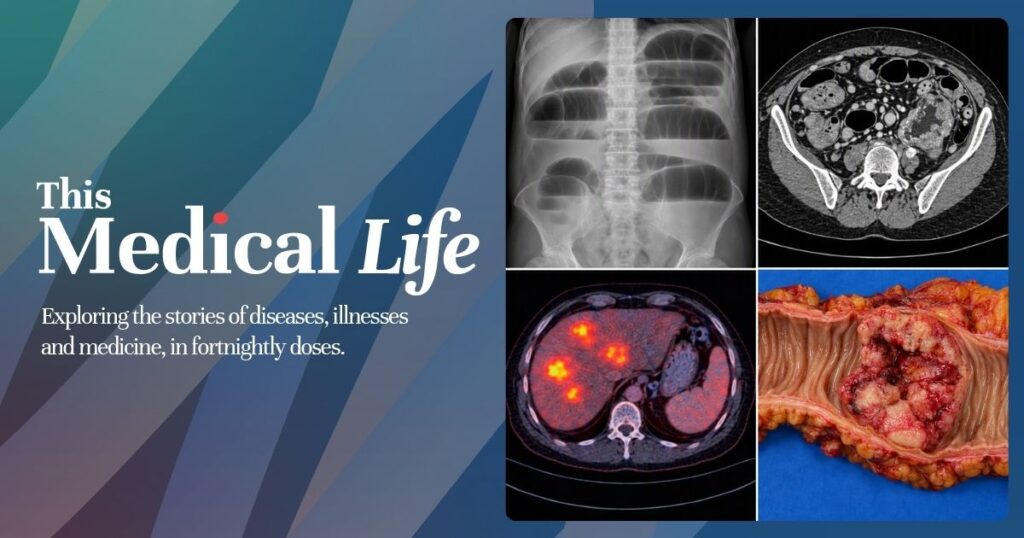
Early onset colorectal cancer is bowel cancer diagnosed before the age of 50. It makes up about 10 to 15% of colorectal cancers, and incidence is rising by about 2% a year according to colorectal surgeon Dr Scott Mackenzie. In Episode 113, a patient, a colorectal surgeon and a GI pathologist look at what the condition means for clinicians.
Age is no guide. Many of these patients have few symptoms and present at stage three or four. Helen Worthington describes her diagnosis of stage four bowel cancer at 39 and what she would like doctors to know. Dr Mackenzie explains why persistent bowel symptoms and rectal bleeding need investigation at any age, and why family history is the most practical risk marker. Dr Tristan Rutland covers how these tumours differ under the microscope, including the poorly differentiated, mucinous and signet ring types seen more often in younger patients.
Younger patients are easy to reassure. The guests suggest a low threshold for colonoscopy referral when a younger patient has a persistent change in bowel habit or rectal bleeding, and genetic assessment after any early onset diagnosis. The episode introduces you to the symptoms, risk markers and pathology findings relevant to this group, so you can feel more prepared for the younger patient with bowel symptoms.
This is the story of early onset colorectal cancer.
Our Special Guests:
Helen Worthington is an Adelaide-based primary educator, wife and mum with almost 20 years in schools as a classroom teacher and in leadership roles. In 2025, at 39, she was diagnosed with stage four bowel cancer. She is on extended leave from teaching and having chemotherapy.
Dr Scott Mackenzie studied medicine in Aberdeen, completed basic surgical training in Glasgow, then subspecialty training in general and colorectal surgery in Edinburgh. He was the international colorectal fellow at Concord Hospital in Sydney, and is now a senior lecturer in surgery and a surgeon in the Colorectal Surgery Department at Liverpool Hospital. Scott is a returning guest.
Dr Tristan Rutland is an anatomical pathologist and associate professor at the University of Western Australia, with a subspecialty and research interest in GI pathology and asbestos-related diseases. He received the Conrad Muller RCPA Outstanding Teaching Award in 2020 and the Resident Advocate Award from the College of American Pathologists in 2022. Tristan is a regular guest.
Listen:
This Medical Life podcast is available on all podcasting services, Apple Podcasts, YouTube, and Spotify. Members of the RACGP are able to log the hours as CPD (Education) that they listen to the episodes under self record via Quick log. We invite you to help support us on our donation page.
Automated Transcript:
This transcript was generated automatically by Descript. I will contain errors and spelling mistakes, but is offered as a guide and resource to help AI and search tools discover the content on behalf of GPs, medical students, other allied health professionals, and the general public.
TML S07E113
Steve Davis: [00:00:00] Welcome to This Medical Life podcast. These are the stories of medicine with Steve Davis and Dr. Travis Brown. This is the story of early onset colorectal cancer
Dr. Travis Brown, one of the beautiful things about being younger is that blissful period of life when you could ignore every mainstream health message that goes out because it happens to older people. Sadly, in this episode, we’re about to, uh, suggest that’s not always the case.
Dr Travis Brown: Talking about early onset colorectal cancer, and this is…
It’s always a, a challenging when you start looking at patients who have cancer early. [00:01:00] Uh, and normally when you think about early, often you’re thinking about 50 or 60. Mm. But we’re talking about people getting cancer at the ages of 30 and 40. Uh, and again, it’s, it’s f- falled into this category of early onset.
And the challenge is these patients may have very little to no symptoms, and they present with often what we… stage three or four. So it’s extended beyond just the organ and gone into metastatic spread. Uh, and it’s always hard from the medical perspective, ’cause often what happens is doctors tend to see a bit the worst side of diseases, meaning that you can, when you’re doing rotations, e- encounter children who have cancer.
Uh, and often you, you see sort of just heartbreaking situations that people are going into. And this is one of those areas where people are presenting with very advanced colorectal cancer in their 30s and 40s and sometimes even younger. And so [00:02:00] it’s hard because you look at it and doctors talk and they say, “Oh, we’ve seen young patients.”
Now, there is a medical bias in that, meaning that we see the worst, and it’s hard to know, is this genuinely something that’s increasing or you just happen to be seeing patients who are young and, and these people are just really unlucky? Uh, it tends not to be the case. It seems like as a percentage- Oh
about 10 to 15% of patients o- of all the people with colorectal cancer are early onset. Uh, and anecdotally, and even sometimes with some of our guests we’re talking about, it seems to be that’s rising. And so this is what this episode is about. It’s creating awareness of a really, first of all, difficult to identify, but a trend that’s happening in young patients when they’re presenting with this advanced colorectal cancer.
Steve Davis: Is it just advanced or is it something different from other colorectal cancer?
Dr Travis Brown: Well, and that’s, that’s the hard [00:03:00] thing. Like it presents from a pathology perspective, it, it actually looks like a very aggressive tumor, what we often say is poorly differentiated. So, uh, normally what we consider it, it– the pathway that it goes takes about five to 10 years for colorectal cancer in patients of 50 and 60, which is why we screen at that time.
You catch it early and you can treat it really well. These patients who are, who are young seem to have rapid growth in a very short time, and so that’s the question. Is this a different kind or is it just the same pathway just really accelerated? And so it actually produces quite a bit of a challenge for doctors and for researchers, uh, and for patients who are going through this, you know, why has this happened?
And so we’re really just wanting to try and catch this early because patients, uh, tr- manage the treatment really well and usually far better than 20 or 30 years older. Uh, but it’s just a matter of, I guess, [00:04:00] it being consideration for doctors. And so this is where we’re just going to discuss with some of our patients as to what can be done, what do we know, where to from here.
Steve Davis: Helen Worthington is an Adelaide-based primary educator, wife, and mum who spent almost 20 years working in schools, both as a classroom teacher and in leadership roles. She has an interest in how children learn, what sits behind behavior, and how teachers and schools can better understand and respond to individual needs.
In 2025, at the age of 39, Helen was unexpectedly diagnosed with stage four bowel cancer. She had surgery and is currently undergoing chemotherapy treatment. She’s on extended leave from teaching and found herself applying many of the [00:05:00] same qualities that shaped her work as a teacher: asking questions, seeking evidence, understanding the bigger picture, and trying to make sense of complex information.
And Helen’s our guest, uh, on this Medical Life podcast. Helen, welcome.
Helen Worthington: Thank you. Thank you for having me.
Steve Davis: Would you prefer if we say, “Good morning, Miss Worthington”?
Helen Worthington: Oh, gosh. That’s taking me back.
Steve Davis: Um, Helen, how were you first diagnosed with early onset colorectal cancer?
Helen Worthington: Uh, it was August 2025, and I, uh, woke up, um, having gone to bed completely normally on an ordinary day, had, uh, woke up in the middle of the night feeling a little bit unwell and decided to take the next day off work.
And later that, uh, next day, I decided that my symptoms were strange in that I was having this abdominal pain that couldn’t really be explained. And so I presented to an, um, emergency department, um, really thinking that they [00:06:00] would dismiss me and send me home, and I was really more worried about how many days off work I would need to take.
Uh, and so I presented at this ED and the, uh, doctor thankfully took me quite seriously and, um, sent me off for an X-ray and, um, it came back. I’m … really don’t have a medical background, and came back, um, didn’t look right. Even I knew that, and so I got sent for a CT scan and, um, what followed was, um, a full bowel obstruction and you have some spots on your liver and you need emergency surgery and off you go.
So I like to say to people I went to bed feeling fine and woke up with stage four bowel cancer. That was, that’s my journey.
Dr Travis Brown: Right. Yeah. So on leading up to that, like that’s extensive. I mean, going from pretty much zero to 100 there. Did you have any symptoms leading up to this? I mean, a bow- presenting with a bowel [00:07:00] obstruction is really quite severe.
Mm. Did you have any inklings that anything was wrong?
Helen Worthington: I, I have obviously spent a long time over this last 12 months, um, a- asking myself that same question and also asking a lot of, uh, medical practitioners and every doctor that I see, how, how did I miss this? Like, what were my symptoms that I didn’t really have?
The truth is, is I didn’t really have any symptoms. I, um, was, was tired. I had quite a bit of fatigue. Uh, could be that I’m a wife and a mom and a s- full-time teacher, but, um, there was just a little bit of fatigue that was sort of hanging over me. Um, but in terms of bowel movements, I actually scoffed when the, uh, physician said, “You know, it could be related to your bowels.”
And I was like, “No way. I’m fine. Um, in fact, I don’t even need to go.” Obviously, I had a full bowel obstruction, so I couldn’t. But, um, yeah, there really wasn’t a [00:08:00] lot of … There were not many symptoms, and if they were, they were so minor, and they could be explained by lots of other things
Dr Travis Brown: So you’ve gone through the list.
When you ticked it off, you said there was no weight loss, there was a little bit of fatigue, but you didn’t find any blood in your stool or anything
Helen Worthington: like that? No blood. I’ve never had blood in my stools. I, um, probably a little bit of thinning of the stools late in the, you know, probably a week, you know, maybe.
Um, but really no. All the … If anything, I felt like I was putting on weight. I kind of felt like I was hitting that middle-aged woman, 40. Oh my gosh, this is what everyone tells me. It’s g- I’m g- I’m getting a little bit f- I kept thinking I was getting internally fat. It’s a really silly way to put it, but that’s the only
I, I guess a little bit of bloating maybe. Um, yeah. So there’s, there really wasn’t much more than that.
Dr Travis Brown: When you’re looking at this and someone actually says to you and says, “You’ve got extensive like stage four,” did you know what that meant?
Helen Worthington: [00:09:00] No. I remember thinking, “I have to look up how many stages there are.”
I really in my head thought, “I think there’s a stage five. It’s all good. I’m not at the end.” And obviously within, um, a very short amount of time realized that I was the most serious case that you can sort of get. It doesn’t really get much worse than, um, how big and how widespread it was. Uh, so I, it wasn’t really until, yeah, I understood how, how it even worked.
But yeah, definitely there was, um, the … I think I knew that the secondary cancer part piece was really big. I was very concerned about the spots on my liver. Uh, that concerned me more than obviously the primary bowel obstruction. I remember thinking spots on my liver means secondary cancer. Secondary cancer means I’m dying.
Um, so that was how I looked at, looked at it at the, at the start.
Dr Travis Brown: Do you remember the final diagnosis they gave you? What did they, what the actual
Helen Worthington: diagnosis [00:10:00] was? Um, I, I, they said, “You know, you have stage four metastatic bowel cancer, um, with liver metastases.” So I had, um, ex- I have extensive mets on my liver, um, both widespread and deep, uh, meaning that yeah, it was, um, not a, not a very fun diagnosis when you are 39 and think you’re going up there, think you’re going to a h- um, hospital to be told that, you know, you might need a day off work because you’re sick.
Dr Travis Brown: Now, have you ever had a colonoscopy or any investigations like this?
Helen Worthington: Uh, you know, I sadly did. I actually had a col- I had a colonoscopy five years ago, or six now, but five years before diagnosis. Um, really randomly I had a, an irre- quite irregular bowel movements, and, um, I knew that there was a slight history of bowel cancer.
I probably didn’t realize the significance of it. Uh, but had a, um, history of bowel cancer in this family, [00:11:00] and I got scared I was going to get bowel cancer. I know that sounds really strange, but I got scared I was gonna have bowel cancer and decided to go and, um, you know, proactively get looked at. Um, really sadly, I don’t think I was taken seriously.
I remember feeling like, um … In fact, the anesthetist said to me, um, “But what are your symptoms?” And so I just lied through some symptoms. And he said, “You know, you’re … I, I don’t know, really know why you’re here.” And so I, I wasn’t really looked at, um, very seriously, and … But my report came back excellent, um, with the final sentence being, “No need to follow up.”
And I guess, I, from a medical perspective you might read that and say, “No need to follow up immediately.” Um, but as a non-medical person, I read it as, “I don’t have bowel cancer. I’ve got nothing to worry about. See you at 60 or, you know, later on.” So, um, upon reflection I, I think even if I’d had symptoms in the last [00:12:00] few years, I probably wouldn’t have been able to
I wouldn’t have acted on them anyway.
Dr Travis Brown: There’s something that you may not be familiar with. This is when we do molecular testing on, on tumors. And it’s sort of like, it’s normally a bit of an alphabet soup or anything like that. Did you have molecular testing on your tumor? W-
Helen Worthington: I, I did. Um, I actually got sent to the cancer screening program.
Um, uh, and I thought I was so lucky to be selected to be, to have my tumor molecularly tested and, um, until I got the permission form which said, um, only for advanced, incurable and poor prognosis cancers. And I was like, “Oh, okay. Right. That’s where I’m at.” And, um, so yeah, I did get it m- um, tested, and I have the BRAF strain which is, um, or mutation I should say.
Uh, and obviously that being one of the most aggressive forms of bowel cancer that you can get
Dr Travis Brown: Did you have any significant family history of colorectal cancer?
Helen Worthington: Uh, look, [00:13:00] I, I did. I’m from a, um, huge, big family. And so my mom’s one of eight, my dad’s one of six. My grandfather had it pretty early, but, uh, still sort of, you know, the history is there.
I think it probably, um, I didn’t realize the significance of it. Whether or not it is related to what I have, I, I, it’s hard to sort of know. It felt like that older disease versus a new, um- Hmm … aggressive disease. Uh, but yes, there is some in the family. Um, how, how much I, I don’t think I realize. And I also think the older generation are probably a little bit more, um, private in their, in what they deal with, and so it wa- certainly wasn’t something that was talked about.
Whereas when I got diagnosed, I sent, you know, every single cousin and every single person in my family off for testing. So, it’s, um, been, yeah, it’s been a ride.
Steve Davis: I hope you also gave them a question and answer sheet [00:14:00] with that as well.
Helen Worthington: Absolutely. And some feedback.
Dr Travis Brown: Now, looking, you’re going through chemotherapy.
How have you gone with the chemotherapy?
Helen Worthington: Um, chemotherapy has been very tough. Uh, people ask me what it feels like, and I answer with, “It feels like my body has been poisoned.” And that is about the only way I can say it. I did 22 rounds of, um, uh, Folfox, um, s- with, uh, um, cetuximab and encorafenib, which is a targeted therapy, and I prog- I had some really great response to that.
Unfortunately, I only got, um, about 10 months on that before, um, my disease started progressing, and I have done another four rounds of, um, my second line therapy. So, um, chemo’s hit me very hard, but I’m 26 rounds down. So it’s, it’s been a journey.
Dr Travis Brown: Have you had many of the side effects?
Helen Worthington: I have. Unfortunately, I was, I [00:15:00] sort of got, um, I’ve always thought, um, chemotherapy was very much around, uh, vomiting and diarrhea and feeling really sick and, uh, I didn’t, I haven’t really had a lot of that.
But I’ve had every other weird side effect that you can possibly imagine. I have, um, neuropathy in my feet, so my feet have, um, pins and needles 24 hours a day. Uh, I’ve got nosebleeds every morning. I have, I get really bad pains in my joints. Um, my, my nails are chip- chipping. I know it sounds really silly.
My hair has, I’ve got, um, a, quite a nice shaved head, uh, just because my hair hasn’t actually, it stopped growing as opposed to fall out, falling out. So, um, yeah, it’s hit every single part of my body, no doubt about it.
Steve Davis: Helen, you mentioned it felt like your body was being poisoned. From my limited understanding of thinking, you know, working with Travis, the human body will do everything it can to f- to remove and, and, and [00:16:00] fight back when it’s under threat.
How, what, what is the psychological journey that you go through as- Yeah … you know this is entering your system?
Helen Worthington: Um, you know, I know that it is killing the cancer, and so I have this weird relationship with chemo. If you were to tell me that I wasn’t allowed to have chemo, I would be so disappointed and angry and frustrated and sad, um, because I know chemo is saving my life.
But at the same time, um, it, it, yeah, it’s quite, a, quite an interesting, um, space to be in because you know it, you know it’s helping you. And un- for, for me personally, uh, I know it’s working when I feel the side effects. I have been known to say to my oncologist, “I think I need to push up. I think I need more.”
And he says to me, “Are you complaining about feeling well?” I’m like, “Yes. Yes, I need to feel sick,” because I, in my head, the sickness and the, the pain of neuro, um, of the chemo means that it’s doing something. I [00:17:00] don’t know if that’s scientifically proven that it does correlate, but in my head it does.
Dr Travis Brown: Have there been any services or support that you’ve found that has been useful during this time?
Helen Worthington: Yeah, absolutely. Look, um, Bowel Cancer Australia produce a lot of really great, um, information and, um, also have a lot of services, um, as does the Jodi Lee Foundation. I found both of them to be quite helpful. Uh, Bowel Cancer Australia, I- I’ve tapped into some of their nutrition, um, their nutritionists would have been, which have been really, who have been really helpful in thinking about my diet in, in relation to, um, chemotherapy.
And, uh, also I obviously have come into doing some lots of work in exercise, um, exercise medicine. Uh, Lift Cancer Care in South Australia has been absolutely an amazing resource there.
Steve Davis: Curiously, the nutritionist, just the short version. Yeah. What are the dominant themes?
Helen Worthington: Um, hilariously, I really thought that somebody [00:18:00] was gonna sit down and say, “You gotta change everything.
Like, here we go. You’ve got cancer. Here’s a brand new diet.” Um, and in fact, it wasn’t like that at all. It was very much like, “Let’s just do a few little substitutions, um, around your diet. Look, um-” Probably the most interesting thing, not so many supplements. I thought they might throw, throw me the supplements.
It was more like, let’s just have a really varied diet, um, eat really well. Um, obviously I, I know there’s a lot about protein at the moment, and I’m reluctant to even say that word, protein and fiber. But, uh, obviously trying to, um, keep weight on has been a really big part for me. I’m quite … I’m not huge, and, uh, so putting weight on has been really important just for the chemo side effects.
Dr Travis Brown: Can you tell us a little bit about the rehabilitation therapy, like Lift Cancer Care? What’s that all about?
Helen Worthington: Look, it is, um, it’s really a, one of the [00:19:00] first in Australia, I will say. Um, it is a specific cancer clinic dedicated entirely to, um, evidence-based, um, medically supervised exercise treatment, so only for people with cancer.
So, uh, you see a medical practitioner. They go through and make sure that you’re healthy enough to go into the clinic or, you know, what some might look at as a gym sort of setting. And then you work with an exercise physiologist, um, um, to, to really push you into vigorous exercise. Quite the opposite of what we think people need in cancer.
You know, we think we always … It’s so synonymous with rest, and yet, um, actually the evidence suggests that, um, it does a lot. And it really does. It, uh, reduces my chemo fatigue. Uh, it gives me, it gives me a really great physical, mental wellbeing. Um, and you can’t use the excuse of having cancer. It’s just like, “You need to work hard.”
I’m like, “I have [00:20:00] cancer.” They’re like, “Yes, we know. Keep going.” Um, and it’s not just for young people. I work, work out next to, you know, 80-year-olds, um, who are there. And you can go because it’s- Um, cancer related. It, the h- the hygiene and the, the safety are paramount. And so everything is, you know, everyone wears masks.
I mean, the, the physios wear masks, and you wipe down your machines really well. So it’s a really safe and supportive environment to exercise in.
Dr Travis Brown: Upon reflection of this journey that you’re going on, when you’re looking at the health sy- healthcare system, what has medicine done well?
Helen Worthington: Um, this has been really interesting p- especially given that I’m, um, obviously an educator.
I love the idea of, um, MDTs, like the teams that work around patients, and the idea that everyone comes together. Um, I love this idea that there’s all these doctors sitting in a room thinking about me and talking [00:21:00] about what they can do and from their perspectives. Um, and it’s not often … In, in education, we do it informally.
We do it all the time. How can I help this student? But we don’t do it as a formal setting, you know, everyone’s ideas together. And I lo- I have really loved that space and being able to talk to the different doctors that are in my MDT or who sit around and hear their perspectives, you know. You … I’ll listen to my liver sur- liver surgeon who will say, “Well, from a liver perspective, this is what we need to look at.”
And then my oncologist is there s- um, so everyone’s sort of … Yeah, it’s, it’s, it’s done really, really well. And it’s, it’s this i- this … It challenges this idea where a doctor thinks they know everything and sort of being put and being able to ask their colleagues for help. I, I, I don’t know. I love that.
Dr Travis Brown: Now the other side, what do we need to do for improvement?
Helen Worthington: Look, there’s a few things. I think one of the big, um, parts was early on in my treatment, um, I’m a private patient, [00:22:00] and early on in my treatment I, um, ended up in a public emergency department. Um, I had really low platelets, and obviously being a woman, I, um, had my period, and I was basically hemorrhaging and, um, needed, needed some support in that space.
And I arrived at the emergency department in the public setting, and they said, “Oh, we don’t have any of your records. Like, can you start at the start?” And I think that link, that communication link between the public and private systems for me was really frustrating and really hard. Um, and thankfully I’m
I know my blood counts. I can tell you what they are. But even the bloods were like, we use a different … You know, they use SA Pathology versus a ClinPath, and these little tiny pieces that just made it quite, um … I guess I’d be quite frightened to be an older patient or a patient that doesn’t have English as a first language.
Um, it made me think about what might happen to those people in that system. So the [00:23:00] communication links, I think, would, um, you know, is something that, uh, every organization work, can work on.
Steve Davis: Absolutely. Um, Helen, just in closing, do you have any final thoughts, final bits of advice for doctors and/or patients about early-onset colorectal cancer?
Helen Worthington: Uh, look, I would like doctors to really take young people seriously when they present with symptoms that may potentially indicate a bowel cancer or an issue, um, with bowels. I think there’s, it is such a taboo topic in society, and so there’s a real chance that people are probably under-reporting their symptoms anyway.
And so if there’s a person that comes or comes into your setting or speaks about some of these symptoms, that, that if there’s a need to investigate, to really investigate and to take people seriously, I think that would be my, um … You know, then you’d rather rule something out than, than have a missed opportunity.
The thing about colorectal cancer [00:24:00] is that, you know, 90% of, um, cancer can be treated successfully if you get it early. I, I just didn’t get to get it early.
Steve Davis: Helen Worthington, thank you very much for joining us on this Medical Life podcast.
Helen Worthington: Thank you so much.
Steve Davis: Dr. Scott McKenzie is from Scotland, having studied medicine in Aberdeen. He completed basic surgical training in Glasgow, then moved to Edinburgh for subspecialty training in general and colorectal surgery. Dr. McKenzie then traveled to Australia as the international colorectal fellow at Concord Hospital in Sydney.
He’s currently a senior lecturer in surgery and surgeon in Liverpool Hospital’s Colorectal Surgery Department. Scott’s a returning guest here on this Medical Life podcast. Scott, welcome [00:25:00] back.
Dr Scott Mackenzie: Well, thanks for having me back.
Steve Davis: Let’s continue the discussion in this episode on this topic. Is there an increase in young patients, and by young I mean people in their 30s and 40s, who are presenting with colorectal cancer?
Dr Scott Mackenzie: So the simple answer is yes. Um, that sort of began as an anecdotal noticing of more younger patients in the, um, sort of surgical chat around, uh, the coffee room. You know, every now and again we’ve got a younger patient becoming more frequent in their 30s and 40s and even younger. But the, the evidence certainly suggests that, that there’s definitely an increased evidence for the early onset colorectal cancer cohort, and that’s a term we now use, the early onset colorectal cancer cohort.
So there’s been about a 2% increase a year. It’s gone up, you know, significantly. I think the overall sort of per 100,000 of [00:26:00] population increase is about 60%. I mean, that still only means about 12.9% of the, uh, population per 100,000, but that’s still a huge increase respective of that, that group. So long-winded answer, but yes, there is more early onset colorectal cancer around.
Dr Travis Brown: Do we know why? Is there any leading theories as to the cause of early onset colorectal cancer?
Dr Scott Mackenzie: We, I mean, to say it clearly, we don’t know definitively why. Are there theories? Absolutely. And you get, uh, three or four different scientists in a room, and you’ll get several very leading and, uh, very promising theories.
Uh, there’s a, as I said, there’s a birth cohort effect. We can see the risk of colon and rectal cancer different in those born around sort of 1990 and beyond those born in the ’50s. Um, one of the appealing, appealing in as much as it [00:27:00] seems to work concept is related to the gut microbiome. Uh, that change from, say, the p- population born around the ’50s to those in the 1990s and beyond have existed in an environment with a very different exposure to antibiotics, which makes a change to the, the gut microbiome.
And you can look for evidence of that affecting almost any disease process. But there’s strong evidence that it probably does have a bearing on your risk of colorectal cancer. We, we can’t say that it’s as simple as we introduce antibiotics to the population exposure causes a dysbiosis, and therefore we have cancer.
But there’s some strong evidence that we change the type of bug in our gut microbiome. A certain type of E. coli, Colibactin-forming E. coli, are related to cancer risk. And it’s probably something that happens in early life that then has early mutational risk for [00:28:00] later in life, and then we see this early onset colorectal cancer.
But it’s like everything. It’s appealing because it’s elegant and it works, but there’s not necessarily You know, absolute evidence for that. And there are other things, the sort of forever chemicals, the environmental exposures, again, which changes through that cohort that we’ve seen the change in incidence for.
So it’s always the question patients ask, and you have to be honest that we don’t have a definitive answer. We’ve got some theories.
Steve Davis: So if I’m sitting in front of you and I say, um, “Dr. Scott, I’m taking those little tablets with, uh, gut bacteria every night,” does that mean I’m, uh, I’m off the hook on that front?
Dr Scott Mackenzie: So that’s, that’s the kind of question we get. “Uh, well, h- how can I have…” Or if I put it slightly differently, “How can I have an early onset colorectal cancer? I took my probiotics, and I’ve had high fiber, and, and…” And we have to just explain that these are looking at population level risk factors. That [00:29:00] doesn’t always correlate with the individual, and it’s, uh, it’s a constant conversation we have to have.
“But I’ve done X, Y, Z, and the literature says…” Well, you are an individual. You are not the population, and we have to get that, you know, communicated carefully to our patients.
Dr Travis Brown: Are there any risk factors that we know of?
Dr Scott Mackenzie: You know, again, on a population basis, yes. Looking at, uh, some of the environmental exposure, some of that dysbiosis question, yes, and that there’s work being done looking at, for instance, analyzing the gut microbiome genomically.
But in terms of having a patient sitting in front of you, the best risk factors we can look at are probably family history because that still, um, is an easy way for GPs, for surgeons, for practitioners of any sort to identify a greater risk population. Do you have a family history of colorectal cancer?
Do you have a family history of [00:30:00] polyps? And then more specifically, are there any early cancers? Um, are there polyps in an earlier patient population? Obviously increases our risk that there may be something, uh, heritable. Um, patients often don’t know for certain, particularly as older. You know, patients won’t necessarily disclose to, to children and grandchildren that they’ve got polyps or they’ve had colonoscopies.
But that’s a simple way to identify admittedly a select group of at-risk young individuals. Do you have a family history?
Dr Travis Brown: Are there any common presenting symptoms for patients?
Dr Scott Mackenzie: This is where the, this topic gets challenging because there’s nothing particularly different to the symptoms that I might present with as a young person, I think I can remember being a young person, uh, that has cancer to being an older person with cancer.
But we’ve always, uh, and, [00:31:00] you know, we sort of almost taught this to medical students, that you can use epidemiology to help with risk stratification. If I’m 25, and I’ve just moved into my own house, and I’m cooking for myself, and I’m not really looking after my diet, and I’ve got constipated, and I’m now presenting with some rectal bleeding, that’s different to the 85-year-old who presents with a change in bowel habit and some rectal bleeding.
We could be reassured by the epidemiology saying bowel cancer is a disease of those later decades We can’t be quite as reassured by that anymore. But similarly, we have to be balancing that with a lot of young people with rectal bleeding, have outlet bleeding, have simple hemorrhoids. So really, it’s a very challenging situation.
We have to be taking every large bowel symptom presented by our patients, regardless of age, seriously. And the challenge for GPs, for [00:32:00] specialists alike is how do you now risk stratify without worrying every single sort of 18-year-old with a bit of blood on wiping that they might have bowel cancer because they’ve seen the inc- increased incidence data versus ignoring the fact that, well, 25-year-olds do get bowel cancer as well.
Uh, so really the symptoms or the features are the same as we would explain to, to anybody of any age. Change in your bowel habit that can’t easily be explained that persists. Rectal bleeding really of any sort, because patients aren’t good at quantification, and admittedly some blood on wiping is probably hemorrhoidal.
But really my way of doing this is bleeding is something that needs investigating. My job is then to try to work out how urgently that investigation needs to be done, if I can put it that way.
Dr Travis Brown: Are there any environmental lifestyle or genetic causes that come up in these discussions with, with patients?
Dr Scott Mackenzie: A- again, that’s, [00:33:00] that’s often more once the diagnosis is reached and we’re having to say to someone, “Yeah, that, that lesion we found is a, a cancer. Yes, you’re only in your 30s.” Well, well why? And they will have read, they will have Googled, they will have some of the, the data. And again, we have to say that, yes, there, there’s evidence for these gut microbiome issues or the, the PFAS, the forever chemicals.
There, there’s all sorts of theories, but in terms of for that individual sitting in front of you, it’s not particularly useful or helpful because again, as we, as we mentioned, there’s a, “But I never did that. I, I’ve not been exposed to that. I’m a whole food aficionado.” So it’s, there’s not really something specific on that individual basis.
Dr Travis Brown: With patients who are pretty much if you’re looking in your 70s and then you’ve got someone in your 30s, is it essentially the same disease just accelerated, or is this almost a different condition because it presents [00:34:00] very advanced early?
Dr Scott Mackenzie: There’s sort of conflicting data in some ways that does appear that the younger population has a predilection to present with later stage disease, stage III, stage IV more commonly, and yet their survival cancer specific tends to be better Um, you know, someone like Dr.
Rutlander, uh, pathology guru will be able to talk more about the genetic basis of the, the difference and there are definitely some, you know, microsatellite instability differences and mutational differences. But it may be as simple on one level as the younger patients are not being as readily investigated because, oh, you’re 25, you don’t have cancer.
Let’s give it a bit longer, see if something simple, conservative management, supportive management sorts it. So they present later, but then that group of patients diagnosed with later stage are a much more robust group because [00:35:00] they’re young, they’re fit, they’re not in their 80s and have had, you know, three myocardial infarcts and are on 12 different antihypertensive.
They’re much more able to tolerate aggressive treatment, if I can put it that way. So again, long-winded, but there’s probably some mutational and microbiological differences in these cancers, so they, they are to some extent a different entity, but some of it may also just be that they’re diagnosed later, but we’re able to do more treatment protocols.
Dr Travis Brown: So screening tends to happen around 50 years on, and then you’ve got 45 for people who have a high, considered higher risk. Are they adequate for this or is this– should they be extended or would they even pick them up with, uh, being ill at younger age?
Dr Scott Mackenzie: It’s difficult and it’s easy as a colorectal surgeon to go, “Oh, we should be screening everybody earlier and longer and…”
But you have to be, you know, cognizant of the fact that we have limited health resources and yes, [00:36:00] there’s this increase, yes, there’s, you know, very significant increases, but that has to be balanced across the population and the other priorities for our, our health dollar. Um, from 45 onwards you can opt into screening Um, with the family history, I’m coming back to that.
With any family history, you’ve got a reason to be more aggressive in terms of your, your surveillance of patients. The more challenging group are the ones with no family history, with no symptoms. Well, what do we do in terms of, of screening that asymptomatic population? I don’t have a clever answer. I think one of the things to sort of get across as a message is to be really vigilant with regards to symptoms.
We, we just can’t be reassured anymore because of the patient’s age. So symptoms are admittedly more likely with more, uh, for later disease, but any symptom we need to be asking, could it be cancer? Do we investigate?
Dr Travis Brown: For the surgical [00:37:00] treatment of patients with early onset, is it different to patients who are 50 or, or say 60 or 70?
Dr Scott Mackenzie: Only in as much as we’ve got that more robust physiology on our side. So it’s always challenging in the, you know, the octogenarians presenting with advanced disease, how able are they to withstand really, you know, aggressive chemoradiation followed by, you know, multivisceral resections, exenterative surgery.
We talk about, you know, beyond TME, that sort of extra anatomical surgery that we’re, we’re pushing the boundaries of. But in the younger patient population, those things are still possible, and we’re supported by physiology that’s much more able to bounce back from it. All the evidence suggests that that more aggressive surgery in the older population works.
It knocks patients back much more for that six months. But both in terms of survival and quality of life, [00:38:00] ultimately, it’s worth that. But we’re often constrained by the fact that the, the patient themselves is every year of their eighty five, and they’re not going to be robust enough to withstand that, whereas the earlier group.
So the principles are the same, but we’re backed up by that more able to tolerate surgery group.
Dr Travis Brown: So if a GP is seeing a patient and it does come across in the back of their mind, oh, could this be something very sinister? What would be the best test? Would you actually say do a fecal occult blood test, or would you just say, let’s just go straight for colonoscopy?
Dr Scott Mackenzie: So the, again, the sort of simple sort of medical student answer as well, the sensitivity and specificity of colonoscopy is the most superior. It is our gold standard Unfortunately, the availability of colonoscopy, not just in our health system, but in any health system, means that it’s not always the case that you can just organize colonoscopy at the drop of a hat.
And again, I see a select group of patients who’ve been [00:39:00] through my GP colleagues, who’ve been triaged. So it’s easier for me to say, “Well, I’m gonna investigate pretty much everybody who has symptoms.” I think there’s little benefit from FOBT or even FIT testing because the patient tells you they’ve got bleeding, they need to be investigated.
The, the group that, as I said, are harder are the ones who truly are the asymptomatic. But really I think that’s why we have to focus on identification of, of symptomatic patients. And in that situation, if someone tells you they’re bleeding, someone has an altered bowel habit that’s not readily explicable, then I think referral for colonoscopy is very reasonable.
Dr Travis Brown: Is there much discussion in surgeons about the liquid biopsy area, where you’re talking about … ‘Cause we’ve, we’ve been able … I went to a pathology conference where they talked about they’re able to actually distinguish different types of cancer by the mutations that are found in the blood. Is that something that’s in discussion?
I, I, [00:40:00] I’d always caution that with screening being a discussion in that, but is that a discussion at all?
Dr Scott Mackenzie: It is, absolutely. We had some work done locally on CTC and circulating tumor DNA, and, uh, there’s actually a local liquid biopsy sort of conference because that’s really what we want. We want patients who we have any concern about to do a quick blood test, some analysis is done, and we can say, you know, even if we could just say, “You are at higher risk, we can then prioritize your colonoscopy.”
So again, it’s work in progress. It’s not yet sort of circulating tumor cells, circulating DNA isn’t yet at the point we can use it as a screening test. Sadly, sometimes patients think the CEA, the carcinoembryonic antigen tumor marker, is a screening test, and they say, “But my, my CEA is normal. I can’t have a cancer.”
And we, we really, again, it’s about patient expectation. We need to make it very clear what’s the purpose of that test. Um, whether I’ll still be in practice or it’ll take longer, there will [00:41:00] be liquid biopsy approaches, and that will allow us to potentially target again the colonoscopy. Um, because I think it’ll be a bit longer before we can do the blood test and say, “Yes, you have bowel cancer.”
That will come ultimately, but the first stage will potentially be identifying those who’ve got a higher risk and need to be investigated more aggressively potentially.
Steve Davis: I do hope you’re still around to see that, Scott.
Dr Scott Mackenzie: Well, well, well, the way things are going, maybe. We’ll see.
Steve Davis: Do you have any final thoughts or advice for doctors or even patients about colorectal cancer in younger people?
Dr Scott Mackenzie: The best advice I could think of is really think about it, and it’s a real balance. I don’t want every GP seeing, you know, the very obvious sort of hemorrhoid in the teenager. This, this could be cancer, but the tragedy is the, the bowel cancer that’s treated as hemorrhoids for, for six months. So it’s a really challenging thing we’re asking of our GP colleagues [00:42:00] and, and indeed of our patients.
It’s really to think about it. It’s not necessarily going to be the cause, but you know, those symptoms I’ve had for the last six months and I’ve blamed my wife’s cooking or my travel overseas or I’m getting older or young. We all do it. We all explain away our symptoms. So for patients, I would say if you have a symptom of any sort related to the bowel and you are younger, get it checked out.
And for the, the GPs who really we, we rely on so heavily, it’s think about it, and it’s that balance between terrifying every single hemorrhoid-bearing 25-year-old and, and missing that. So at least think about it. Sh- should I be referring this on for investigation?
Steve Davis: Dr. Scott Mackenzie, thank you for joining us again on This Medical Life.
Dr Scott Mackenzie: Thank you.
Steve Davis: Dr. Tristan [00:43:00] Rutland is an anatomical pathologist and associate professor at the University of Western Australia. He has a subspecialty and research interest in GI pathology and asbestos-related diseases. In 2020, he was the recipient of the Conrad Muller RCPA Outstanding Teaching Award, and in 2022, he received the Resident Advocate Award from the College of American Pathologists.
Tristan is a regular guest here on This Medical Life, and we welcome him back today. Welcome, Tristan.
Dr Tristan Rutland: Thank you so much for having me back. It’s been a while.
Steve Davis: It has, and we need to get into one of your specialties today. What is early onset colorectal cancer?
Dr Tristan Rutland: That’s a really interesting question because I think you sort of really gotta break down what the sort of cutoff is and what the clinical practical cutoff is as well.
So it’s defined as colorectal cancers occurring in people less than fifty years old. But if you think [00:44:00] about that, cancers occurring in a forty-nine-year-old and a fifty-one-year-old are not too dissimilar as well. Um, so- And a cancer occurring, you know, someone in their 20s is much more, is gonna be a different, a different type in, in all the different ways than someone, a 49-year-old.
So why we talk about it with those sort of aims, I think we’ve got to realize that it’s quite a large heterogeneous epidemiological category. Is that a, is that a word? Uh, like a string of words together as well. Um, um, more of a sp- yeah, so and th- and that’s the best way of, of sort of thinking about it.
So, uh, s- cancer happens usually, um, below the age of 50, but once again, with those caveats in place as well.
Steve Davis: And is the incidence rising?
Dr Tristan Rutland: Yeah, so that’s, that’s a once again, a really interesting, um, question to look at. So first of all, um, in high-income, uh, countries just to get some perspective, um, the incidence [00:45:00] of colorectal carcinoma in over 50s is actually declining and it’s most likely to do to with screening programs as well.
So screening programs picking up, you know, polyps and, and, and patients, um, repeated patients and, and, and that’s, and that’s obviously paying off which, which is, which is great as well. But, um, when you actually sort of look at the younger age groups as well, it certainly is, um, it’s certainly increasing and when you look at say somebody that’s born in the 1990s and compare them to someone that’s born in the 1960s, there’s about a fourfold increase, um, in risk of getting colorectal cancer now when you, when you look at it as well.
Um, and the mortality associated, um, with, with, with cancer is not when you’re looking at, you know, the survival rate is also just increasing just because there’s more of that happening as well. Um, so yeah, [00:46:00] that’s, that’s, it pretty much is and, and it is, it is a phenomenon that’s happening in high income countries as well.
Um, and certainly I think there’s probably maybe some evidence maybe it’s happening in other, in other areas, but certainly in high income areas and we’ll talk about I f- I’m sure we’ll talk about why a little bit later on, but yeah, um, there’s probably some, some things that are intri- attributable to that that probably link into that sort of the demographics.
Dr Travis Brown: So we’ve looked at whether this, you’ve already mentioned it, whether there’s someone who is 55 who has colorectal cancer and then someone has 25 is essentially a different disease. So do we think it follows the same pathway, the same pathway that’s, uh, for colorectal cancer in older patients or is it, it’s, is, is it accelerated or is it different?
Dr Tristan Rutland: Yes and no. Uh, so, um- So most of, so most of the colorectal cancers that we’re seeing in [00:47:00] younger patients generally, um, and I, I think we might have discussed this in previous episodes, um, but just a reminder that, uh, especially back to med school, that with colorectal cancers there’s a couple of different pathways.
But the, the, the classical pathway is this stepwise pathway of getting more mutations, um, from an adenoma, so from a premalignant lesion to invasive malignancy. That, that’s the classical one. It’s about 70 to 80% of, of tumors. And, and most of Um, most of these early onset carcinomas generally follow that, that sort of pathway with some, some little tweaks as well.
Um, and the other pathway in the sporadic cases, so we’re talking about not people that have some recognizable germ cell lung tumor. So the canonical ones, yes, and the early onset ones, but the, the mismatch repair protein, the sporadic one, so that’s the second [00:48:00] pathway that’s, that’s relying on a funny enzyme that, that repairs all these little things in our DNA that goes a bit haywire.
Um, that’s a lower incidence in, um, lower incidence in sporadic patients in younger onset. So but that’s– But when we look at that, the, that, that classical pathway, there are some s- little differences, and some of the mutations that we see commonly in that pathway, I mean, older patients, are less common, um, in younger patients as well.
So, um, and I, I’m not a great fan of listing a whole bunch of different sort of different proteins and so on and so forth, but just to give a bit of a flavor for people that do know these things is that classically we have a, in a, in our– we look at our older colorectal carcinomas, they have a mixture of, um, tumor suppressor genes turned off and, and oncogenes turned on.
So, um, they tend to have APC, KRAS, um, and BRAF, and some of these do have [00:49:00] applications and not in treatment prognosis. We see less of that, um, in, we see less in the, um, the early onset canonical colorectal cancers and tend to have more of what we call PT fifty-three. It’s a, um, and something else called CNTNNB1, which is sort of related to APC sort of, um, to do a bit of cataloging stuff.
But it’s anyway, long story short, there are some s- there are… And then that’s, that’s, and there’s some other little other things. There’s some other weirdo things that, um, line one hypermethylation stuff which, which is not really within the scope of talking. But putting all that together is saying, “Yeah, they are similar” but it’s not, it’s not a good thing to say that these are just a, um, uh, what’s the word for it?
A younger copy of the same disease. There are, there are differences that we’re seeing and they’re, they’re not, you know, they’re not a completely different pathway. They largely fol- uh, pa- they largely follow this stepwise sort of process, but some of the mutations that we’re seeing are different as well.
So they are, there [00:50:00] are some differences that are emerging there as well. Um, hopefully that makes a bit of sense, but, um, yeah. So the answer is yeah, but no.
Dr Travis Brown: So you mentioned it before, but is there any geographical or epidemiological factors that are different for early onset colorectal cancer?
Dr Tristan Rutland: Yeah. Good question.
So once again, I suppose most of the data that the emerging data because it we’ve done in the US, um, would show that, um, there are gonna be increased, uh- In- increased groups of people in rural settings as well. Um, and in the US and particularly in places like southern of the US and the Appalachian sort of areas as well.
Um, and there seems to be sort of, um, association with, um, long-term multi-generational poverty, um, that is sort of associated with increased risk and, and, and survival. But we are talking about a different country here as well. But, um, you know, a lot of these things will, will definitely will be studies.
Well, and, and, um, maybe [00:51:00] there is something I just haven’t come across my reading, but, um, that may actually be there in regards to, um, looking at this in, in Australia and other countries as well. Um, and there are some racial and ethnic differences as well. So, I mean, in the US, um, so Black patients historically had worse incidents and they’re more likely to be hit with this as well.
So, but there is an increase in, in white patients, um, as well. Interesting s- when you break it down into male versus females, um, uh, there is an a higher raising, more higher spike in, in men compared to women, um, as well. Um, and, and interesting enough, females are more likely to have the right-sided mismatch repairs unstable tumors than, um, than men are as well.
So, um, yeah, there are, there are some… There definitely are some that are emerging as well. So there is more of this going on. And I suppose because it’s an evolving thing as we’re learning more about it, um, [00:52:00] the data is probably gonna change again as well, especially as we’ve become recognizable and, and maybe the screening, um, the screening for these things adjusts hopefully, as we could see, as I mentioned, first up with our 50s, we’ve actually had a little fall because we’re being able to pick these people up as well.
Um, and I think that’s something that I’ll probably mention at the end is that there’s been a recent bit saying that one of the problems is that younger patients are quite often dismissed more often with symptoms or symptomatology and, um, and they’re missed and there’s opportunities to pick them up earlier.
So hopefully that would be something that could influence a lot of these things as well.
Steve Davis: I don’t want to go too deep if this is a fringe question, but that little change or shift with, uh, this occurring more in men than women with that data you saw from the US, can you posit a reason as to why that might be?
Is there something that makes men more risk prone, or is there something in females that, uh, has more of a preventative protective, uh, mechanism [00:53:00] as far as rectal cancer, colorectal cancer?
Dr Tristan Rutland: I, I, I’ll be honest with you, I don’t know. I, I don’t… I’m not an epidemiologist, and I wouldn’t want to posit, um-
Steve Davis: Oh, okay
Dr Tristan Rutland: a direct answer to that, but I could just say that, um, like with anything with, with early onset, um, carcinomas, and we can put all this in, um, is that we have modifiable and unmodifiable, um- Risk factors and, and we know the modifiable stuff are, um, obesity, diabetes- Yeah … metabolic syndrome, um, Western diet, s- sugar, you know, sugar beverages, you know, s- all that sort of wonderful stuff.
Processed meat, we know that. Alcohol, smoking, sedentary behavior, um, and there’s some em- emerging things about certain types of bacteria probably all linked in with that as well. Um, and interesting enough, having a cesarean being… So cesarean delivery is an increased, is an emerging s- ris- so, um, I suppose going back to that is, like, once again, I’m not an epidemiologist, but maybe [00:54:00] there’s a cluster of things in regards to males are more likely to do those things.
But like I said, I, I would only posit that, um, and I wouldn’t want to go any further than that as well.
Dr Travis Brown: Are there any histological features that are different in colorectal cancers? Uh, so, um, early onset, like, have aggressive types, so mucinous, signet, poorly differentiated. Is there anything that’s significant?
Yeah.
Dr Tristan Rutland: I, I, I think you you know, already know the answer to that, Trevor. So yeah, absolutely. Those are, those are absolutely correct, so.
Dr Travis Brown: So you actually will see more of those types with early onset?
Dr Tristan Rutland: Absolutely, yes. So p- poorly differentiated, um, so poorly differentiated or undifferentiated, um, carcinomas and, and those mucinous ones and the, the signet ring cell ones which, um, which, which, uh, can be quite, are very nasty, can be quite sometimes a bit of a diagnostic dilemma, um, both clinically and pathologically.
Um, yeah, we certainly see them, especially in the sort of like, um, under 40s age group as well. Um, and one of the problems is that, [00:55:00] um, especially with some signet ring ones is that they’re microsatellite stable which, um, uh, uh, in older patients there’s a good portion that tends to be Uh, unstable which means treatment like immune treatments can be used on them, but, um, in, um, younger patients with these ones it’s, and that tends to be a little bit more nastier as well.
So yeah. Um, and also just from a outside the histology, um, but actual sort of like, uh, prognostically they tend to be, yeah, that, that is reflected in we see, um, uh, perineural invasion more likely to see lymphovascular space invasion as well and, and, and nodes and quite often. Now there are some reasons for the, the staging things, um, and I sort of mentioned it before in regards to late detection, but, um, but um, but they certainly do see it with those groups of patients.
Yeah.
Dr Travis Brown: I mean, this puts it into a really hard area though because patients will present like not be dis- not be dismissed as you mentioned, but whoever’s thinking of [00:56:00] cancer in a 30-year-old presenting with abdominal pain, you’d be sitting there going, “Oh my goodness, you know, this is…” You put it into Google and yeah, Google will say, “Oh, you’ve got a tumor.”
And it’s like, my goodness. It’s, you know, that’s crazy. But to actually think of colorectal cancer in a young patient’s requ- really quite challenging. I mean, do we have any idea? Does the, do, do gastroenterologists or surgeons have any idea as to why this is… ‘Cause not only is it prese- presenting, it’s presenting with an aggressive type and very advanced in someone who is under the age of, well, often 40.
Do we- does anyone have any idea or theories as to what is going on?
Dr Tristan Rutland: So I suppose one of the things is, yeah, so I think that now that we’ve got, there are some more talk about it, so luckily I think that certainly, you know, many of the clinicians are very aware of this as well. And from a medical, um- For me being, uh, in the medical education as well, I, I, I certainly hammer home those points in [00:57:00] the medical students about, yeah, we used to go through medical school and you had your list and colorectal cancer or things would be down on the lower list, but we have to now be aware that even though it is still not common, we need to, we need to put it up.
We need to consider it at much more than we did beforehand as well. Um, because I think absolutely the, the, the impact of missing a colorectal carcinoma in a 20, 30-year-old or, you know, considering the age and, and, and late, and late diagnosis is, is, is catastrophic potentially as well. And just going back to something like I was talking about with the colorectal cancer.
For example, one of the, one of the sigmoidal ring cell carcinomas can present not classically like a big mass in the colon. It can actually present like you can get sigmoidal ring cell carcinomas in the, in the stomach, and we, we call it liratus plastica. It can just mean that the, the folds of the stomach are thickened and they don’t look like a classical cancer.
They look thickened and, um, experienced endoscopists will recognize that. But you can get that same [00:58:00] change, um, with that particular type of, of tumor in the colon. Um, so it’s also recognizing that, um, those, you know, an experienced person will pick that up, but recognizing in a younger patient as well, that should definitely be something that could trigger that as well.
Um, so they can mimic inflammatory things as well. So absolutely. So but a- going back to your question, I imagine you’re talking about, uh, why are we talking about in, in the etiology sort of factors. Is that correct, Travis?
Dr Travis Brown: Yeah. Yeah. It’s just trying to work- Yeah …
Dr Tristan Rutland: out what’s going on. Yeah, it is. And, uh, I think once again, there’s a lot more– there is a, a lot of emerging data on this, um, as well.
Um, in a nutshell, it’s probably due to a mixture of lifestyle. Obviously, we’ve got our unmodifiable, um, risk factors, but things like, um, o- obesity, childhood obesity in particular, and our foods as well. Um, and then messing up the, [00:59:00] the, the gut biome and, and probably increasing, accelerating that whole, um- Yeah, increasing inflammation and then as a result getting Changes in the mucosa that can then, premalignant changes that can, that can lead to eventual cancer.
Once again, that stepwise sort of fashion. So there are a number of different, um, models and so on and so forth, but I certainly think that when we’re talking about the microbiome is certainly one thing that people are thinking more and more about in regards to these things interplay a lot as well. I, I probably should also add that when we’re talking about this, that there is a group of people that I, I, I probably haven’t mentioned, and I, as much and I probably should, is that people that do have hereditary cancer syndromes which disproportionately present as early onset cancers.
We are also … Well, the literature is, and I, and I think anecdotally starting to see patients that are younger with things like Lynch syndrome in [01:00:00] particular are presenting earlier as well. Um, so, um, but the, the, the, the data seems to be that they present not decades early, but probably a couple of years earlier, um, than say what they would
But they are still, these are the early onset people that are s- that are, that, that are, that are pre the focus have got, um, hereditary condition, but they are presenting even a little bit earlier as well. So there’s, there’s that associated, so there’s probably a lot of, um, interplays with inflammation, microbiome, and, and genetics and, and as well as all those other risk factors that we talked about.
So yeah.
Steve Davis: Tristan, do you realize you are yet another guest on this podcast that talks about obesity and diet and the fact that we need to pay attention to that?
Dr Tristan Rutland: Yeah, I know. It’s, um, it’s, it’s really interesting that we sort of like the more and more data that we come across as well and, and the more research that goes into how much this interplays into
Because we know that, for example, physical activity is protective [01:01:00] for these sort of things as well. But then we look at these things, we analyze the diet and, and it really is, and it just, it, you know… And I think part of it is that a lot of these, um, especially obesity and so give this sort of low-grade inflammatory type.
And then we all know the long-term inflammation is bad for you, and that’s probably part of all that sort of plays into it. So yeah, absolutely. Um, absolutely. So you know, what are they saying? Sitting is the new smoking nowadays as well. So should be having those desks that stand up. I should get one as well.
Dr Travis Brown: The, the thing that kills me though is that, um, we still, there will be some people that do not have any risk factors, any at all that you would think, and they’ll still present with advanced stage four. And so this is the kind of where like I’m trying to work out like is there any molecular studies that are useful?
Is there any, any history? Is there any, anything in genetics that would, that would sort of be for patients who have these, [01:02:00] uh, early onset?
Dr Tristan Rutland: That’s a good question. Um, I’m, I’m not a molecular pathologist. Um, uh, it’s an interest, but I’m not, I’m not that. But, um, or a genetic pathologist. But from- From what I can say is that from these sporadic, because of just the nature of these sporadic tumors.
So for people that have those early onset sporadic tumors at the moment, it probably isn’t. I suppose the important thing is any young onset, any early colorectal cancer needs to be screened for some genetic syndrome and has to have a family tree done. So, um, and I should just put a little aside to say when we talk about hereditary cancers and so on and so forth, we’re talking about people that have recognizable syndromes, like Lynch syndromes, and then people that have a family history which have an increased risk as well.
So you need to sort of make sure that we capture those groups of people and, and make sure that they can be, uh, um, worked up and sent to the appropriate genetic, um, you know, a gen- to, to clinical genetics to then [01:03:00] be worked up through as well. But in regards to our sporadic cases, because of, I suppose, yeah, it’s, um…
I don’t think we have any particular markers that we can do for people at this stage that will show that they’re increased risk apart from that. And I know that from, yeah, I had a friend, um, who actually in his forties had, you know, fit, healthy, uh, ate well, super fit, no risk factors, just got it. Got, got rectal cancer and no identifiable reason for it.
So, um, it can just pop up like that as well. And so it is absolutely a real fun, and we don’t really, for to my knowledge, um, have a particular marker for getting those sporadic cases. But Hopefully with adjustment of things like screening, we can maybe be a little bit more, uh, we can pick them up a bit earlier as well.
So that’s a real key for those things.
Dr Travis Brown: So now you’ve just touched on screening. I’m trying to work out, are our screening [01:04:00] guidelines adequate? Because, well, certainly they’re not at the moment to detect these people, but is there anything, would screening help with these people? Even though you’re talking about a segment of the population, you’re looking for a very, very small segment.
Would you think that screening is an adequate, uh, solution or at least trying to find these patients going through? I’m not sure at a population level it sort of cut- you know, ticks the epidemiological factors with everything, with cost-effective and everything, but would it be a viable solution?
Dr Tristan Rutland: So the current sort of guidelines are, um, beginning at 45 is, I think it’s moved back from 50 to, to 45 as well.
Um, I suppose it’s one of those things, and it’s just really boiling it down to, um, when you’re doing a screening test, you’re looking at a huge amount of population. And we know that our screening test has a high sensitivity. I pick up a lot of people with the disease. It’ll also pick up a bunch of people that have probably got [01:05:00] hemorrhoids and so on and so forth.
Um, the specificity. So if you’re reducing that, you need to see what’s the benefit of, of that as well. And certainly I know there is a bit of a push, um, for it to be at a younger age. And I suppose that, um- Is that should people be screened at a younger age as well? Um, I think that there may be some lower evidence to support that, but I, I…
once again, I think that would be a very good question for someone that’s, that’s got a bit of an epidemiology because they’re looking at the cost benefit with those particular things. Though I, I do think that maybe more attention to these things with anyone that, you know, having that sort of same sort of like, uh, if people present with the symptomatology that if you’d think in a 60-year-old you’d send them off for a colonoscopy, then if someone present with a 20 and a 30-year-old, you should be doing that.
And that’s not a screening thing. That’s a, you know, it’s a clinical thing, but I think that’s certainly something else. But yeah, certainly there is an argument to even make it lower than that as well. But what, how low do you make it? [01:06:00] Um, that’s a good question and I suppose once again seeing what, uh, the data is.
Certainly when we look at people that have had got a family history, um, of colorectal carcinoma, um, the, the, the, the guidelines of, uh, especially for younger patients, the, the guidelines are very, very robust. So if you have a first-degree relative that had colorectal cancer at any age, you start screening 10 years before they s- they had their first cancer.
So they had a cancer at 40, you start them at 30. If they had a cancer at 30, you start them at 20. Um, and that’s because we know that those adenomas take about 10 years. The little polyps take about 10 years to turn to cancer. You want to get it before it’s, it’s gone as well. But, um, how do you then apply that to the big sporadic population?
So it’s a, that’s a good question, I suppose. And, um, it’ll be very interesting to see what it is because obviously screening, you get more screening, you’ll get more colonoscopy coming out of that as well. Colonoscopies are, um, something you have to be booked in and they take a while, they take pressure on the health service and, and they take resources away from somewhere else.
Um, and what is the benefit [01:07:00] of, of increased colonoscopies to picking up those things? And, and, and I don’t know the exact answer to that question, but, um, there probably, there probably is some, there probably is, um, yeah, to reducing it. But, um, when do we make it to and, and how do we do that as well? Um, that’s, that’s a really, really good question.
Dr Travis Brown: Now the, um, interesting th- thing that’s coming up is, uh, circulating tumor DNA, uh, which is actually sort of blood tests that are coming through actually do, uh … So whether that’s going to be adequate for screening or not is going to be an interesting one, but that’ll be the next 10, 15 years. Mm. Uh, because you can actually type the kinds of cancer and mutations that comes through.
It’s a blood test as opposed to a fecal test. But, uh, yeah, I was just the, it’s, it’s just one of those questions. But, um, whether it’s, whether it’s appropriate or not, but I, I always know that there’s one of those things that it’s, I know there’s an economic things, but it was just, yeah, it’s, it’s trying to find the patients who, who will have [01:08:00] benefit the most.
But look, do we know, is there a general prognosis for patients with early onset colorectal cancer?
Dr Tristan Rutland: I suppose it really is gonna play into that last question in some ways. Um, and you’ll see why when we sort of play it out as well. When we look at patients- With early onset carcinoma, they tend to present with advanced stage, right, and more aggressive types of tumors as I, as I, as I mentioned as well.
So, um, and there’s ways that we can look at that because if we then group everybody that presents with colorectal cancer, given that, um… So if we group all of them and we look at them, well, they, they’re not gonna do overall that well. But we do know that when we break things up into, um, cancers into stage, so i- like how advanced they are, and then look at like the pro- the prognosis versus them versus other age groups, we get a different sort of a picture as well.
Because what happens is when we look at the stage, the more advanced stage we know will just do worse generally. But when we [01:09:00] actually compare them to, say, older patients with advanced stages, younger patients will do better. Many reasons for them, and, and mainly because the patients are fitter, they can tolerate more things and so on and so forth as well.
Um, and our treatments are getting better, um, which, which is good. But, but the prognosis is one of those things that if you look, you have to look at the different pools of data and then separate them out as well. So yeah, why more of them will present with a more advanced stage than compared to, you know, when you’re looking at just the older population, it will, they will, yeah.
And but when you break it up into stage. And that’s what it comes back to then a whole thing about, uh, with the screening thing is that, um, is how do we capture those patients and make the lower stages to, to bring that back down. Um, and is that part of it just more of awareness of just sending a patient to, you know.
Once again, going to that whole thing, if you had this patient you would send them for an endoscopy. If they were a youn- older patient, well, maybe you should be doing that for a younger patient. Once again, that’s, that’s just something that’s worth discussing as well. But yeah, so that, but that’s, that’s when we’re talking about [01:10:00] that prognosis thing, there’s a lot of things that tie into that and it’s probably part of it is because it’s just younger patients don’t necessarily see the doctor often as much as well, so they get more advanced.
But then when they do get diagnosed, um, and they c- go for treatment, then they have got a better chance of a cure or, or, or long-term survival because of just their, warrant of their age and so on and so forth. Yeah.
Steve Davis: So therefore, Tristan, do you have any final thoughts, final bits of advice for doctors and even for patients about early onset colorectal cancer?
Dr Tristan Rutland: Yeah, there’s a couple of things. So first of all is that, so early onset colorectal cancer is a real thing. Um, but we still need to be aware of that we need to separate those groups of people that have sporadic cancers to genetic cancers ’cause they’re still gonna pop up, so we still need to make sure that we’re doing all those, those testing on it and, and in this day and age that we can do, um, not only just, you know, mismatch repair, but molecular tests.
You know, you have access to that. But that is good. I know some places don’t, but, um, those are good things as well. And [01:11:00] also, um, making sure that, you know, we, we, we can identify them and also making sure we d- do all those, those extra bits as well. Um- And I think the other thing is just being aware of it existing, um, and it’s a real phenomenon, and having a, a bit more awareness of it as a, as an entity, um, and having a lower threshold to do something about it.
Um, I think that’s really important. Um, I s- but I suppose from, from, like I say again, from a, from a pathology point of view, from looking at a report, we really need to make sure that you– we do everything that we would do on a normal, on an older patient report with all that extra data. But also s- it’s particularly making sure that we’ve looking for capturing these people that do have, uh, the early onset due to a, um, hereditary thing, ’cause we also need to separate them out because they also have a risk of getting early, but also that has implications to the rest of their family as well.
So absolutely. So yeah, and yeah, and then having making sure that we’ve done all the work so we have got all the, [01:12:00] the, the data that we can give them the correct treatment, um, as well. Um, because, yeah, treatment for, for any sort of tumor can be pretty hectic, so we wanna make sure that we’ve… And we’ve got lots of new things that are emerging, so wanna have as much of that information as possible.
Steve Davis: Dr. Tristan Rutland, thank you again for joining us here on this Medical Life podcast.
Dr Tristan Rutland: Thank you so much. Take care
Steve Davis: This Medical Life is recorded in the Talked About Marketing Studios in Adelaide. For show notes and more information about the podcast, visit thismedicalife.com.au. You can contact the hosts on social media. Dr. Travis Brown can be found on X. His username is @drtravisbrown, that’s D-R Travis Brown. And Steve Davis can be found on LinkedIn.
Go to [01:13:00] linkedin.com/in/therealstevedavis. This has been a Pathnotes Proprietary Limited production