
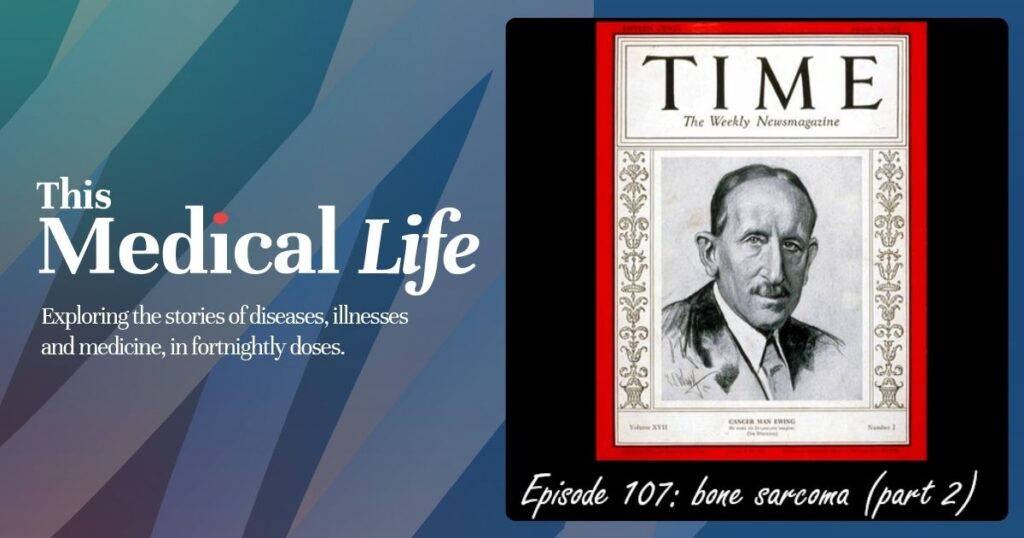
Two teenage patients, thirty years apart, changed how bone sarcomas are treated. In 1890, seventeen-year-old Bessie Dashiell saw New York surgeon William Coley with a painful hand. Despite an amputation, she died of metastatic cancer ten weeks later. Coley’s search for a better answer led him to Coley’s toxin, a bacterial treatment now recognised as an early form of immunotherapy.
In 1921, pathologist James Ewing treated a fourteen-year-old girl with a wrist tumour he believed was osteosarcoma. Coley’s toxin failed. Radiotherapy, tried next, worked, even though osteosarcoma is classically radiotherapy-resistant. The tumour turned out to be a different disease entirely, now known as Ewing sarcoma, accounting for around 15 percent of bone sarcomas.
Dr Travis Brown traces both stories in detail, then turns to two guests for the clinical picture in 2026.
Dr Liz Connolly, medical oncologist at Peter MacCallum Cancer Centre and oncology research fellow at ProCan Children’s Medical Research Institute, covers staging (localised versus advanced), chemotherapy regimens for osteosarcoma and Ewing sarcoma, targeted therapies, and why immunotherapy has so far shown limited benefit in these cancers. She also discusses five-year survival, which sits around 70 percent for localised osteosarcoma or Ewing sarcoma, and why chondrosarcoma remains difficult to treat with drugs.
Professor Angela Hong, clinical professor at the University of Sydney and radiation oncologist at Royal Prince Alfred Hospital, explains why Ewing sarcoma responds so well to radiotherapy while osteosarcoma and chondrosarcoma do not, how multidisciplinary teams decide between surgery and radiotherapy, current dosing and an active Australian phase III trial, and why early referral to a sarcoma centre matters regardless of where a patient lives.
What to listen for: the diagnostic overlap between early bone sarcoma symptoms and everyday musculoskeletal complaints, and what that means for when to consider imaging and referral.
This is the story of Bone Sarcoma Part 2. Find Part 1 here.
Useful links:
Australia and New Zealand Sarcoma Association: https://sarcoma.org.au/
Find a sarcoma specialist: https://sarcoma.org.au/pages/about-sarcoma/find-a-sarcoma-specialist
Sarcoma guidelines: https://sarcoma.org.au/pages/sarcoma-guidelines
Seeking a second opinion: https://sarcoma.org.au/pages/about-sarcoma/seeking-second-opinion
Useful patient information: https://sarcoma.org.au/pages/about-sarcoma/patient-and-carer-sarcoma-information
Our Special Guests:
Dr Liz Connolly is a medical oncologist who specialises in treating and researching sarcomas
Professor Angela Hong is a radiation oncologist and clinical professor at the University of Sydney
Listen:
This Medical Life podcast is available on all podcasting services, Apple Podcasts, YouTube, and Spotify. Members of the RACGP are able to log the hours as CPD (Education) that they listen to the episodes under self record via Quick log. We invite you to help support us on our donation page.
Automated Transcript:
This transcript was generated automatically by Descript. I will contain errors and spelling mistakes, but is offered as a guide and resource to help AI and search tools discover the content on behalf of GPs, medical students, other allied health professionals, and the general public.
TML S07E107
Steve Davis: [00:00:00] Welcome to This Medical Life podcast. These are the stories of medicine with Steve Davis and Dr. Travis Brown. This is the story of bone sarcomas, part two
Dr. Travis Brown, something just occurred to me We are on the fourth episode of a special series on sarcomas, one of the rarest things medicine deals with, and yet four episodes, Travis. What’s going on?
Dr Travis Brown: Well, this shows the complexity of dealing with difficult diagnoses. Uh, and, and again, we have a whole bunch of specialists who are involved.
You can [00:01:00] have, just even from these episodes, you’ll have, uh, surgeons, you’ll have radiation oncologists, you’ll have oncologists, pathologists. And not only that, then you’ll have a whole range of allied staff helping people to recover from all the operations and treatments have. So it shows the complexity.
Why we can put four episodes into sarcoma is because this is a… It’s putting a patient in, uh, a circumstance where they have, um, a challenging diagnosis and then has to get treatment, has to get management. So this is one of those ones that w- we’re hoping that most doctors listening to this will be, it’ll be an academic and don’t have to deal with it.
But for, for those who end up encountering this, they at least have this resource. And so, yes, it is. And, and for this episode coming up, we’re looking at treatment for bone sarcomas. And [00:02:00] one of the ones I wanna focus on is, is Ewing sarcoma. Now, this accounts for about 15% of bone sarcomas. Uh, and the name is actually quite distinctive, so Ewing.
Now, this is actually named after James Ewing, and he was… If you look back at his history, th- this is a, this is a remarkable story, and we go down a bit of a rabbit hole here as well, so which I always love doing. Uh, and there was, he’s, now, he’s one of five children. He was born in Pittsburgh in the Unid- United States.
Uh, this is at the, uh, end of the 19th century. He was training. Uh, he became a doctor. Uh, but just before that, he was 14 years old. He ended up having an ice skating accident. Um, he fell, he injured his leg, his femur, got osteomyelitis. He was bedridden for months and started studying. Uh, and, uh, in his, he ended up entering a whole bunch of contests.
He won, uh, a microscope, I believe, for, [00:03:00] uh, his, uh, wordplay on, um, it was Constantinople. So he was clearly a bit of a, a gifted person. And now, as I said, he got into medicine, but he had an interest in anatomical pathology. Now, this was very much in the emergence of the, of, you know, looking down microscopes.
So-
Steve Davis: It’s not something I’d expect to read in someone’s autobiography- … from the 1800s. And then, yeah, exactly, in the
Dr Travis Brown: 19th century. And he volunteered as a contract surgeon in the, the US Army, which volunteering is It’s an, it’s an interesting concept these days. You know, uh, I know people do it, but it’s w- it’s not something we advertise much.
Steve Davis: And even to volunteer to subject yourself to those conditions where you’d be doing harrowing stuff under threat of being shot at.
Dr Travis Brown: Yeah. And so he ended up also, he landed the first ever pr- professorship at, uh, of pathology at the Medical College of Cornell University. Uh, [00:04:00] and after two years, he wrote his first medical textbook, uh, which happened to be in clinical pathology of blood.
Uh, he began studying cancer in animals. Uh, and he ended up becoming a spokesperson for cancer research, an avid fundraiser, uh, for cancer research. Now, he ended up establishing or co-founding a whole bunch of organizations. One was called the P. Huntington Fund for Cancer Research. He did that in 1902. He co-founded the American Association for Cancer Research in, in 1907.
He founded the American Society for Control of Cancer, which is now the American Cancer Society, in 1913. He created the Journal for Cancer Research. Uh, he teamed up with James Douglas, a, a philanthropist, and created the Memorial Hospital of New York, which ended up becoming nation- the United States’ first cancer center and is now known as the Memorial Sloan Kettering Cancer Center.
And [00:05:00] in 1919, he wrote a cancer textbook called Neoplastic Disease: A Textbook on Tumors, which effectively created the foundation for oncology. And so-
Steve Davis: Unbelievable …
Dr Travis Brown: it is. It is. It’s one of those ones where you start reading and you feel very small.
Steve Davis: Yes. Yes. And
Dr Travis Brown: you wonder, what, what have I done with my life?
Uh, but two years later, so in, in 1902, he saw a patient. Now, this was a 14-year-old girl, and she had a, a tumor of her wrist, of her radius. Uh, now he believed this to be osteosarcoma. Now, the treatment, the traditional treatment for osteosarcoma at this time was amputation. But for whatever reason, and I couldn’t find out why, he didn’t do an amputation on this 14-year-old girl.
He ended up … This, this girl ended up being treated with, with something called Coley’s toxin And this was developed by [00:06:00] William Coley. Now, he was a New York surgeon, and th- around 30 years before this time, when William was a young surgeon, he encountered a patient by the name of Elizabeth, let’s put in quotes, “Bessie” Daschille.
And so she was known as Bessie. Now she’s a s- she was a 17-year-old l- young lady. Uh, now she, one time when she was, uh, clearly going somewhere on a, on a train, she got her hand caught between the seats of a passenger train, in the, in the, the passenger train car, and her hand got increasingly more painful over the next few weeks.
And after a month, she ended up going to the doctor. Now, she ended up seeing William Coley, and he was 28 at the time, young surgeon. Initially, he thought it was infection, but when he examined further, he believed it to be an aggressive bone cancer. Now, the treatment then, of course, was amputation, and he did treat her.
[00:07:00] He did a below wrist… below elbow, sorry, amputation. Uh, but the cancer had already spread, and it spread all throughout her body, and she only lived another 10 weeks. And so this profoundly affected William to the point where he, he was … wondered how could such a young person die of metastatic disease from an old person disease for cancer.
That’s what it was believed. And so he went on a mission, and his mission was: how do we treat this? How … There has to be some way. He ended up doing a whole bunch of research. He went to the New York Hospital records, and he read through patients’ files and records, their histories. Uh, and I’m not even sure he knew what he was looking for, but he miraculously, he found it.
He came across a patient by the name of Fred Stein, who was a German immigrant, who had been admitted to the hospital with a large neck tumor. [00:08:00] And they had had, he’d had surgery twice to try and remove it. They couldn’t remove it. But on the second time, he got a very severe skin infection postoperatively, what we call erysipelas, and this caused him to go almost li- it was a life-threatening infection.
He did recover from it. Amazingly, the neck tumor began to shrink after the infection. And so it got to a point where it shrank so much that they couldn’t see it clinically anymore, and the patient left the hospital seemingly cured And so he then thought, “Is this real? Has it happened?” So he went searching for Fred to see is it real.
Was this patient really alive or, you know, was the records wrong? He found him. He was alive, well, and disease-free. So seven years [00:09:00] after this neck tumor, which seemed inop- inoperable, was cured. And so he had an ep- epiphany Can skin infections treat tumors? And so he scoured the journals and the archives. He found some cases, and so there was one, uh, one in Germany in 1867.
There was a German physician by the name of Busch. He reported that a patient’s tumor disappeared after a severe skin infection. And in 1888, another German doctor by the name of Bruuns had injected a patient with bacteria and said the actual f- the re- the resulting infection shrank the tumor as well.
Steve Davis: So this is fighting fire with fire.
Dr Travis Brown: So, and that’s the… He ended up gathering about 47 cases where they seemed to have this tumor-shrinking ability after an infection, and so he developed his own toxin. It’s called Coley’s toxin, and it’s meant to be a [00:10:00] mix of a, a treated bacteria, so he heat-treated bacteria.
We believe today it was Streptococcus pyogenes, which is actually quite a dangerous organism to be playing around with, uh, and Serratia marcescens. And what ended up happening was he created this as a… He would heat treat it so it would be somewhat, uh, not infective, but who knows in those days? And you would inject the tumor with this bacterial heat-treated concoction.
And he started treating patients in the late 1900s, and he treated 10 patients and seemed to get encouraging results. I couldn’t find exactly what was happening. But he was encouraged enough that they s- ended up continuing. And now one of the famous cases was a 16-year-old boy by the name of John, uh, Thickens, uh, and he had a large abdominal tumor, and he got these Coley injections, and so this produced high fevers and [00:11:00] rigors in the- Yeah.
Awesome But the tumor began to shrink, and so months later the tumor was undetectable, and he w- he end, ended up living another 26 years. And so th- this toxin was actually commercially produced. It was called Coley’s toxin. I have seen it sometimes referred to as Coley’s vaccination, but I’m not quite sure if that was…
that term would’ve taken off by then.
Steve Davis: Trav, is this the earliest form of chemotherapy?
Dr Travis Brown: This is the e- earliest form of immunotherapy. Oh,
Steve Davis: okay.
Dr Travis Brown: And so that’s right. This is, this is one of those ones where you’re actually trying to stimulate… Now, he might not know. You stimulate the immune system to go into the tumor, and it would’ve been sensitized to the tumor, and then the immune system would’ve started attacking the tumor, and that’s how it shrunk.
It just… The foundations- Amazing … is incredible. And again, this was still being used. And so we have now in 1921 still being used, still being used against James Ewing’s [00:12:00] patient, this 14-year-old girl. She ended up receiving eight of these injections. The problem was it didn’t work. There was no effect. And so why she received Coley’s toxin, uh, maybe that was the treatment at the time, maybe they were trying.
But then they tried another experimental treatment, and that experimental treatment was radiation, and the tumor responded incredibly well to this radiation. The problem was, and, and James Newing- Ewing knew this very well, osteosarcom- sarcomas do not respond well to radiotherapy. So somehow he had this bone tumor that responded to radiotherapy, which shouldn’t respond to radiotherapy.
And so he ended up calling it diffuse endothelioma of bone. Uh, so he thought it was a- actually the endothelial cells in the bone that, that was the malignancy, and that’s why it was responding. So maybe it wasn’t bone. Turned out microscopically this was very different to [00:13:00] osteosarcoma. We call Ewing’s, uh, Ewing sarcoma, as, as we discussed with Fiona.
We– It’s called a small round blue cell tumor. These are very primitive cells. They look very different to osteosarcoma. Uh, and a few years later, because of this discovery and understanding, it, um, ended up getting the name Ewing sarcoma after, after James Ewing. And so you look at this story and it’s incredible because first of all, you have f- uh, recognize a, a diagnosis that had never been recognized before with Jam- named, named after James Ewing.
But you also have William Coley, who pretty much provided the foundation for immunotherapy and, and cancer tumor therapy. Uh, and so this is, this is where we, we find, and again, just love these kind of stories that you, that dig up when you start looking at these conditions. But yes, we’re talking about treatment of osteosarcomas, chondrosarcomas, and Ewing sarcomas, uh, with the experts and where we are today.
Steve Davis: And yet again, as we [00:14:00] discover, it’s a couple of people in medicine who gave a damn about their patients and joined dots that led to some sort of advancement, which is wh- what we’re gonna look at at the end of this year in a very special episode where we trace back to some of those moments in a practitioner’s early history that spur them on to great insight.
Dr. Liz Connolly is a medical oncologist who specializes in sarcoma. Liz works at Peter MacCallum Cancer Center and leads sarcoma proteomic research as an oncology research fellow at ProCan Children’s Medical Research Institute in Sydney. Her work spans clinical care, translational research, [00:15:00] and education.
Her position is supported by the Tony Denny Foundation Sarcoma Research Scholarship through the Cooper Rice Brading Foundation and an ANZA Sarcoma Research Fellowship. She’s also involved in committees of the Australia and New Zealand Sarcoma Association and main international sarcoma research body, CTOS, the Connective Tissue Oncology Society.
And Liz is our guest here on this Medical Life podcast. Liz, welcome.
Dr Liz Connolly: Thank you very much for having me.
Steve Davis: Liz, let’s start by telling us about the stages of bone sarcomas and, and what they mean.
Dr Liz Connolly: With bone sarcomas, there– while there are traditional staging systems that people have heard of, like stage one, two, three, four, the way we tend to think about sarco- bone sarcomas is localized versus advanced, and that kind of is everything.
Localized would be stage one to stage three, and advanced is where it has spread, and that is stage four. And in most cancers, that means the same thing. Stage four [00:16:00] is an, a cancer that has spread to somewhere else in the body. And that’s really the big question I have every time I see a patient and I’m seeing scans.
That’s what you want to know. Is it, has it in the bone where it has started, or has it spread to another part of the body?
Dr Travis Brown: So when they come to see you, have they already been worked up, and that will actually be present in all the imaging, or is this something that they see you at the initial stages, and you, then you go on to stage them?
Dr Liz Connolly: It, it can really depend. Um, often they have had, most patients have had staging because the concern about it being a sarcoma has arisen. But one of the problems with sarcoma is it’s often difficult to diagnose. Uh, it can show many different ways, and it, it, it, um, you know, they can present often, for example, bone sarcomas, they start in young people, and it can, you know, it’s in a bone, it can feel like a musculoskeletal injury, so there are often delays in diagnosis.
They might have scans where it doesn’t really show that well, like an [00:17:00] ultrasound. So it really depends on how it gets picked up, how long it takes to get picked up, who’s then got involved, and it kind of goes from there. Um- You know, I d- it, it depends. I wouldn’t say it’s absolutely necessary, for example, for a GP to have done all the scans.
It’s important to speak to a sarcoma center early, and we can guide you through the rest. We can either say, “We will arrange that,” or we’ll say, “It would be great if you could help organize a CT.”
Dr Travis Brown: In general, and this is just a rule of thumb, how common is it for patients to present with localized disease at or versus, uh, extended spread, really?
Dr Liz Connolly: On the whole, it’s much more common to prevent, to present with localized disease. So the majority, I would say, of our patients present with localized disease. And cure rates are high, so thankfully it stays that way.
Dr Travis Brown: When you’re looking at someone who has a bone sarcoma, when do you consider [00:18:00] does this person, is, is this person suitable for chemotherapy?
Dr Liz Connolly: Every sarcoma is different. So the three common bone sarcomas are called osteosarcoma, Ewing sarcoma, and chondrosarcoma. In osteosarcoma, we kind of, there are two types. There is either low-grade or high-grade. If it is high-grade, you always get chemotherapy. If you have Ewing sarcoma, it’s always high-grade.
There’s not a low or high. It’s always high-grade. You always get chemotherapy. And chondrosarcoma can have different grades, but even the high-grade, you never get chemotherapy, on the whole. So, uh, and sorry, with the osteos and Ewings, this is localized. This is not sp- You know, one that has spread. And whereas chondrosarcoma, even advanced, chemotherapy just doesn’t work.
So it really depends. The, the, this is why seeing a sarcoma center is really important because we need to figure out what you have, and every different type of sarcoma is treated in a different way.
Dr Travis Brown: So you’ve just mentioned that the treatment is different. Is [00:19:00] it different chemotherapy agents, or how do you tr- how do you determine what’s…
Like with osteo, chondrosarcoma, and Ewing, what is the treatment for each of these?
Dr Liz Connolly: It’s a great question. Well, yes, we do treat them differently, and this is based on research. So both of them, neither of them are common, but they’re the most common of what we see. So people across the world have worked to do trials to work out what drugs work and what combinations work.
So we actually have different regimens for both. So for Ewing sarcoma, it’s actually five different chemotherapies. So we give three in one go, and then we alternate with two in another go. So that’s the regimen for it. It’s worth, it’s called VDCIE, and each of those letters is a type of chemotherapy. So you do VDC, and then you do IE.
You go back and forth. With, um, osteosarcoma, we have a different regimen called MAP, which is three chemotherapies. So we give one chemo called methotrexate, and then we give two together called AP, which is [00:20:00] cisplatin and doxorubicin. So it’s really quite specialized, and this is why even amongst medical oncologists, we still say, “Come to a sarcoma center.”
If it’s, if it’s, obviously, it’s not always possible, depending where you live. But the ideal is to either be treated at a sarcoma center or at least have the guidance of a sarcoma oncologist to help say, you know, to know what we give and what works.
Dr Travis Brown: So what are the s- common side effects of these treatments?
Dr Liz Connolly: So it’s really, as you can imagine, five chemos or three chemos are really quite tough, and we have different side effects with the different drugs we use. So, you know, all chemotherapy, there’s some sort of commonalities, and that’s things like nausea or vomiting. But we, we have good medicines these days to help, you know, control that.
You will inevitably feel tired, but the depth of that tiredness and how long you feel really tired for can vary. Um, it can affect your bowels. You can have diarrhea. You can have constipation. You can have both. It’s great fun. Um, and then there are sort of specifics with [00:21:00] each chemotherapy, so things like the, one of the, the drug that’s used in lots of different cancers, doxorubicin, it can affect your heart, things like that.
There are, there are specifics. So this is, again, why it’s kind of important to, you know, we will always give you information. When, when a, when a patient comes to see an oncologist, we often give written information on the specific treatment regimen we’re recommending, and that will kind of explain all of the side effects.
Dr Travis Brown: Are there any targeted therapies you use for different bone sarcomas?
Dr Liz Connolly: Yes. There’s, there’s, uh, the most common sort of one that is Used is the, we can use things called tyrosine kinase inhibitors, and they affect growth pathways. Um, it varies on the different sarcoma, and these aren’t always available on the PBS, but where we have evidence, we try to approach drug companies to get them if we…
And, and we do that for osteosarcoma and Ewing’s. We, there are… Now, this is, we don’t use these in the [00:22:00] localized setting. This is only for advanced disease and after cancer has unfortunately grown on chemotherapy. That’s where these would come into play. And there are always things emerging that are specific to the sarcoma itself.
So for example, in chondrosarcoma, there are the, what’s common is something called an IDH mutation, and we sometimes, we’re, we’re trying to investigate whether we can use drugs called IDH inhibitors. And then something very specific to chondros is something, we’ve got something called a DR5 agonist or death receptor 5 agonist, and we’re starting to see really promising results with that.
So things are always evolving and changing. Now, that’s not a medicine we have available at the moment, but that’s, we think, we hope will come in the future.
Steve Davis: Liz, just before, um, Travis asked about the side effects of the chemo, but are there any possible long-term side effects of treatment for these sarcomas?
Mm-hmm.
Dr Liz Connolly: Yeah, absolutely. Yeah, it’s very difficult. Often, um, the, you know, [00:23:00] Ewing’s and osteosarcoma, they can occur in children, they can occur in teenagers, and they’re very, they very much are long-term side effects. So things like, as I say, it can affect the heart, and that can happen years after you finish chemotherapy, where it’s effectively, it redu- the pumping function of the heart reduces, um, so, or heart failure in time.
It can happen at the time, it can happen later down the track. A common side effect of chemo, not necessarily in every, not necessarily for all sarcomas, but for some, is peripheral neuropathy. It can affect your hearing. Unfortunately, there are a lot of things that can, uh, be long-term after treatment is finished.
And- And that’s why we want to, the aim of research is to find better drugs that work better and have less side effects.
Dr Travis Brown: Does immunotherapy play a role with sarcomas?
Dr Liz Connolly: Uh, we’re still learning, but it doesn’t appear to be very… Your standard immunotherapy, what’s called a PD-L1 or PD-1 inhibitor, doesn’t tend to work very well in osteosarcoma and Ewing sarcoma.
So we have looked at that in a study, and it just doesn’t, on its own, doesn’t [00:24:00] seem to work. Um, cancers can actually get worse. They can actually, you know, what’s called hyperprogression. There’s, in theory, they can actually grow quicker. And so there can be, you know, people say, “Well, isn’t it worth a chance?”
But if you do that, it can be giving something, it’s giving the time, when we don’t think or expect it to work, it actually can give the cancer time to grow, or in theory, could, it could actually grow quicker. But, um- Whether that’s, you know, just on its own, but obviously we’re, the, the oncology research world is working to see are there things we can do to augment that.
So whether using a combination of immunotherapy drugs. So these are all things that’ll be happening in the future. But at the moment, the sort of boring, dull, basic stuff that we have available on the PBS we don’t think works particularly well for osteosarcoma or Ewing’s. Chondrosarcoma we’re still learning, and we’re probably getting signals that maybe it does, particularly one called dedifferentiated chondrosarcoma.
So you can start to see how kind of nuanced and, uh, tricky it really is.
Dr Travis Brown: What determines [00:25:00] how many cycles and the duration of therapy?
Dr Liz Connolly: In the localized setting, we have regimens that are, uh, you know, a set number of cycles that have been evaluated and determined to be effective through clinical trials. So we’ve done these trials in hundreds of patients across the world over many years, and that’s
There maybe isn’t an exact art as to why it’s 10 versus 12, 14, whatever, but the, that we have a trial to say we gave that number and that worked well, or that worked better than whatever they were comparing it to. In the advanced setting, we tend to give medicines until they stop working. So you would just keep having them, and you can have breaks, and sometimes we take a bit longer.
But on the whole, you know, you think of it as you need to be taking something to, um, keep the cancer at bay. And so it tends to be an ongoing, it’s not a set number of cycles.
Dr Travis Brown: Just with regards to chondrosarcoma, so we don’t treat that with, with, uh, chemotherapy. Is there something that Does it [00:26:00] need chemotherapy or is it, i- is it one of those ones that, um, really doesn’t need treatment, or we’re just not good at treating it?
Dr Liz Connolly: We’re not good at treating it. I mean, there are, as we sort of mentioned, there are different grades. So there are… The main, if you’ve got a localized chondrosarcoma, the barn door standard of care treatment is to cut it out before it can spread. But being something that starts in the bones, it can start in the spine or the pelvis, that can be quite difficult to remove.
The, as you get sort of higher grade chondrosarcoma, grade 2, grade 3, the chance of it spreading elsewhere in the body is higher, and yes, we could do with something like chemotherapy like we do in osteo and Ewings. The reason we don’t is because it doesn’t seem to work, versus we know that the cure rate improves sig- substantially by introducing chemotherapy for Ewings and osteo, but chondrosarcoma is a little c- different kettle of fish.
Mm. So if we had a drug that worked well in chondrosarcoma, it, it probably would. We would probably start trying to combine that with surgery to increase cure rates. [00:27:00] But we just don’t have the good drug right at the mo- medicine at the moment.
Dr Travis Brown: So how do you measure treatment goals and patients’ progressions through treatment?
Dr Liz Connolly: We, we, uh, monitor with surveillance scans. So when we have, for example, an osteosarcoma Ewings, we will do on chemotherapy, so localized at the start. We will do a scan after a couple of cycles of treatment to see if it’s responding and getting smaller, which is what we expect, and that will help us plan the surgery.
And what we often do is we sandwich the surgery in between the chemo. So we do a couple of rounds of chemo, we do the surgery, we do a couple of rounds of chemo afterwards. In the advanced setting, we just, we do a scan every maybe two or three months to check that the medicine is actually working and that the cancer is stable.
And obviously, if it’s growing, that means we have to, there’s no point doing that medicine, and what else can we move on to?
Steve Davis: Liz, I’m sitting here as the layperson, and for many of the people we talk to, I have a pretty good gut feel of what I’d be asking if I was [00:28:00] sitting in front of you. But I’m not sure here.
What are some of the common questions that patients put to you when they first sit down with you?
Dr Liz Connolly: I guess it’s, I, I guess the, what most people want to know is, you know, h- at what stage is this? Has it spread? What do I need? What do we need to do here? And is this going to… Am I going to die? Is this going to kill me?
And how long have I got? Um, I think they’re the kind of three key bits. So obviously we try to go through, I try to go through all that before I even need to be asked. Um, and then we obviously leave lots of time to kind of say, “Well, what, you know, what questions do you have?” And try to answer them.
Steve Davis: Do they ever ask, “Why me?
How did I get this?”
Dr Liz Connolly: Absolutely. Um, and that’s the, you know, we, we don’t think sarcoma is caused by anything an individual does. It’s, it’s not diet or exercise or [00:29:00] environment on the whole. That’s definitely a question. And family also saying, “Did I… Is this genetic? Did I cause this? Will my children get it?”
Um, so we, we know that we’re learning more and more, and we, we’re learning that actually probably more than we thought, like up to maybe 20% of sarcoma might be as- associated with genes or genetic conditions, familial family conditions. Um, but it’s still very rare overall. And, you know, with sarcoma, we have…
Sarcoma makes up less than 1% of all cancers, and within that there are over 80 different types We have had to even rename it so we’ve got rare, and now we even define some sarcomas, which is an awful lot of them, as ultra-rare, and that’s when it’s less than one in one million. Then within each of those, there are different genes that might be associated.
And then if you break that down, if that’s only, you know, one to five percent of each of those, it’s rare on rare on rare. [00:30:00] Um, so we’re still learning on that front. Uh, it’s something we always consider and discuss, um, and so we take a family history, and that kind of gives us maybe some indicator.
Steve Davis: I hear what you’re saying, but if I hear there’s a sense that there could be something genetic and I say, can I, can my kids be scanned in any way-
Dr Liz Connolly: Mm-hmm
Steve Davis: is that possible?
Dr Liz Connolly: So what we would say is we certainly first of all appraise whether we think the risk is reasonable to even as an individual get tested. And if we think there is, you know, a reasonable risk, the q- the case would be referring you to a, a clinical geneticist for the person with the sarcoma to get tested.
And obviously then it depends if they are found to have something or not. If not, then no, they wouldn’t have any further scanning for just general cancer surveillance. They obviously would still get followed up for sarcoma, and there wouldn’t be any role for their children to be tested or to have regular scans.
What we just say is, you know, if you’ve had a cancer as a young person, it’s just being aware of your children, just [00:31:00] being aware of things, I guess having a higher index of suspicion to get investigated if they got a lump or a symptom and just going in. There’s no need to have extra scans or e- like heightened alert, um, anxiety about it as such, but it’s just being alert and think, okay, there might be cancer in the family.
Just take things, you know, don’t just sit on. If you’ve got something, go and get it checked out, which is what we’d actually say to anyone in, in the population generally.
Dr Travis Brown: What’s the five-year survival rate for patients? Uh, now whether you do stage one, two, three, four, or whether you do localized versus advanced.
Dr Liz Connolly: So it probably, it, it, it depends on the sarcoma itself, right? Um, so what we, the sort of, this isn’t a perfect estimate, but I guess just to give a number, you know, the cure rate, this would just be osteo and Ewing’s combined. It’s not exact, but maybe would be in around the seventy percent mark if you have a localized osteosarcoma or Ewing’s.
But again, that depends on, as you say, stage and the, the [00:32:00] specific tumor type. If you have advanced disease, so you have You know, your osteo or Ewing’s that has spread, the cure rate is, is much lower. But some people, like much lower being sort of 5, 10%. Um, but there are still some people who are cured.
Chemotherapy can work extremely well. And sometimes with osteo and Ewing, sometimes we just see one little or two, one or two little lung nodules as opposed to it spreading widely in the body, and they are cases where it can be cured. Um, so there’s always a reason, even in the worst case, which is advanced, having an advanced sarcoma, there’s reas- uh, and these specific ones, osteos and Ewings, there’s still, you know, reason for hope.
Dr Travis Brown: Is there any signs or treatment responses that makes, makes you ca- categorize this as, oh, actually this is going to be a really difficult one, or this is going to be a really good responsive one?
Dr Liz Connolly: Yeah. Uh, not, not from the outset, as in before we start treatment. What we do know is we can look at [00:33:00] the necrosis, so how much looks dead under the microscope after they’ve had a few rounds of chemo and had surgery.
And we have shown that the cure rate is higher when we see a high rate of what is called necrosis or death, so above 90% in osteosarcoma. Ewings, it’s harder to measure. So with, with osteos you have a bone, so you can kind of measure it a bit better, but os- Ewings can be a bit harder. But the thing about that is I- it’s great n- if, so if we say, “Great, you had that.
You were above 90%, it nearly all looked dead, or all of it was dead”, that’s obviously very reassuring. We, uh, w- you know, we’re delighted to see it, and it’s great for the patient. But for the person who doesn’t have, you know, a say less than 90%, the, the sort of rate might be around 50% cure. And so that sounds like a negative for the patient, but actually, it, it, it’s not the best, you know…
Yes, it tells us this is a slightly worse scenario, but that’s still 50% of people being cured, and obviously might be quite upsetting. [00:34:00] So I think it’s always taking it with a, you know, a pinch of salt. It, it’s a… We use it as a way to try and find, you know, we’re going, “Okay, you’re the highest risk. We try and make things better.”
But it’s not a all or nothing. It’s, it’s just a marker and it, you know, you could still be in that good basket that is cured. You know, it’s one for one.
Steve Davis: Liz, are there any final thoughts or advice you have for doctors or patients about bone sarcomas?
Dr Liz Connolly: Yeah. I think it’s just being aware of it. Know that it exists, and yet, and as a, a GP might see one in their whole career.
It’s not we are very aware that people come in with the same symptoms. The teenier with a, teenager with an osteosarcoma might come in with the same symptom as 99 other teenagers with musculoskeletal problems. So it’s just having it on the radar, and then the best, best advice is speak to us early. Don’t, you know, you don’t have to do this alone.
Get in touch with our sarcoma unit. So there is a, our national sarcoma association, [00:35:00] ANZA, Australian New Zealand Sarcoma Association. We have a, you can s- l- you can use that to look up a specialist or a center, and there are contacts and phone numbers. We always want to hear from GPs, even if you’re just worried that it might be you’ve got an X-ray that looks a bit suspicious.
‘Cause there are, there are, the, you can have bone tumors that are benign and aren’t anything. Just get in touch. We are more than happy to talk to you and sort of guide you through what, you know, what the next steps are and who the right people to speak to are.
Steve Davis: Dr. Liz Connolly, thank you very much for joining us on This Medical Life.
Dr Liz Connolly: Thank you very much for having me and for raising awareness of sarcoma.
Steve Davis: Angela Hong is a clinical professor at the University of Sydney. She’s trained at the Memorial Sloan Kettering Cancer Center in New York, University of California, Davis, and [00:36:00] completed her specialist training in radiation oncology at the Royal Prince Alfred Hospital. Professor Hong is the author of more than one hundred peer-reviewed publications and principal investigator of several clinical trials in melanoma and sarcoma.
She’s also received the K. Scott Prize by the Royal Australian and New Zealand Association of Radiologists. Angela is our guest on this Medical Life podcast. Angela, welcome.
Professor Angela Hong: Good morning, Steve. How are you both?
Steve Davis: Very well. So let’s continue our discussion on this podcast into bone sarcomas. What are the important features that you consider when determining if someone needs radiotherapy or not?
Professor Angela Hong: Well, for primary bone sarcoma, the decision about radiotherapy is highly individualized, and is usually made in a multidisciplinary sarcoma setting, including surgical oncologists, orthopedic surgeon, medical oncologists with input from [00:37:00] pathologists and radiologists. The key factors we consider are the subtype of primary bone sarcoma and then the tumor location, so, uh, whether it’s resectable by surgery, so, uh, whether it’s a pi- primary pelvic or spine or skull base, um, primary, it can be difficult to remove by surgery.
And then we also look at the size and the extent and the response to preoperative or pre-local treatment chemotherapy, particularly in Ewing sarcoma. Where, where the s- surgery is feasible and what’s the expectation of functional outcome after surgery. We also need to consider the extent of the sarcoma, whether it’s localized or whether there’s metastatic disease.
On top of that, we need to think about the patient, the age, comorbidity, and the expected short-term and long-term toxicity of radiotherapy or surgery. Um, in Ewing sarcoma, [00:38:00] um, radiotherapy may be used when definitive treatment with surgery is not feasible. So as I mentioned, in the spine, in the pelvis, where it’s just not possible to resect and reconstruct the primary site, or sometime we consider radiotherapy after surgery as additional treatment to improve the local control.
So factors we’ll look at will include the, the margins, whether it’s close or positive, and the response to the preoperative chemotherapy. And very occasionally, we do do what we call whole lung radiotherapy, specifically for patient with metastatic disease in the lungs, Ewing sarcoma, and when they have good response to chemotherapy, we add in lower dose of radiotherapy to both lungs to reduce the chance of the Ewing sarcoma coming back in the lungs.
Dr Travis Brown: So when we’re looking at bone sarcomas, which are sensitive to radiotherapy?
Professor Angela Hong: In general, Ewing sarcoma is highly [00:39:00] sensitive to radiotherapy. Um, it can be used a definitive curative treatment, uh, without surgery. Now, there’s been no direct comparison, um, between surgery and radiotherapy in term of which one’s actually better to control Ewing sarcoma.
It’s just not possible to do a direct randomized trial because of highly variable size and extent of the Ewing sarcoma. Um, so Ewing sarcoma, we do use it as definitive treatment. On the other hand, osteosarcoma or chondrosarcoma, they are more radioresistant, and we tend not to use it as definitive treatment, so we go with surgery possible.
Um, we might add in radiotherapy after surgery for osteosarcoma or chondrosarcoma if the margins involved not possible to get a bigger margin.
Dr Travis Brown: So how effective then is it at treating Ewing?
Professor Angela Hong: As a definitive treatment, so without surgery, it’s ve- highly effective in term achieving the local control. As I [00:40:00] mentioned, there’s no direct head-to-head comparison with surgery.
Prospective study data, um, not randomized data, looking at very good, um, long-term, 10-year, very low local failure rates after 50 to 60 gray of radiotherapy.
Dr Travis Brown: So what are some of the common side effects for this treatment?
Professor Angela Hong: Depends on the location where we’re treating, right? Um, so generally patient can feel a bit tired, and often they already had chemotherapy.
Um, and if you’re treating the arms or leg and spine, the skin could go slightly pink, uh, like a mild sunburn. And if it’s near a- an area there’s hair, um, hair loss within the treatment area tend to be temporary, so the hair will come back two, three months later. And if we’re treating near the abdomen, pelvic, there might be some abdominal symptom like mild nausea and diarrhea.
Treating head and neck region, mild to moderate esophagitis. Um, so these are what we call temporary [00:41:00] side effects tend to happen during radiotherapy, so peak at the end of the radiotherapy and get better within two, three weeks of finishing treatment. There are some specific longer-term side effects, and again, this depends on the size and location where we’re giving the radiotherapy to.
Dr Travis Brown: What type of doses do patients receive?
Professor Angela Hong: So in term of Ewing sarcoma, we tend to give, um, as definitive treatment, about s- daily treatment, 30 fractions over six weeks, what we call 54 gray. We actually have a phase III randomized trial that are recruiting in Australia, both in adults and pediatric hospital, looking at the optimal dose, uh, for Ewing sarcoma.
So for someone having definitive radiotherapy, we randomize them, a one-to-one randomization to the standard dose of 54 gray in 30 fractions over six weeks versus a dose escalation with an extra boost, um, [00:42:00] to another six fractions For those who are having radiotherapy after surgery, um, typically we do, again, about six weeks of treatment, and in that clinical trial we randomize them to have a lower dose to 25 fractions.
So a 45 gray in 25 fractions.
Steve Davis: I hear you say there’s no direct comparison head-to-head surgery versus radiotherapy, but I- Correct. Yeah … I am leaning towards thinking I would be wanting radiotherapy. Um, but are there- Mm-hmm … some patients who it’s just not suitable for?
Professor Angela Hong: Sure. Well, in fact, um, as I said, this is my usually the best local treatment is made in a multidisciplinary setting.
We tend to go with surgery if possible because it’s one-off, you get it out, you check the margin. Radiotherapy, once you have it, you still have to wait for the response, and especially in pediatric or young adults, we worry about [00:43:00] potential late effects. So most of the patient, if possible, we go with surgery.
If it’s not feasible to do surgery, you’re not gonna get a clear margin in the spine, head and neck region, then we go with radiotherapy. And so that’s the first decision. There are some patient not suitable for radiotherapy, pregnancy, unusual situation. Um, some people have radiotherapy before in the location many years ago that might not be feasible to repeat the full course of radiotherapy, or in a location you just can’t, can’t get the right dosing.
That is quite unusual. Um, so most of the time it’s feasible to do surgery, but the decision on what is the best local treatment, um, for patient is made in a multidisciplinary setting.
Steve Davis: See, now my mind is flooding with a lot of other questions. So Sure. So-
Professor Angela Hong: Yeah …
Steve Davis: as, as a patient, what are some of the… Or, or pretend I’m playing the role of the patient here.
Are there any [00:44:00] common questions that we ask you?
Professor Angela Hong: Lots and lots of questions, right? Usually, um, they will ask about the pros and cons, whether they have surgery or radiotherapy. So what tend to happen at Royal Prince Alfred Hospital at our multidisciplinary team is we usually have a discussion among the, um, oncologist and surgeon about what we feel is the best patient, uh, best, um, treatment for the patient.
We come up with our- Top recommendation, then we go and talk to the patient. We have a clinic, actually patient come to our clinic and see all of us in the same clinic. It’s true multidisciplinary clinic, so patient not going to see the surgeon and see radiation oncologist, medical oncologist. They come to our Friday morning clinic and see everyone.
Um, and that’s when we explain to them our recommendation and give them a chance to ask question, talk about alternative treatment. So patient can ask [00:45:00] about what is the best local treatment, and we have to go through the explanation why we think surgery is better at this, in these particular situations, or radiotherapy is better.
Um, then the practical question is the number of treatment of radiotherapy they’re gonna get, the details, how many times they have to come. Can they still go to school? Can they still go to work? Is- are they radioactive? Um, potential side effects of radiotherapy, long term, short term. So those are the common question from the patients.
Dr Travis Brown: So with doctors looking after patients who are going through radiotherapy, is there any, is there any questions the doctors should ask the patient or prompt them as saying, “Look, are you okay with going through?” Or is there any side effects that they sort of prompt the patient they’re looking after?
Professor Angela Hong: So, um, I see the patient once a week during the radiotherapy, a quick checkup, um, just to see how they’re going.
So, um, depends on the location. Usually ask them how they’re feeling, how they’re coping with [00:46:00] the radiotherapy. Are they managing their day-to-day life activities? Um, and then specific location side effect, tiredness, any redness of the skin, any trouble with the joints movement. Are they able to do their normal exercise?
And if we’re treating the pelvic region, any, um, bladder symptom, nausea, diarrhea, or, uh, uh, irritation when they pass urine. Yeah. So that’s daily, uh, weekly follow-up, um, during the radiotherapy. And then I see them usually about three, four weeks after radiotherapy to make sure they’re recovering from the treatment.
Dr Travis Brown: Are there any long-term side effects that doctors should be aware of for patients who receive radiotherapy?
Professor Angela Hong: Oh, um, so if we say, if we’re treating a pelvic location or spine, those are the common site we use radiotherapy as definitive treatment. Um, in younger patient, pediatric or adult, young adults, we talk about the, um- Any skin [00:47:00] irritation, joint stiffness, uh, reduced mobility, um, a- any fertility issue if it’s treating the pelvic region.
There is one very rare side effect of radiotherapy is radiotherapy causing a cancer, secondary cancer, somewhere within the treatment area, close to the treatment area, many, many years later, 15, 20 years. In fact, a, a very small risk. They carry that lifelong risk. So something anyone looking after patient who had radiotherapy many years ago need to be aware of this potential, um, complication in the longer term.
Steve Davis: Do you have any final thoughts for GPs or even patients, or even just some advice about radiation oncology in bone sarcomas? It’s
Professor Angela Hong: a highly specialized, um, and the decision really should be made in a multidisciplinary sarcoma team, um, setting. Um, and [00:48:00] so early referral to a specialized sarcoma center is critical.
Um, there are few sarcoma center around Australia, um, they’re mainly in the, um, in the city region. And I would strongly encourage patient that are not living close to the sarcoma center still consider to be managed through a sarcoma center. Um, and this is several aspect we need to consider. The multidiscipline care is very, very important.
Um, you get the surgical pathological input, um, the setup, the delivery of radiotherapy is highly specialized just because it’s a rare cancer that not many, um, radiation oncologists or radiotherapy center have the experience to deliver the radiotherapy. Um, often it’s come down to the practical challenge of needing to be away from [00:49:00] family, school, or work for five, six weeks of radiotherapy.
But I would encourage, um, GP to help to support patient to have the treatment at a sarcoma center. I think that’s very, very important.
Steve Davis: Professor Angela Hong, thank you very much for joining us on This Medical Life.
Professor Angela Hong: You’re most welcome. Thank you.
Steve Davis: This Medical Life is recorded in the Talked About Marketing Studios in Adelaide. For show notes and more information about the podcast, visit thismedicalife.com.au. You can contact the hosts on social media. Dr. Travis Brown can be found on X. His username is @drtravisbrown, that’s D-R Travis Brown. And Steve Davis can be found on LinkedIn.
Go to [00:50:00] linkedin.com/in/therealstevedavis. This has been a Pathnotes Proprietary Limited production